Atmosphere in hip hop beats refers to the ambient and textural elements that establish mood, emotional depth, and sonic identity in a track. These elements go far beyond drums and melody. Vinyl crackle, synth pads, tape hiss, and field recordings are the tools producers use to pull listeners into a world, not just a song. When you understand the role of atmosphere in hip hop beats, you stop making tracks and start building experiences. That shift separates good producers from great ones.
How do ambient textures create depth in hip hop beats?
Ambient textures in hip hop replace or supplement traditional harmonic elements to push beats toward cinematic experiences. This means your beat can carry emotional weight even before the rapper opens their mouth. The texture is doing the storytelling.
The most common atmospheric elements producers layer include:
Vinyl static and tape hiss: These add warmth and a sense of physical space. They signal “this is real” to the listener’s brain.
Synth pads: Long, slow-moving chords that sit underneath everything else. They create emotional continuity across the track.
Field recordings: Rain, traffic, crowd murmur, wind. These pull from real environments and make a beat feel lived-in rather than constructed.
Foley sounds: Footsteps, doors, fabric movement. Used sparingly, they add a cinematic layer that connects music to visual storytelling.
The key to making these textures work is placement and volume. Atmospheric layers should support the mix, not compete with it. Ambient layers kept low at between -30dB and -24dB glue the mix together without overpowering vocals or core beats. That means the listener feels the atmosphere without consciously hearing it. That subconscious pull is exactly what you want.
Pro Tip: Start with your main elements fully mixed, then bring atmospheric layers in at low volume. If you can clearly identify the texture as a separate sound, it’s too loud. The goal is for it to feel like the room the music lives in.
What atmospheric elements define cloud rap vs. other hip hop styles?
Not all hip hop treats atmosphere the same way. The impact of ambiance on hip hop shifts dramatically depending on the subgenre, and understanding those differences helps you make intentional choices.
Cloud rap prioritizes ethereal textures like long reverb tails, granular pads, and time-stretched vocal samples to create a weightless sonic identity. The goal is floating, not bouncing. Producers like SpaceGhostPurrp and the early Raider Klan movement built entire careers on that distinction.
Here is how the three major hip hop styles approach atmospheric production:
Style | Atmospheric approach | Key textures | Emotional goal |
|---|---|---|---|
Cloud rap | Reverb-heavy, spacious | Granular pads, stretched vocals, long tails | Weightless, dreamlike, introspective |
Trap | Dry, percussive-forward | 808s, hi-hat rolls, minimal ambiance | High energy, aggressive, immediate |
Boom bap | Warm, sample-driven | Vinyl crackle, jazz loops, room tone | Nostalgic, grounded, lyric-focused |
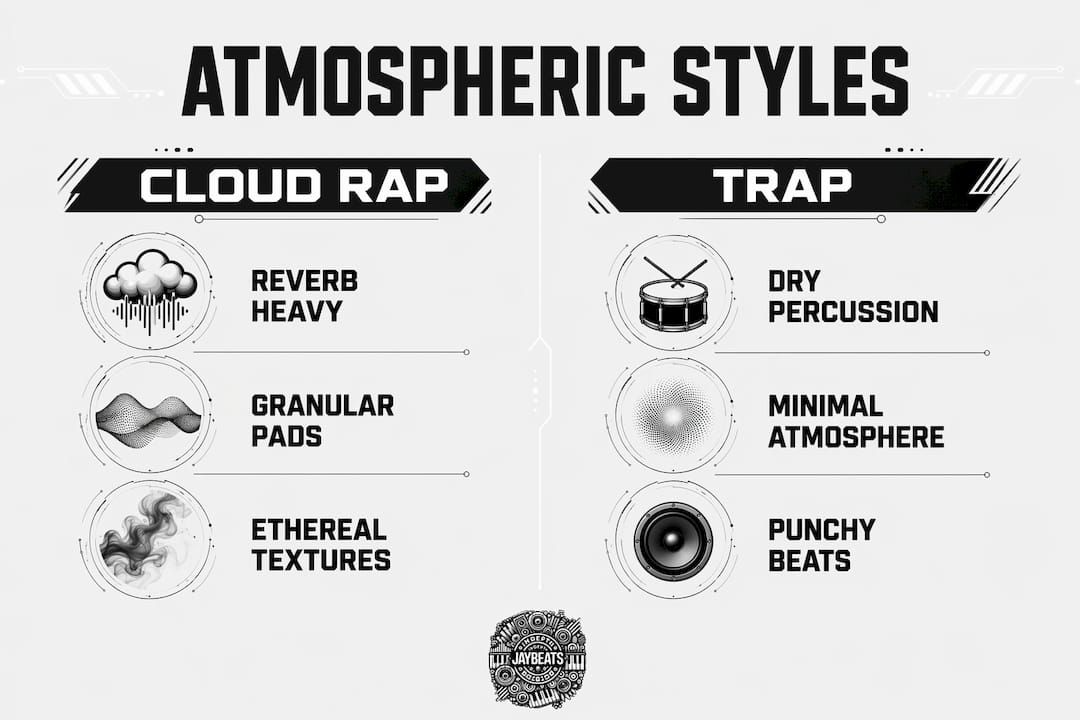
Trap’s dry percussion focus is a deliberate choice. The absence of heavy atmosphere keeps energy high and the beat punchy. That works for club records and hype tracks. But when you want a listener to sit with a song, reflect on lyrics, or feel something deeper, atmosphere becomes the primary tool. Boom bap sits in the middle, using vinyl warmth and sample texture to create nostalgia without losing rhythmic drive.
The takeaway is this: atmospheric production is mood-setting by design. Choose your approach based on the emotional state you want to create, not just the genre you’re working in.
How does atmospheric production impact listener experience and artist performance?
Atmospheric beats are built for immersive listening rather than immediate, high-energy engagement. This is a fundamental difference from commercial fame-driven tracks. When a beat creates a mood environment, the listener enters a reflective or meditative state. That state changes how they receive lyrics, how long they stay with a song, and whether they return to it.
The influence of environment on hip hop extends to the artist performing over the beat. Producer and rapper Elucid integrates ambient city sounds from New York into his production, and the result is music that feels like it belongs to a specific place and emotional experience. That specificity shapes how he writes and delivers his verses. The beat tells him where he is, and his performance responds to that location.
Here is what atmospheric production does for the artist in practical terms:
It sets a vocal register. A dense, reverb-heavy beat naturally pulls a rapper toward slower, more deliberate delivery.
It creates emotional permission. A melancholic atmosphere tells the artist it is okay to be vulnerable. An aggressive one demands energy.
It establishes narrative context. Field recordings and Foley place the listener in a scene before a single word is spoken.
Restraint and strategic tension are what separate effective atmospheric production from noise. What you leave out carries as much weight as what you put in. Silence and space create anticipation. A beat that breathes gives the rapper room to perform and the listener room to feel.
Pro Tip: Try removing every atmospheric element from your beat and listening to what remains. Then add them back one at a time. The moment the beat starts to feel like a place rather than just a rhythm, you have found your atmospheric sweet spot.
What are the best practices for integrating atmosphere into your beats?
Knowing how atmosphere shapes hip hop is one thing. Executing it well is another. These steps give you a production framework that keeps your mix clean while building genuine emotional depth.
Start with sonic hierarchy. Your vocals and main melodic motif sit at the top. Drums and bass sit in the middle. Atmosphere lives at the bottom, acting as the foundation. Atmosphere as background fog supports spatial context without distracting from the core elements.
Use effects to add movement. Reverb creates space. Chorus adds width. Saturation adds warmth. Apply these to your atmospheric layers, not just your main instruments. A static pad with no movement feels flat. A pad with subtle chorus and slow modulation feels alive.
Keep levels in check. The industry standard for ambient layers is between -30dB and -24dB. This keeps them present without pulling focus. Test your mix on headphones, laptop speakers, and car audio. If you can hear the atmosphere clearly on all three, it is too loud.
Evolve your textures. Static ambient loops produce hollow results. Atmosphere should shift with the track’s emotional arc, just like film lighting changes with a scene. Automate your reverb tail length, filter your pads over time, or swap textures between the verse and chorus.
Avoid overcrowding. More layers do not mean more atmosphere. Three well-placed textures beat ten competing ones. Each layer should serve a specific emotional or spatial function.
Here is a quick reference for atmospheric layer management:
Layer type | Recommended level | Primary function |
|---|---|---|
Vinyl static / tape hiss | -28dB to -24dB | Warmth and analog character |
Synth pads | -30dB to -26dB | Emotional continuity |
Field recordings | -32dB to -28dB | Spatial and narrative context |
Foley sounds | -34dB to -30dB | Cinematic texture |
Think of atmosphere as the psychological temperature of your track. It tells the listener how the room feels before they consciously process a single note. Get that temperature right, and everything else lands harder.
Key takeaways
Atmosphere in hip hop beats is not decoration. It is the emotional infrastructure that determines how a track feels, how a rapper performs, and how deeply a listener connects.
Point | Details |
|---|---|
Atmosphere defines emotional depth | Layering vinyl static, synth pads, and field recordings builds mood beyond rhythm and melody. |
Volume control is non-negotiable | Keep ambient layers between -30dB and -24dB so they support rather than compete with vocals. |
Subgenre shapes atmospheric approach | Cloud rap uses reverb-heavy textures; trap stays dry; boom bap leans on vinyl warmth. |
Restraint is a production tool | What you omit creates tension and space as effectively as what you include. |
Textures must evolve | Static loops flatten emotional impact; automate and shift layers to match the track’s arc. |
Why atmosphere is the most underrated production decision you make
I have been producing since 2004, and the conversation about atmosphere in beats almost never comes up in beginner circles. Everyone talks about 808 tuning, sample clearance, and BPM. Almost nobody talks about what the beat feels like as a room. That is the gap.
Here is what I have observed working across trap, boom bap, and cinematic production: the beats that get placed in film and television are not always the most technically impressive. They are the ones that create an immediate emotional environment. A music supervisor does not need to think about whether a beat fits a scene. They feel it in the first four bars. That feeling comes from atmosphere.
The importance of mood in music extends beyond listener enjoyment. It affects the therapeutic and psychological experience of both the creator and the audience. When you build atmosphere with intention, you are not just making a better beat. You are creating a space where real emotion can exist.
The mistake most producers make is treating atmosphere as something you add at the end, like a filter or a reverb preset. It should be the first decision you make. What does this track feel like? What city is it in? What time of night? Answer those questions before you place a single drum hit, and your production will have a direction that no amount of technical polish can fake.
Urban soundscapes, the way New York sounds at 2am or Atlanta sounds in the summer, are not just inspiration. They are raw material. Record them. Sample them. Let the environment inform the beat. That is how atmosphere shapes hip hop at its deepest level.
— IndepthJayBeats
Explore atmospheric beats from IndepthJayBeats
If this breakdown gave you a new way to think about your production, the next step is hearing these principles in action. Indepthjaybeats has been building beats with textured atmospheres since 2004, with placements in WWE 2K25 and Love And Hip Hop Atlanta as proof of what intentional sound design delivers.
Browse the full catalog of boom bap beats built with layered textures, vinyl warmth, and cinematic depth. If trap is your lane, the trap beat catalog features hard 808s alongside atmospheric production that gives your vocals room to breathe. There is also a free beat pack available so you can test the sound before you commit. Build something real.
FAQ
What is the role of atmosphere in hip hop beats?
Atmosphere in hip hop beats refers to the ambient and textural layers, such as vinyl crackle, synth pads, and field recordings, that establish emotional depth and sonic mood. These elements create the environment a track lives in, shaping how listeners feel and how artists perform.
How do you add atmosphere to a hip hop beat without cluttering the mix?
Keep atmospheric layers between -30dB and -24dB so they sit beneath the main elements without competing with vocals or drums. Use reverb, chorus, and saturation to add movement, and automate textures so they evolve with the track’s emotional arc.
How does atmosphere differ between cloud rap and trap beats?
Cloud rap uses long reverb tails, granular pads, and time-stretched vocals to create a weightless, dreamlike feel. Trap keeps percussion dry and percussive-forward, prioritizing energy over immersion.
Why does atmosphere matter for rapper performance?
Atmospheric beats set a vocal register and emotional context that directly influences how a rapper writes and delivers their verses. A dense, reverb-heavy beat naturally pulls toward slower, more deliberate delivery, while a dry, aggressive beat demands high energy.
What is the best way to use spatial audio techniques in atmospheric hip hop production?
Spatial audio techniques like stereo widening, binaural panning, and depth layering place atmospheric elements at different perceived distances from the listener. This creates a three-dimensional soundscape that makes the beat feel like a physical space rather than a flat recording.