Trap beat structure is the specific arrangement of tempo, drum patterns, 808 bass lines, melodic loops, and song sections that produces trap music’s signature half-time groove and heavy, cinematic energy. Every professional trap track you hear on radio or streaming platforms follows a recognizable blueprint. Understanding that blueprint is what separates a beat that sounds amateur from one that lands a sync deal or gets an artist signed. This guide breaks down every layer of that structure so you can build beats that hit with purpose.
What tempo and rhythmic feel define trap beats?
Trap beats run between 130 and 150 BPM, with 140 BPM serving as the most common starting point for producers learning the genre. That number surprises a lot of people because trap feels slow and heavy, not fast. The reason is the half-time feel.
When you work in a half-time grid, your snare lands on beat 3 instead of the standard backbeats at 2 and 4. That single shift makes a 140 BPM track feel closer to 70 BPM perceived groove. The result is a wide, spacious rhythm that gives 808s room to breathe and rappers room to ride the pocket without feeling rushed.
The half-time grid also opens up real estate for rhythmic complexity. Your hi-hats can run 16th and 32nd note rolls without cluttering the core pulse because the kick and snare are spaced far apart. Think of the tempo as the engine and the half-time feel as the gear ratio. You are running fast but moving with weight.
Pro Tip: Set your DAW grid to half-time when you start programming drums. In FL Studio or Ableton Live, this means working in a 2-bar pattern at 140 BPM rather than a 1-bar pattern. You will immediately feel the spacing open up.
How to arrange typical trap drum patterns
The drum pattern is the backbone of any trap beat composition. Get this wrong and nothing else matters. Get it right and the whole track locks in.
Trap drum structure places the kick on beat 1, with optional syncopated hits on the “and” of beat 2 or beat 3 for variation. The snare or clap sits on beat 3 in the half-time feel, or on beats 2 and 4 for a more standard groove. That space surrounding beat 3 is where the bounce lives.
Here is how each drum element functions in a standard trap pattern:
Kick drum: Anchors beat 1. Add a second kick on the “and” of beat 2 or the “and” of beat 4 for syncopation. Keep it punchy and sub-heavy.
Snare or clap: Lands on beat 3 for half-time feel. Layer a clap on top of the snare for crack and presence. Velocity matters. Hit it hard.
Hi-hats: Start with an even eighth-note or 16th-note grid, then add rapid 16th and 32nd note rolls snapped to triplet subdivisions. Vary velocity across each hit so the pattern breathes instead of sounding robotic.
Open hi-hat: Drop one open hat before the snare hit to create anticipation. Producers like Metro Boomin and Southside use this constantly.
808 bass: Not a drum in the traditional sense, but it functions rhythmically alongside the kick. Program it in the same step sequencer pass as your drums.
Hi-hat patterns act as energy contracts between the producer and the listener. Simpler patterns in verses keep space for the rapper’s voice. Fuller rolls and fills in hooks heighten intensity. This is not a stylistic preference. It is a structural rule that separates polished beats from cluttered ones.
Pro Tip: Record hi-hat rolls with a MIDI controller in real time rather than drawing them in. The natural velocity variation from your fingers creates a human feel that programmed grids rarely replicate. Even one pass of live hi-hat data transforms a stiff pattern.
What role do 808s play in trap beat composition?
The 808 bass is the defining sonic element of trap music beats. It functions as both the bass instrument and a melodic voice, carrying pitch information that the kick drum cannot. Tuning the 808 to the song’s key is the primary quality gate in trap production. An out-of-tune 808 undermines even a perfectly programmed drum pattern because it creates harmonic clashes that listeners feel before they consciously identify.
Start by pitching your 808 sample to match the root note of your melody or chord progression. If your melody is in A minor, your 808 root note is A. From there, you can move the 808 melodically, hitting the 5th, the flat 7th, or other scale tones to create movement. Producers like Zaytoven and TM88 treat the 808 as a lead instrument, not just a bass note.
Decay and tail length are just as critical as pitch. Managing the 808 release tail at 0.5 to 1 second for a 140 BPM track balances fullness with mix clarity. A tail that is too long bleeds into the next kick hit and creates a muddy low end. A tail that is too short loses the sustain that makes trap 808s feel powerful.
808 slides and pitch bends add the signature glide texture you hear on tracks by artists like Future and 21 Savage. In most DAWs, you achieve this by overlapping two 808 notes in the piano roll with portamento enabled. The pitch slides from the first note to the second, creating that vocal-like movement that defines modern trap beat design.
Pro Tip: Sidechain your 808 to the kick drum using a fast attack and medium release. This ducks the 808 slightly every time the kick hits, preventing low-frequency buildup and giving both elements their own space in the mix.
How does trap song structure work from intro to outro?
Standard trap song sections follow a tight arrangement built for streaming platforms and short attention spans. The structure is shorter and more repetitive than boom bap, which is a deliberate choice, not a limitation.
Section | Bar Length | Production Approach |
|---|---|---|
Intro | 4 to 8 bars | Sparse loop, no drums or half-drums, builds anticipation |
Verse | 8 to 16 bars | Simpler hi-hats, 808 carries melody, space for rapper |
Hook | 8 bars | Full drums, complex hi-hat rolls, layered 808, peak energy |
Bridge or Outro | 4 to 8 bars | Strip back elements, fade or hard stop |
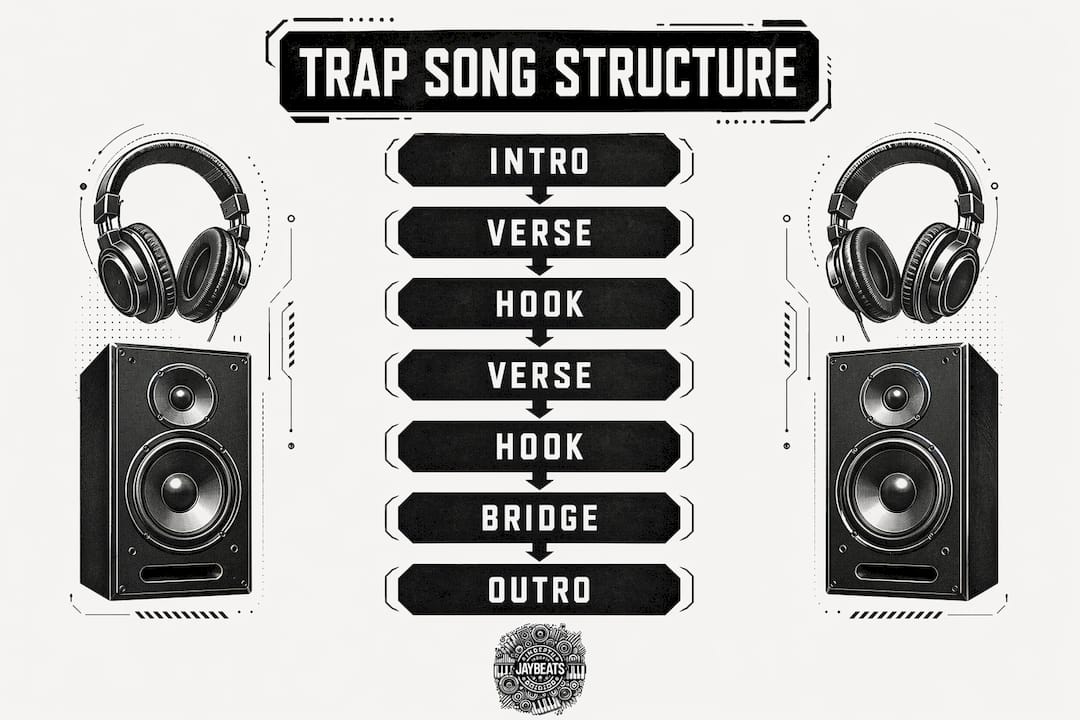
A common trap beat workflow builds a 4-bar repeating loop first, then arranges it into intro, verse, hook, verse, hook, and outro sections. The loop stays consistent while you add and remove layers to create energy shifts. This is how producers build tension and release without writing entirely new music for each section.
Front-loading the hook is a strategic move for streaming. Listeners on Spotify or Apple Music decide within the first 30 seconds whether to skip a track. Dropping the hook at bar 4 or 8 instead of waiting through a full verse gives the song its best chance at retention. Artists like Lil Baby and Gunna consistently use this structure because it works.
Transitions between sections use risers, snare fills, and automation to maintain momentum. A simple technique is to automate a high-pass filter on the melody loop, cutting low frequencies in the last two bars of a verse before the hook drops. The release of that filter on the downbeat of the hook creates instant energy.
How do trap producers create dynamic tension?
Trap’s bounce is not about how many notes you play. It is about where you place silence. Snare placement on beat 3 extends the rhythmic bar, creating a slow, heavy feel at fast tempo. The space before that snare hit builds anticipation. When the snare lands, it releases that tension like a pressure valve.
“Changing snare accent placement while keeping kick and hi-hat steady isolates groove effects, clarifying what defines trap’s unique rhythmic feel.” — Trap half-time feel: The secret behind the bounce
You can test this yourself. Take any trap pattern and move the snare from beat 3 to beats 2 and 4. The tempo does not change. The notes do not change. But the entire feel of the beat shifts from heavy and slow to standard and upbeat. That single variable controls the emotional weight of the whole track.
Hi-hat rolls add surface energy without disrupting the core rhythm. Think of the kick and snare as the skeleton and the hi-hats as the muscle. The skeleton provides structure. The muscle provides movement and expression. Overloading the skeleton with too many kicks destroys the groove. Overloading the muscle with too many hats without varying velocity creates noise instead of energy.
Empty space in drum programming is intentional. Producers who leave gaps between kick hits and 808 notes give the listener’s ear a moment to anticipate the next hit. That anticipation is what makes a beat feel like it has bounce.
Key takeaways
Trap beat structure is built on half-time snare placement, tuned 808s, dynamic hi-hat programming, and tight sectional arrangement that creates tension and release across every bar.
Point | Details |
|---|---|
Tempo and half-time feel | Set your project to 130 to 150 BPM and place the snare on beat 3 to create trap’s signature heavy groove. |
808 tuning is non-negotiable | Pitch every 808 note to the song’s key before anything else; harmonic clashes kill mix quality instantly. |
Hi-hats as energy contracts | Simplify hi-hat patterns in verses and unleash complex rolls in hooks to control listener energy. |
Song structure for streaming | Use 4 to 8 bar intros, 8 bar hooks, and front-load the hook to maximize listener retention on streaming platforms. |
Space creates bounce | Empty space between kick and snare hits builds anticipation; restraint in drum programming defines trap’s groove. |
What I’ve learned after 20 years of building trap beats
I have been producing since 2004, and the single biggest mistake I see from newer producers is filling every moment of a beat. They hear a professional track and think the density is what makes it hit. It is not. The density is the result of careful layering across sections. The verses are sparse. The hooks are full. That contrast is the whole game.
The 808 is where most producers quietly lose the plot. They grab a sample, drop it in, and move on without checking the pitch. Then they wonder why the mix sounds muddy or why the melody feels off. Tuning your 808 takes 30 seconds. Skipping it costs you the entire track’s harmonic integrity.
Hi-hat programming is the skill that separates a beat that sounds like a loop from a beat that sounds like a record. Velocity variation, triplet rolls, and strategic simplification in verses are not advanced techniques. They are basic discipline. Build that habit early and your beats will sound more professional immediately.
My last piece of advice: keep your arrangement adaptable. Rappers need room to perform. A beat that is too busy in the verse leaves no space for a vocal. Build with the artist in mind, not just the speaker. The beats that get placed in productions like WWE 2K25 or Love and Hip Hop Atlanta are the ones that serve the performance, not just the producer’s ego.
— IndepthJayBeats
Build your next track with professional trap beats
You now have the full blueprint. The next step is hearing these principles in action on beats built to professional standards.
At Indepthjaybeats, every beat in the trap beats collection is built with the exact structure covered in this article: tuned 808s, half-time drum patterns, dynamic hi-hat programming, and arrangements designed for vocal performance. The catalog includes hard 808 trap beats ready for rap artists and producers who need genre-authentic instrumentals for recording, sync licensing, or placement. Licensing is straightforward, and a free beat pack is available so you can hear the quality before you commit. If you want to study great trap beat composition up close, start there.
FAQ
What is a trap beat?
A trap beat is a music production style built on half-time drum patterns, tuned 808 bass lines, and rapid hi-hat rolls, typically running between 130 and 150 BPM. The genre originated in Atlanta and defines the sound of mainstream hip-hop and rap production today.
What BPM should a trap beat be?
Trap beats typically run between 130 and 150 BPM, with 140 BPM being the most common starting point. The half-time feel makes the beat sound and feel closer to 70 BPM despite the higher project tempo.
How do you tune an 808 in a trap beat?
Pitch the 808 sample to match the root note of your song’s key before programming any notes. Out-of-tune 808s create harmonic clashes that damage mix clarity regardless of how well the drums are programmed.
How long are sections in a trap song?
Standard trap sections run 4 to 8 bars for intros and outros, 8 to 16 bars for verses, and 8 bars for hooks. Shorter sections than boom bap are standard because trap is structured for streaming platform retention.
Why do trap beats feel slow even at high BPM?
Trap uses a half-time feel by placing the snare on beat 3 instead of beats 2 and 4, which makes a 140 BPM track feel rhythmically closer to 70 BPM. The wide spacing between kick and snare hits creates the heavy, slow-motion groove that defines the genre.