Original beats are the foundation of every independent artist's creative identity, legal safety, and long-term earning potential. When you build your music on a beat you fully own, you control what gets released, where it gets placed, and who gets paid. The importance of original beats goes beyond sound quality. It covers copyright protection, YouTube monetization, sync licensing for TV and film, and your ability to stand out when every other rapper on SoundCloud might be rapping over the same instrumental you leased last Tuesday. This article breaks down exactly why artists need original beats and what happens when they skip that step.
Why artists need original beats: the core argument
Original beats give you something leased beats never can: exclusive ownership. When you license a beat non-exclusively, that same instrumental can be sold to dozens of other artists simultaneously. You are not building a unique sound. You are sharing a foundation with strangers. Exclusive or custom-produced beats, by contrast, belong to you and only you. That distinction shapes every business decision you make afterward, from registering your copyright to pitching your music to a sync supervisor at a major network.
The benefits of unique music are concrete, not abstract. You can register the composition with the U.S. Copyright Office, claim your YouTube revenue without disputes, and pitch to TV and film placements without a producer pulling the rug out from under you. Grammy-winning producer Swizz Beatz advocates for originality over hype, specifically recommending records without samples to avoid clearance issues and build long-term success. That advice applies just as much to the beat itself as it does to the lyrics on top of it.
What makes a beat original and legally protectable?
A beat is legally original when it contains distinctive, concrete musical expression. That means specific melodies, harmonic progressions, and compositional choices that are yours alone. A 2024 U.S. court ruling confirmed that rhythms and chord sequences are part of the shared musical language and cannot be owned. Courts protect only the concrete expression layered on top of those building blocks.
What this means practically is that a simple drum pattern or a common trap hi-hat roll will not hold up in court. The protection lives in the melody, the specific arrangement, and the unique harmonic content. Drum patterns alone are weakly protectable. Strong copyright claims rely on stacked melodic and harmonic content that is clearly distinguishable from anything else on the market.
Here is what you need to document to prove originality:
Timestamped project files from your DAW (FL Studio, Ableton, Logic Pro) showing the creation date
Unique melodic and harmonic content that goes beyond basic scales or common progressions
A copyright registration filed with the U.S. Copyright Office, which you can learn how to do through resources like this copyright registration guide
A clear paper trail between you and the producer, including the licensing agreement or work-for-hire contract
"Originality isn't just a new loop. It means creating unique, protectable melodies and maintaining clear rights documentation from day one." — The Conversation
Without that documentation, you are vulnerable. Even if your beat sounds completely different from anything else out there, you need proof that it is yours.
Risks of using non-exclusive or leased beats
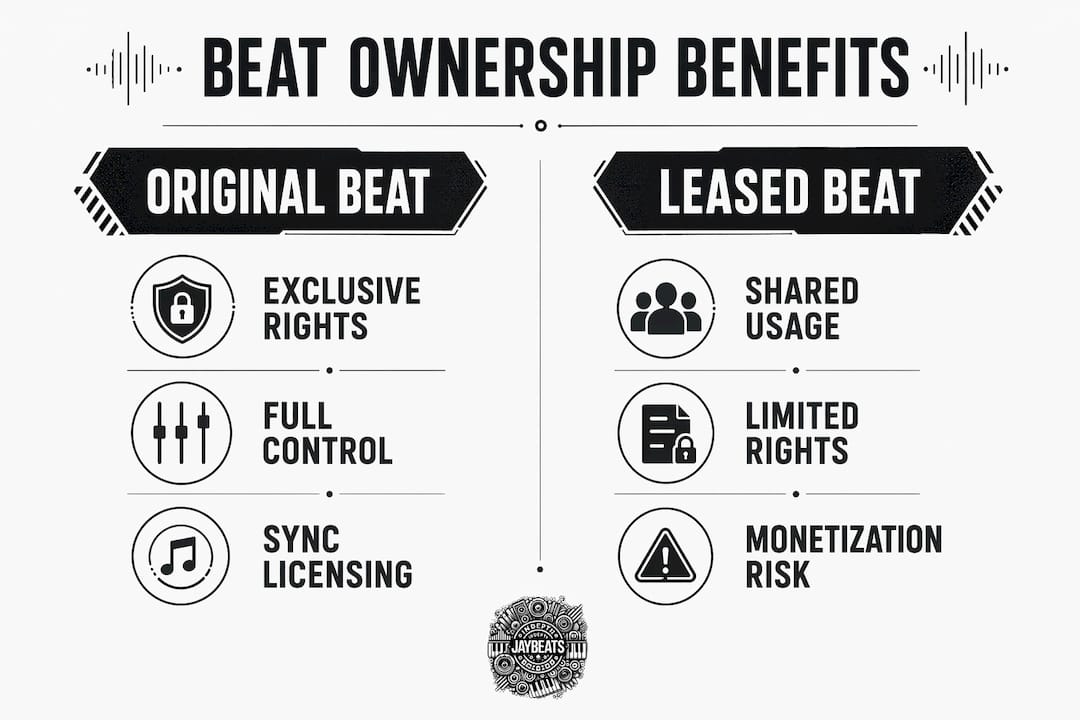
Non-exclusive beat leasing is the most common trap independent artists fall into. The price is low, the beat sounds great, and you move fast. Then you upload to YouTube and Content ID flags your video within 48 hours because the producer sold that same beat to 15 other artists and registered it with a Content ID service.
YouTube's Content ID systemrequires exclusive ownership to make a valid claim. When multiple artists use the same leased instrumental, overlapping claims trigger automatic disputes that freeze monetization. You cannot collect ad revenue while the dispute is being resolved, and resolution can take weeks. That is weeks of lost income on a song you worked hard to create.
The problems stack up fast:
Monetization freezes the moment a competing Content ID claim is filed against your video
Takedown notices can remove your content entirely if the dispute escalates
Streaming conflicts arise when distributors like DistroKid or TuneCore flag duplicate instrumentals across multiple releases
Brand dilution happens when listeners hear the same beat on three different artists' songs in the same week
Sync disqualification occurs because TV networks and film studios require clean, exclusive rights before any placement deal is signed
Beat licensing disputesoften arise from shared instrumentals licensed non-exclusively, a situation the industry calls a "beat theft" conflict even when no actual theft occurred. The producer did nothing wrong. You did nothing wrong. But the system treats overlapping claims as a problem you have to solve, not them. Exclusive licenses prevent Content ID conflicts and protect your monetization from the start.
The financial hit is real. You might spend $50 on a lease, invest time recording and mixing, pay for distribution, and then watch your revenue get locked while a dispute clears. Original, exclusive beats eliminate that entire chain of problems before it starts.
How original beats open doors for sync licensing and broadcast
Sync licensing is where independent artists can earn serious money. A single placement in a show like Love and Hip Hop Atlanta or a video game like WWE 2K25 can generate more income than months of streaming. But sync supervisors are selective, and the beat is often the first thing they evaluate.
Sync supervisors requireedit-friendly beats with modular versions including instrumentals, cut-downs, and stems. They need to drop your music into a scene, trim it to 30 seconds, or layer it under dialogue without calling you for a custom edit. If your beat is a single, unedited file with no alternate versions, you are not sync-ready regardless of how good it sounds.
Here is how original beats compare to leased beats in a sync context:
Factor | Original/Exclusive beat | Leased/Non-exclusive beat |
|---|---|---|
Rights clearance | Clean and fast | Complicated, often blocked |
Modular versions available | Yes, producer can provide stems | Rarely included in lease terms |
Content ID conflicts | None | Frequent |
Broadcast eligibility | Full | Limited or disqualified |
Monetization security | Guaranteed | At risk |
Music can be rejected for sync if it lacks predictable structure and cannot hold up through editorial manipulation. Sync supervisors need clear entry points, manageable intensity changes, and sections that work independently. Original beats built with sync in mind include these features by design.
Pro Tip: When you commission or purchase an original beat for sync, ask the producer for a full stems package upfront. Stems (individual tracks for drums, bass, melody, and vocals) save you weeks of back-and-forth when a music supervisor requests an edit.
The sync-ready packaging matters as much as the music itself. A great beat in a single MP3 file is a missed opportunity. The same beat delivered with stems, an instrumental, and a 30-second cut is a product a supervisor can actually use.
Creative and career benefits of owning original beats
Owning your beats builds something no lease agreement can give you: a signature sound. When every song you release is built on a beat that belongs to you, your catalog starts to develop a recognizable identity. Listeners connect that sound to your name, not to a producer who sold the same instrumental to 20 other artists.
Here is what creative freedom in music actually looks like when you own your beats:
You control the rollout. No producer can pull the beat from circulation or change licensing terms after your song is out.
You build catalog value. Owned compositions appreciate over time, especially as your profile grows and sync opportunities increase.
You avoid clearance delays. Sample-based beats require clearing the original sample before any placement. Original beats skip that step entirely.
You pitch with confidence. When a label, manager, or sync supervisor asks about rights, you have a clean answer.
The impact of original beats on an artist's long-term career is compounding. Every placement, every registration, and every stream builds on a foundation you actually own. Leased beats build someone else's catalog while you do the creative work.
Pro Tip: If your budget is tight, prioritize exclusivity on the songs you plan to pitch for sync or release as singles. Use non-exclusive leases only for mixtape cuts or demos you are not monetizing.
Understanding beat licensing options before you buy is the move that separates artists who build careers from artists who stay stuck in disputes and dead-end releases.
Key takeaways
Original beats are the single most important investment an independent artist can make to protect ownership, avoid monetization conflicts, and access sync licensing opportunities.
oint | Details |
|---|---|
Ownership protects income | Exclusive beats prevent Content ID disputes that freeze YouTube and streaming revenue. |
Legal originality requires melody | Courts protect distinct melodic and harmonic content, not drum patterns or chord sequences alone. |
Sync requires clean rights | TV and film placements demand exclusive ownership and modular beat versions like stems and cut-downs. |
Leased beats limit your brand | Non-exclusive instrumentals shared across multiple artists dilute your sound and create competition. |
Documentation is non-negotiable | Timestamped project files and copyright registration prove ownership and protect your work legally. |
What I've learned after two decades of watching artists get this wrong
I have been producing beats since 2004. I have watched talented artists record incredible songs on leased beats, build real momentum, and then watch everything stall the moment a Content ID claim hit or a sync supervisor asked for clean rights. The frustration is real. The setback is avoidable.
The artists who build lasting careers are not always the most talented. They are the ones who treat their music like a business from day one. That means owning what you release. It means knowing the difference between a lease and an exclusive license before you spend money. It means asking the producer for stems before you need them, not after a supervisor is waiting on your reply.
What most articles will not tell you is that sync readiness is not just about the music. It is about the paperwork. A beat that sounds perfect for a TV scene is worthless to a music supervisor if the rights are tangled up in a non-exclusive lease shared with 10 other artists. I have seen placements fall through at the last minute for exactly that reason.
My advice is direct: stop treating beat purchases as a shortcut and start treating them as an investment. The $50 lease feels smart until it costs you a $2,000 sync deal. Original beats are not a luxury for artists who have made it. They are the tool that helps you get there.
— IndepthJayBeats
Get original beats built for TV, film, and your career
Indepthjaybeats was built specifically for independent artists who are serious about where their music ends up. Every beat in the catalog is produced with sync readiness in mind, including clean rights, modular versions, and the kind of structural clarity that music supervisors actually need.
Artists have already placed music from Indepthjaybeats in productions like WWE 2K25 and Love and Hip Hop Atlanta. That track record matters when you are choosing where to invest. Whether you need trap beats with hard 808s or boom bap instrumentals with room to breathe, the catalog covers both. Check the full licensing options to find the right fit for your next release, and grab the free beat pack to hear the quality before you commit.
FAQ
What makes a beat original under copyright law?
A beat is original when it contains distinctive melodic and harmonic content that goes beyond shared musical building blocks like basic rhythms or chord sequences. A 2024 U.S. court ruling confirmed that rhythms alone cannot be owned. Only concrete, unique expressions are protected.
Why do artists need original beats for YouTube monetization?
YouTube's Content ID system flags videos when multiple artists use the same non-exclusive beat, freezing monetization during disputes. Exclusive ownership of an original beat eliminates overlapping claims and keeps your revenue flowing without interruption.
What is the difference between original vs sample beats for sync?
Original beats carry clean rights with no clearance requirements, making them immediately eligible for TV, film, and advertising placements. Sample-based beats require clearing the original sample first, which adds cost, time, and the risk of rejection if the sample owner declines.
How do original beats help independent artists stand out?
When your music is built on a beat no one else can use, your sound becomes yours alone. Shared leased beats mean multiple artists release songs over the same instrumental, which dilutes your brand and makes it harder for listeners to connect a specific sound to your name.
Do I need stems when buying an original beat for sync?
Yes. Sync supervisors regularly request stems (individual audio tracks for drums, bass, melody, and other elements) to edit music to picture. Buying an original beat with a full stems package included saves time and increases your chances of closing a placement deal.