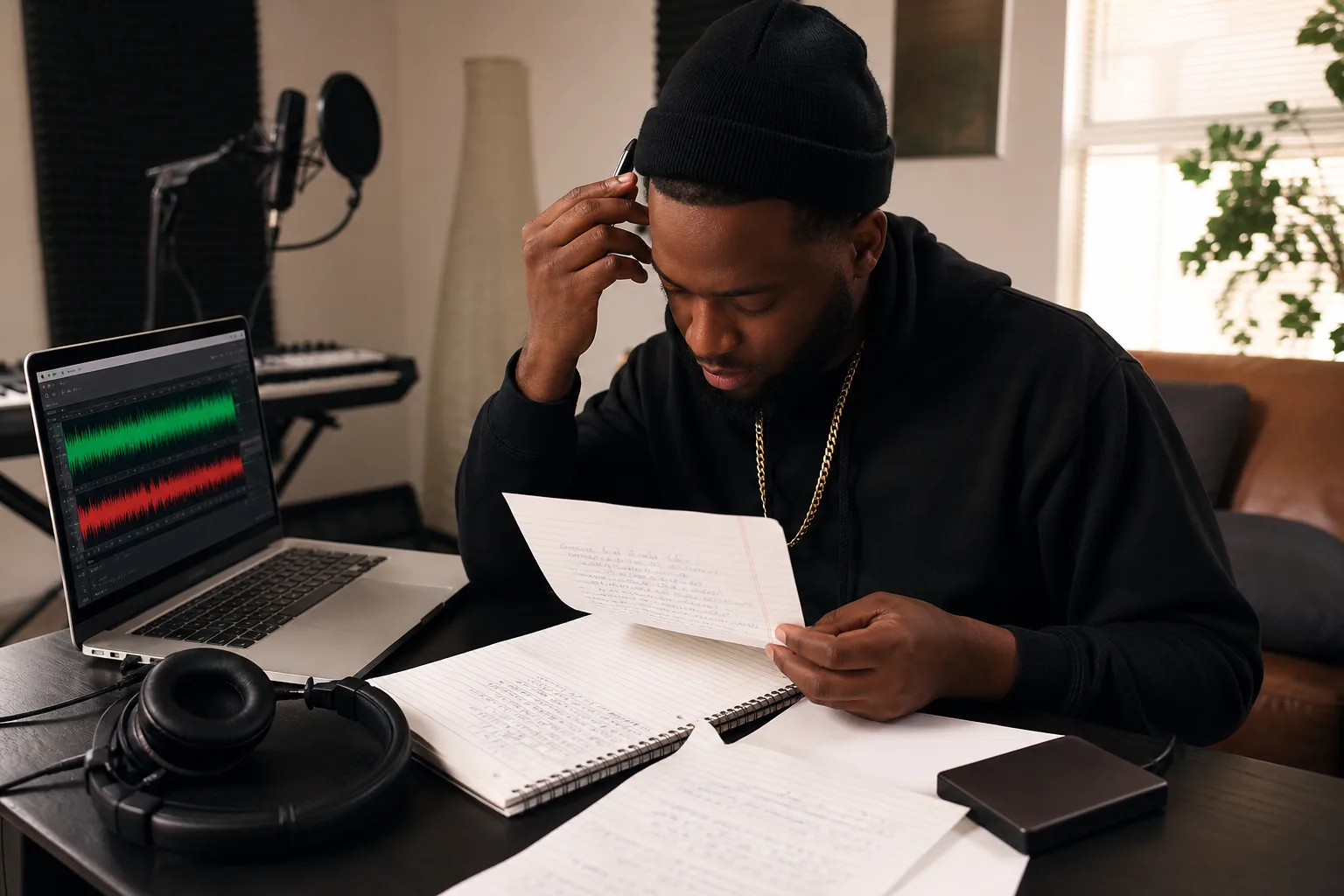
You own copyright as soon as your original song is written down or recorded. But that first layer of protection isn't the same as a federal registration. I'll walk you through the forms, fees, co-writer paperwork, samples, and royalty steps so your next release has a clean paper trail.
Table of Contents
Step 1: Identify and Fix Both Copyrightable Parts of Your Song
Step 3: Choose the Right Filing, Pay the Fee, and Protect Your Legal Position
Step 4: Document Collaborators, Clear Third-Party Material, and Register After Filing
Step 1: Identify and Fix Both Copyrightable Parts of Your Song
Before you learn how to copyright a song, split the work into two parts: the musical composition and the sound recording.
The composition is the song on paper. It includes the melody and lyrics. Songwriters, composers, and lyricists usually own this part. A chord progression or title alone usually isn't enough because those pieces lack the needed original expression.
The sound recording is the master, meaning the specific recorded performance. It includes the vocal take, instrumental performance, mix, and final audio file. The performer or producer may own it, depending on who made the recording and what the contracts say.
The U.S. Copyright Office explains that these are separate works. Its official explanation of musical compositions and sound recordings also confirms that both works can appear on one application when ownership is exactly the same.
That ownership rule matters for independent artists. If you wrote the lyrics but used a producer's beat, you may own your lyrics while the producer keeps rights in the music. A beat license can grant you permission to release the finished track without transferring ownership of the instrumental.
Save the proof of how the song took shape. Keep the final WAV, your lyric file, sheet music if you have it, and dated project files. A private upload may help show when a file existed, but it doesn't replace a federal registration.
If you're recording over a beat from an online beat license, read the terms before you file. Check commercial use, streaming rights, credit rules, Content ID terms, and any stream or sales limits. Dam bro, don't register rights you never received.
Fix the song in a tangible form first. That can be an audio file, a written lyric sheet, sheet music, or a digital recording. Copyright protection begins at fixation, so you don't pay a fee for that first layer.
Key Takeaway: A finished track can contain two copyrights. Identify who owns each one before you submit an application.
Step 2: Complete the Online Copyright Application
To register your song, use the U.S. Copyright Office's online registration system. Start at the official registration portal, make an account, and choose the application that matches your work.
For one song, a single application may fit when you own both the composition and the sound recording. If the ownership differs, treat the works with care. You may need separate claims for the composition and master.
Don't use a Standard Application to bundle several unpublished songs as a collection. The Office says you must choose the Group of Unpublished Works application for up to 10 unpublished works. Using the wrong option can leave some titles outside the claim.
Once you select the work type, the portal asks for the title. Use the final title that appears in your release plan. Avoid generic labels such as “Untitled.” The title won't earn copyright by itself, but bad title data can cause record errors.
Enter publication and author details
Tell the Office whether the work has been published. In this setting, publication means you distributed copies or made them available to the public. A private demo sent to one collaborator may not have the same status as a commercial release.
Enter the year of completion. If the track is published, add the first publication date and country. Keep this date beside your distributor receipt and release confirmation. Small mismatches can lead to questions later.
Next, enter the authors. Add each songwriter for the composition. Add the performer, producer, or other author tied to the sound recording. Then list the claimant, which is the person or company that owns the copyright today.
Author and claimant can be the same person. They can also differ. For example, an artist may write a song while a company owns the copyright under a valid agreement. Don't mark a work as made for hire unless the facts and written agreement support that claim.
Handle limitation of claim, notes, and delivery
The Limitation of Claim field matters when part of the work came from somewhere else. Use it to identify material you don't claim, such as preexisting lyrics, a cover composition, a licensed sample, or material made with artificial intelligence.
Then describe the new material you do claim. For a cover, that might be your new sound recording and arrangement. The original composition still belongs to its rights holders unless you have a transfer or another valid agreement.
If the form doesn't fit your situation, don't guess. Use the Copyright Office help resources or ask a qualified music attorney. A rushed filing can create more trouble than a short delay.
Use the Notes field for facts that need context. Keep it short and clear. Explain a title change, a prior registration, a co-writer issue, or a limitation that the form doesn't capture well.
Review the certification page before payment. After payment, upload the deposit copy. Use the final file you intend to register. Check the file name and audio before submission because the upload becomes part of your application record.
Pro Tip: Make one folder for the application. Put the final audio, lyrics, split sheet, license, receipt, and submission confirmation inside it.
Step 3: Choose the Right Filing, Pay the Fee, and Protect Your Legal Position
The filing choice affects both cost and coverage. For one eligible work by one author who is also the claimant, the electronic single-author fee is $45. The Standard Application fee is $65. A group of unpublished works costs $85, while a group of works published on a music album costs $65.
Paper filing costs more. Fees for paper Forms PA or SR are listed in the fee schedule. Use an online filing option when your work fits an electronic option. It is usually the cleaner path for an independent release.
Check the Copyright Office fee schedule right before filing. Fees can change, and the portal will show the amount tied to your chosen application.
Payment comes before the deposit upload in the normal online flow. The system accepts the payment methods shown in the portal. Don't mail a paper form when you meant to complete an online filing, and don't assume a low-cost private timestamp service gives you a federal registration.
Some services sell timestamps or private records. Those records may help show that a file existed at a certain time, but they don't give you the legal benefits of registration. The government filing is the registration that creates a public record with the Copyright Office.
For a U.S. work, registration is also tied to enforcement. You generally need to register before bringing an infringement lawsuit in federal court. Timing can affect access to statutory damages and attorney's fees, so filing before a dispute is much safer than waiting for a song to get copied.
Expedited handling exists, but it is for special situations and costs far more than a normal filing. The listed special handling fee is substantially higher than a normal filing. You shouldn't choose it just because you want a faster certificate. Use it only when your facts meet the Office's requirements.
Processing often takes months. Official guidance can cite a range of roughly three to six months. Keep your submission receipt while you wait. If the Office sends a question, answer it with the same facts used in your split sheet, license, and release metadata.
Step 4: Document Collaborators, Clear Third-Party Material, and Register After Filing
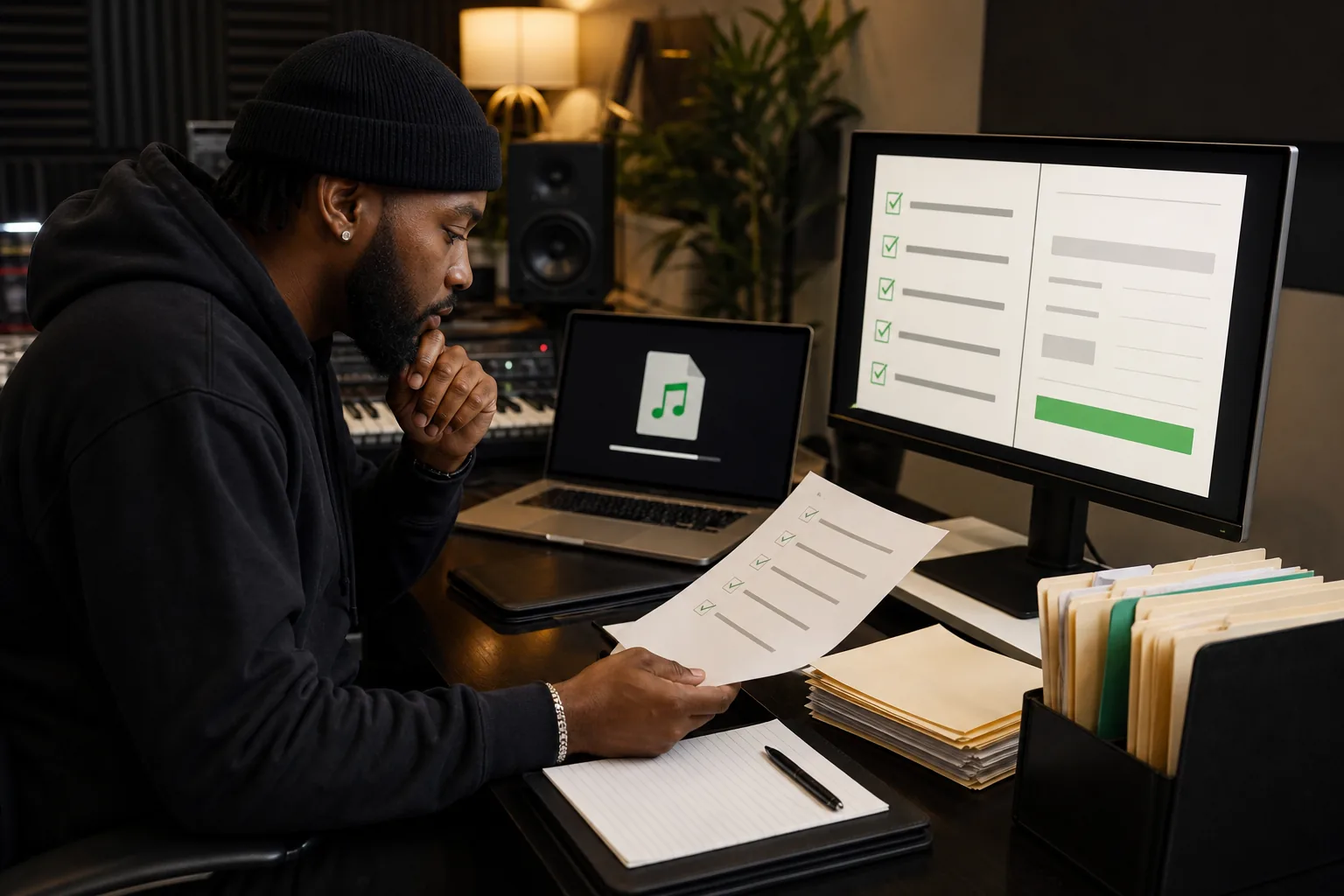
Collaboration paperwork should happen before the release, not after a track starts earning. A split sheet records each writer's share. It should include the song title, legal names, stage names, roles, ownership percentages, contact details, signatures, and the date.
Make every percentage add up to 100 percent. If the producer wrote part of the melody, say so. If you only wrote lyrics over a licensed beat, don't claim the producer's music as your own.
A split sheet records ownership, but it may not explain who can approve a sync placement, sign a license, edit the work, or pull it from a platform. For a song with strong commercial plans, use a fuller co-writer agreement. If the song has a serious budget or several rights holders, get legal advice.
Register the same names and splits everywhere. Conflicting data can freeze royalties while the platforms ask contributors to resolve the claim. Keep the signed agreement with the copyright filing receipt.
Clear third-party material before you upload. A recognizable sample usually needs permission from the owners of the master and composition. An interpolation, meaning a new performance of part of an existing song, still uses the underlying composition.
For a cover, your new recording may have its own master copyright. The original songwriter still owns the composition. A compulsory mechanical license can apply to some audio-only cover releases, but it doesn't solve every use. Film, video, ads, and samples can require separate permissions.
After filing, register the composition with your performing-rights organization. Then review your digital mechanical royalty account for U.S. royalties. The Copyright Office explains that the Music Modernization Act created a blanket system for certain digital uses and assigned a designated service to collect and distribute those payments.
That registration is separate from federal copyright. A PRO or designated royalty-collection service can help collect money, but neither one replaces a Copyright Office filing.
If you used a leased beat, compare the agreement with your planned release before registering. Registering a song with a performing-rights organization using a leased beat can work when the license supports distribution and the writer split is clear.
Need a beat while you finish the paperwork? Indepth Jay Beats has hip hop, trap, boom-bap, and R&B instrumentals with licensing options. I keep the creative side moving while you handle the rights side. Pick a beat, save the license, and store it beside your song files.
FAQ
How do I copyright a song in the US?
To copyright a song in the U.S., fix it in an audio file or written form, then file an application with the U.S. Copyright Office. Choose the correct work type, enter the authors and claimant, pay the fee, and submit the required copy. Protection starts at fixation, but registration gives stronger legal benefits.
Does copyrighting a sound recording protect the lyrics?
A sound recording registration may include the composition when the same person owns both copyrights and the application supports both works. Otherwise, the lyrics and music need their own composition claim. Check ownership before filing. A producer's beat license may let you release the track without giving you ownership of the underlying music.
How much does it cost to copyright a song?
The electronic fee can be $45 for one work by one author who is also the claimant. Other options include the $65 Standard Application, an $85 group filing for unpublished works, and a paper filing for certain forms. The right fee depends on your work, ownership, and filing method.
Can two people copyright the same song?
Two or more people can register a song when they are the authors or valid claimants. List every contributor accurately and document the split before submission. If the master and composition have different owners, review whether separate applications make more sense. Never enter a made-up split to get a filing completed.
Do I need to copyright a song before releasing it?
You don't need a registration before release for copyright protection to exist. The song is protected once you fix it in a tangible form. Filing before release can still help your legal position if someone copies the work later. It also gives you a public record instead of relying only on private files.
Does registering with a performance-rights organization copyright my song?
No, registering with a performance-rights organization doesn't copyright your song. Those organizations help collect performance royalties. Federal registration happens through the U.S. Copyright Office. You may need both systems, plus a digital mechanical royalty collection service for certain mechanical royalties, if you want your rights data and royalty claims set up correctly.
Conclusion
File through the U.S. Copyright Office, match the claim to the people who own each part, and keep every license and split sheet in one folder. Before your next track drops, review the beat agreement and submit the correct application. If you need a clean instrumental for that release, check out Indepth Jay Beats and save the license with your project files.

Get 20+ Free Beats delivered to your inbox
Drop your name and email and I'll send a pack to your inbox right away.
We respect your inbox, no spam. Promise!