Music Production

IN THIS GUIDE
Learn how to rap over boom bap beats with clear steps for beat choice, drum pocket, rhyme, vocal recording, and license checks before you release your track.
How to rap over boom bap beats comes down to hearing the drums, then letting your words sit in their pocket. The snare can make a bar feel sharp, but only if your phrasing leaves it room to hit. Follow these five steps to choose an instrumental, write and record your song, then check its license before release.
We analyzed 57 comments and questions from Reddit, YouTube and Quora about rapping over Boom Bap beats and found that 39% mentioned matching lyrics to the beat.
Table of Contents
Step 1: Choose a Boom Bap Beat That Fits Your Voice
Step 2: Find the Pocket by Listening to the Drums
Step 3: Write Lyrics and Shape Your Cadence Around the Groove
Step 4: Record Clear Takes and Build a Convincing Performance
Step 5: Revise the Song and Confirm the Beat License Before Release
Frequently Asked Questions
Conclusion
Step 1: Choose a Boom Bap Beat That Fits Your Voice
Start with a beat that gives your voice space. Boom bap often pairs punchy kicks with crisp snares and a repeating sample. Many tracks sit around 80 to 95 BPM, though the right tempo is the one that lets you deliver each line without rushing or dragging.
Play the beat at a comfortable volume and rap a few lines you already know. Listen for where your breath falls and whether your natural stress lands near the drums. If the sample competes with your voice, or the beat makes you strain to fit a phrase, keep auditioning.
Indepth Jay Beats sells hip-hop instrumentals, including boom bap. You can preview boom bap beats and test a few against the same rough verse. Use this guide to choosing boom bap beats to compare groove, vocal space, and arrangement—not just mood.
Try this simple check before you commit:
Can you hear the kick and snare clearly at a low playback level?
Does the sample leave a gap for your words?
Can you rap a full verse without running out of breath?
Does the energy fit the subject of your song?
Don’t choose a beat just because it sounds gritty. A dense sample may work for a short hook but crowd a detailed verse. A sparse loop can suit a story, yet feel too bare for a high-energy delivery. Pick the one that supports the performance you want to give.
If you’re making a beat yourself, build around a short loop and a clear kick-snare pattern. Use an original, public-domain, or properly licensed source for samples. A sample can involve rights to both the recording and the underlying composition. Review this general copyright information for sound recordings when releasing a sample-based track.
By now, you should have one instrumental that fits your voice and leaves room for a verse.
Practice with three boom bap beats
Try the same four bars over these three IndepthJayBeats instrumentals. Listen back for the tempo that gives your words room to land.
Luv (76 BPM)
Rap four bars with a conversational delivery. Leave a short pause after the second bar and hear how it changes the flow.
My Bag (90 BPM)
Use the same four bars and see where you naturally stress different words at the faster tempo.
Don’t Play Games (94 BPM)
Run the verse once more and aim the final stressed syllable of each line toward the snare.
Browse more boom bap beats by IndepthJayBeats
Step 2: Find the Pocket by Listening to the Drums
The pocket is how your voice sits against the beat’s timing. Don’t start by forcing words into a pattern. First, hear the kick as the low “boom” and the snare as the sharper “bap.” Many boom bap patterns put the kick near beats one and three, then the snare on two and four.
Loop four bars. Tap your hand on each beat and count “one, two, three, four” out loud. Keep counting until the beat feels steady. Then hum a loose rhythm over it, without lyrics. Notice where your voice naturally rises and where you want to pause.
Now test a line. Try placing its strongest word near the kick, then try the same line with its final stressed syllable landing on the snare at beat four. That last-syllable-on-the-snare move can make the bar feel precise. Treat it as a drill, not a law; a flow can push ahead or hang back when the song calls for it.
Try this: Record the same four bars three ways. First, rap straight on the beat. Next, sit a touch behind the snare. Then leave a short gap before your final word. Listen back and choose the take that makes the words clearest.
Don’t confuse a steady count with a stiff flow. Boom bap often has a loose, human feel. If your voice lands a little behind the snare, that can sound relaxed; if every line trails further behind, the verse may lose momentum. Use the beat as a guide, then trust what you hear on playback.
You can practice with a steady loop or a freestyle instrumental. Freestyle beats for rappers can help you test flow before you settle on lyrics. Keep the beat low enough that you can hear your own timing.
Milestone: You should be able to count the groove and place one full line without racing the snare.
Step 3: Write Lyrics and Shape Your Cadence Around the Groove
Write the hook first. It gives the song a clear center, and it lets you test the main phrase before you fill the verses. Chant a possible title over two bars. Leave it alone for a while, then come back and see if you still remember it. If it sticks, it may be worth building around.
For the verse, start with one scene, thought, or moment. Boom bap leaves room for detail, so use a specific image instead of a string of broad claims. Map a 16-bar verse into four groups of four bars. The first group can set the scene; the next can add a problem or change; the final group can land your strongest thought.
Next, add rhyme inside the lines. An end rhyme gives listeners a place to expect the bar to land. Internal rhymes add sound before that landing. Multisyllabic rhymes match a run of syllables, not only the final word. Keep the words clear when you say them aloud. A dense rhyme that trips your tongue needs a rewrite.
Here’s a small exercise. Write four plain lines about one event. Mark the words you naturally stress. Then add an internal rhyme to one line and a multi-syllable rhyme to another. Read them over the beat and cut any phrase that crowds the snare or leaves no breath.
A slower beat doesn’t mean every bar needs more words. Let some lines run tight, then leave a gap so the sample can speak. Change your cadence when the story changes. You might stretch a phrase across the bar, then answer it with shorter words that strike closer to the drums.
If you’re still testing what suits your voice, use the suggestions in this guide to matching a beat to your voice as you audition instrumentals. The same idea applies when writing: let your natural tone set the range, not a rhyme scheme that sounds good only on paper.
Record a rough voice memo over the loop before polishing every line. A phone recording can reveal weak bars, rushed syllables, and breath gaps early. Fix the spots that sound awkward instead of forcing yourself to keep them because they looked good in your notes.
By now, your hook should be easy to repeat, and your verse should follow a clear arc.
Step 4: Record Clear Takes and Build a Convincing Performance
Clear vocals start with the room and your mic position. Pick the quietest space you can use. Turn off anything that adds steady noise, and avoid facing a bare wall if it throws your voice straight back at the mic.
Set the mic a hand’s span from your mouth, then angle it slightly off-center. This can help soften harsh bursts of air on sounds like “p” and “b.” Keep the same distance through each take. If you lean in for one line and back away for the next, your vocal level will jump around.
Record one full take to learn the song’s shape. Then punch in only the lines that need work. Don’t stack takes just to make the session look busy. Pick the delivery that feels honest and clear, even if it has less volume or fewer ad-libs.
Keep the lead vocal upfront. Start with a clean, mostly dry sound so the words stay easy to understand. Use EQ to reduce a muddy low end if you hear one. Gentle compression can even out loud and soft phrases. A touch of saturation or distortion can add grit, but too much can blur consonants.
Reverb can help the vocal sit in the track, but a long or loud tail can cover the next line. Add a small amount, then compare it with the effect turned off. If the dry take feels stronger, keep it dry. Auto-tune isn’t required for a convincing boom bap performance.
Rapper recording a clear vocal take over a boom bap beat at home.
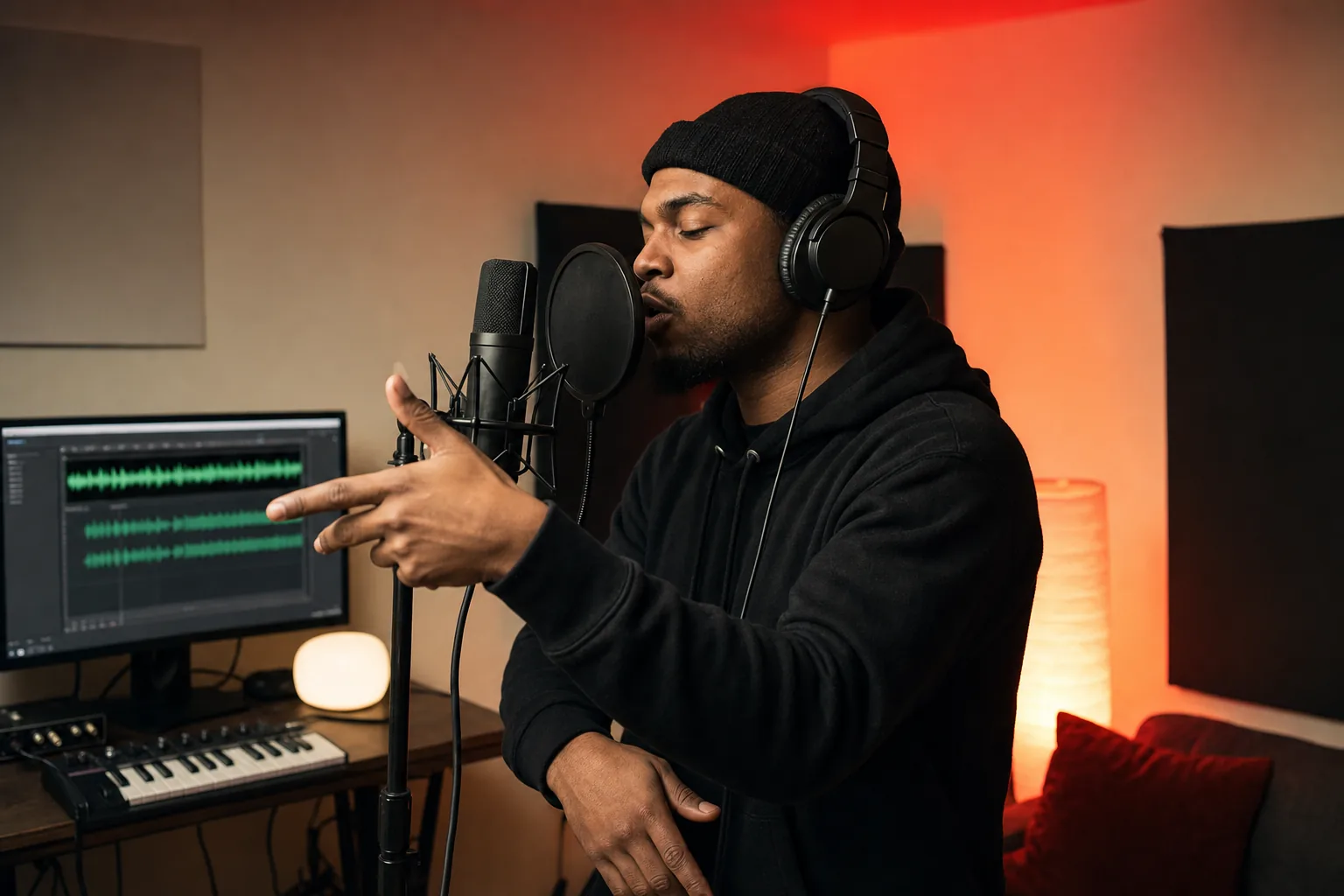
For a clean edit, trim long silences without cutting breaths that make the verse feel human. Listen once on headphones, then once through a regular speaker. If the beat masks a word in either listen, lower the instrumental slightly or adjust the vocal, rather than pushing every effect harder.
If you’re mixing a raw take, the steps in this guide to mixing raw rap vocals cover EQ and compression basics that can also help you think through vocal clarity on other styles. Work gently, and keep checking the full beat.
At this stage, you should have a lead take that stays clear from the first bar to the last.
Step 5: Revise the Song and Confirm the Beat License Before Release
Take a short break, then listen from start to finish without stopping to fix things. Write down each spot that pulls you out of the song. You may hear a verse that starts too soon, a hook that needs a cleaner phrase, or a final word that lands late.
Check the arrangement as well. Does the beat leave enough room for the hook? Does the verse build toward its last line? If the instrumental changes between sections, make sure your flow changes with it. A small pause before a hook can work better than adding another layer of vocals.
Get one trusted listener to tell you where the words become hard to follow. Ask them to name the bar, not just say “the mix feels off.” That gives you a spot to fix. Don’t revise every line to please one person; keep the parts that still sound right to you.
Before release, read the license tied to the beat you chose. Confirm that it covers your planned use, and save the license agreement with your project files. Check what files come with the purchase, what credit is required, and whether the license sets limits on distribution copies or other uses.
Exclusive and non-exclusive licenses can grant different rights, so read the actual terms rather than guessing from the label. A comparison of exclusive and non-exclusive beat licenses can help you spot which details to review. Indepth Jay Beats states that exclusive beats include WAV files and stems, with digital delivery after checkout; check the specific beat option and agreement for the terms that apply.
Indepth Jay Beats sells boom bap instrumentals for independent artists who want to write and record without building a loop from scratch. If your beat uses a sample, make sure the relevant rights are covered for your release. For further reading, see copyright information for musicians, and get qualified advice if you’re unsure about a specific use.
Final check: Save your final audio, lyric sheet, beat license, and any required credit details together. Then you can release the track with a clear record of what you used.
Frequently Asked Questions
What tempo should I rap over for boom bap?
Many boom bap beats sit around 80 to 95 BPM, but there’s no single required tempo. Choose a loop that lets you say the full line without rushing your breath. If the beat feels slow, try a more compact cadence before adding extra words. A rough take will show whether the tempo supports your natural delivery.
How do I stay on beat when rapping?
Count four steady beats with the instrumental, then rap a short line over a loop. Listen for the kick and snare, and mark the stressed words in your line. Record a few versions with different placements. If your last word keeps arriving late, shorten the phrase or shift its stress earlier.
How do I write a hook for a boom bap song?
Start with the song’s main idea and say it in a short phrase. Chant that phrase across two bars, then try it again after a break. A strong hook should be easy to remember and comfortable to perform. Keep the words clear, and leave enough space for the beat to carry the rhythm.
Can I use a free boom bap beat in a released song?
Only if the beat’s terms allow the kind of release you plan. “Free” can refer to different uses, so read the actual license before uploading your song or video. Check whether commercial use is allowed and whether the terms require credit. Keep a copy of the agreement with your project files.
Conclusion
Start with a beat that leaves space for your voice, then build the verse around the drums instead of fighting them. Record a rough take today and listen for one line to tighten. When the song feels right, confirm the license before you share it.
Written by IndepthJayBeats
Jason Szklarek is the producer and composer behind IndepthJayBeats. Creating music since 2007, he specializes in hip-hop, trap, and R&B instrumentals for artists building their sound.
Keep building your sound
INDEPTHJAYBEATS
Find your next beat.
Put the ideas into practice. Explore boom bap, trap, and R&B instrumentals and find the sound for your next record.
Listen & Shop Beats