Exclusive beats are defined as instrumentals where the buyer receives full master and publishing rights, making them the only option that satisfies the clearance requirements of professional film sync licensing. If you are a filmmaker or content creator trying to land music in a production, why exclusive beats serve film placements comes down to one hard fact: music supervisors, studios, and streaming platforms will not clear a track they cannot fully own or control. Non-exclusive leases leave too many doors open for competing claims. Exclusive rights close them all, giving your project a clean path from production to screen.
Why exclusive beats serve film placements better than any other option
The legal and clearance advantages of exclusive beats are not subtle. Music supervisors and advertising agencies require exclusive rights to instrumentals before signing sync deals in 2026. That is not a preference. It is a gate. If your beat does not come with full rights, the conversation ends before it starts.
Here is what exclusive ownership actually gives you:
Full master and publishing rights. You control both sides of the copyright. No co-owner can block a deal or demand additional fees at the last minute.
YouTube Content ID registration. Exclusive licenses allow artists to register their music with YouTube Content ID, which is the mechanism that claims ad revenue and protects against unauthorized uploads. Non-exclusive beats cannot be registered because shared ownership creates conflicting claims.
No usage caps. Non-exclusive leases typically restrict stream counts, distribution numbers, and commercial use. Exclusive rights remove those ceilings entirely.
Full sync clearance. Film distributors, Netflix, HBO, and similar platforms require a clean chain of title before they will accept a delivery package. Exclusive beats provide that chain. Non-exclusive beats cannot provide the full clearance needed for sync licensing.
Protection against unauthorized usage. When you own exclusive rights, any third party using that beat without your permission is infringing. You have legal standing to act.
The practical implication is direct. A filmmaker who builds a project around a non-exclusive beat is building on sand. The producer can sell that same beat to ten other artists, and any one of them could register it, file a Content ID claim, or create a competing sync deal. That conflict disqualifies your track from most professional placements before you even pitch it.
How exclusive beats sharpen the creative identity of your film
Exclusive music for films does more than satisfy legal requirements. It shapes the emotional DNA of your project in a way that recycled or shared beats simply cannot.
Film composer Moses Sumney, in his 2026 film-scoring debut, stated that the most effective film music comes from unique, original soundscapes. He specifically emphasized avoiding music that audiences have “heard over and over again,” pushing instead for fresh sonic landscapes that catch listeners off guard. That principle applies directly to beat selection. When you license a non-exclusive beat, you are using a sound that dozens of other artists, ads, and projects may already own. Audiences recognize repetition even when they cannot name it. That recognition pulls them out of the story.
“The goal is to create something surprising. If the audience has heard it before, you’ve already lost them.” — Moses Sumney, on film scoring in 2026
Exclusive beats give filmmakers the ability to shape a distinct sonic mood that belongs to their project alone. Think about the way the score of Moonlight or Hereditary became inseparable from the film’s identity. That level of sonic ownership starts with exclusivity. When no other project can use your beat, the sound becomes yours. It becomes part of your brand as a filmmaker.
Custom beats for film placements also allow you to work directly with a producer to tailor the arrangement, tempo, and instrumentation to specific scenes. That creative flexibility is impossible with a non-exclusive lease, where the beat is a fixed product sold to the masses. Exclusive rights open the door to collaboration, revision, and true creative partnership.
What practical advantages do exclusive beats give filmmakers?
The benefits of exclusive beats go beyond legal protection and creative identity. They create real, measurable advantages in the day-to-day work of getting music placed.
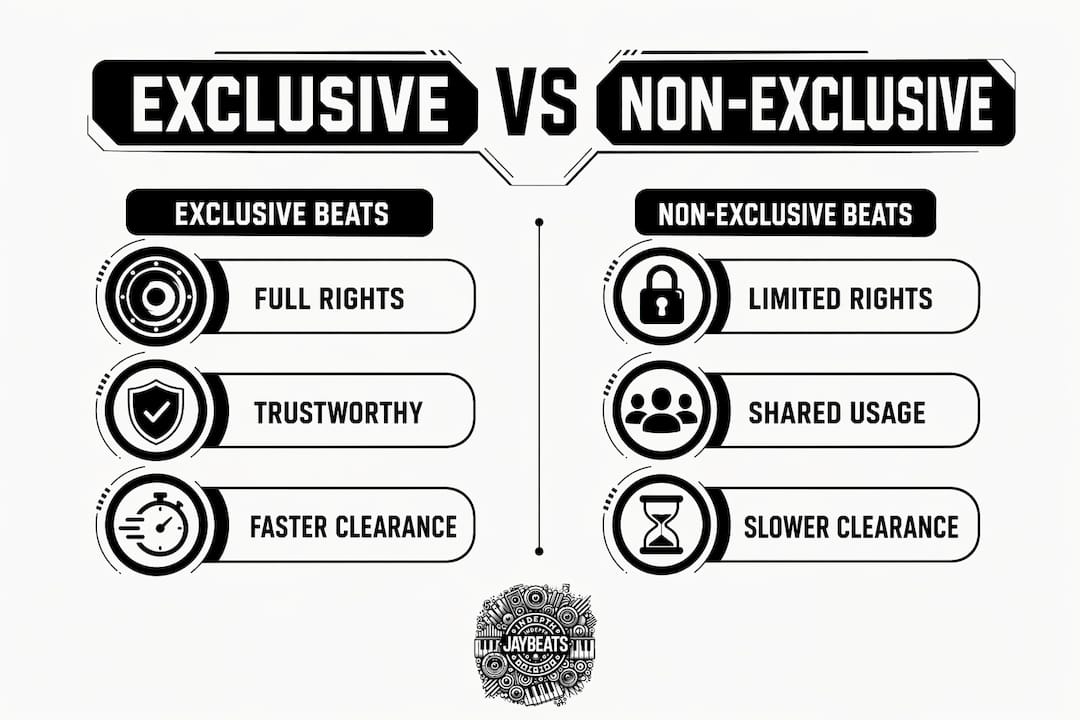
1. Faster clearance under deadline pressure. Independent producers who own full master and publishing rights can clear licenses in hours, not weeks. Music supervisors working on tight post-production schedules choose tracks with the fastest clearance. Exclusive beats from independent producers beat major label catalogs on speed every time. That speed is a competitive weapon.
2. Trust from music supervisors. Sync licensing is relationship-based, and exclusivity signals a businesslike, professional approach. When you show up with a fully cleared, exclusive beat and a clean contract, you communicate that you understand how the industry works. Supervisors remember that. They come back to producers and filmmakers who make their jobs easier.
3. The trailerized version strategy. Creating multiple versions of a beat, including a full mix, instrumental, 60-second edit, and trailer build, maximizes placement potential without requiring new compositions. This tactic lets you pitch the same exclusive composition to TV, film, trailers, and games simultaneously. A non-exclusive beat cannot be packaged this way because you do not control the rights to create derivative versions.
4. Modular stems and clean audio assets. Music supervisors require modular stems and clean audio files for easy mixing against dialogue and scene-length demands. Exclusive beat agreements typically include stem delivery as part of the package. Non-exclusive leases rarely do.
5. Sync-ready packaging from the start. A professional sync-ready beat package includes a full version, instrumental, 60-second edit, and trailer build. When you purchase exclusive rights, you can request this package directly from the producer. That preparation cuts the time between selection and delivery to near zero.
Pro Tip: When you secure an exclusive beat, immediately request the full stem package and all alternate versions. Deliver them to your music supervisor before they ask. That one move puts you ahead of 90% of the competition.
How do exclusive beats compare to non-exclusive beats for licensing?
The difference between exclusive and non-exclusive beats is not just about price. It is about what you can actually do with the music in a professional context.
Feature | Exclusive beats | Non-exclusive beats |
|---|---|---|
Master and publishing rights | Full ownership transferred to buyer | Shared with producer and other licensees |
YouTube Content ID registration | Allowed and recommended | Generally not permitted due to shared ownership |
Sync licensing eligibility | Fully eligible for film, TV, and streaming | Restricted; often disqualified from professional sync |
Usage caps | None | Stream and distribution limits apply |
Stem and alternate version access | Typically included or negotiable | Rarely available |
Pricing range | Hundreds to tens of thousands of dollars | Low cost, often $20 to $200 |
Placement competition | Zero competing claims | Same beat may appear in multiple projects |
Exclusive beats command higher pricing that reflects their cleared rights and market value. That price range, from hundreds to tens of thousands of dollars, reflects what you are actually buying: a clean chain of title, zero competing claims, and full creative control. For a flagship film project, that investment is not optional. It is the cost of doing business professionally.
The smart strategy is to use non-exclusive licenses to test tracks and build your sound library, then commit to exclusives for the projects that matter most. Artists should reserve exclusives for flagship projects to secure brand identity and sync deals. That approach balances budget with strategic positioning.
Understanding online beat licensing in full gives you the framework to make that call confidently on every project.
Key takeaways
Exclusive beats are the only licensing option that satisfies the legal, creative, and professional requirements of film sync placement in 2026.
Point | Details |
|---|---|
Full rights ownership | Exclusive beats transfer master and publishing rights, enabling complete sync clearance. |
Content ID eligibility | Only exclusive licenses allow YouTube Content ID registration to protect and monetize music. |
Faster clearance wins deals | Independent producers with exclusive rights clear licenses in hours, beating major label timelines. |
Creative uniqueness matters | Exclusive beats prevent sonic overlap, giving your film a distinct identity no other project can copy. |
Sync-ready packaging | Exclusive agreements include stems and alternate versions that supervisors require for professional delivery. |
Why I tell every filmmaker to stop sleeping on exclusive rights
I have been producing beats since 2004. I have watched artists and filmmakers make the same mistake repeatedly. They find a beat they love, grab the cheapest lease available, build their project around it, and then hit a wall the moment a distributor or supervisor asks for a clean chain of title. The deal falls apart. The timeline collapses. The opportunity disappears.
Here is what most articles will not tell you. The independent producer actually has an advantage over the major label in sync licensing, but only if they operate with exclusive rights. Supervisors under deadline pressure do not want to chase down three co-owners for clearance. They want one person with full authority to say yes. When you show up with an exclusive beat and a clean contract, you are that person. You become the easiest yes in the room.
I have seen tracks from clients placed in productions like WWE 2K25 and Love And Hip Hop Atlanta. Those placements did not happen because the music was merely good. They happened because the rights were clean, the assets were ready, and the producer could move fast. Exclusivity made all of that possible.
The overlooked advantage for independent creators is that you can build a real career on a catalog of exclusive beats without a label, a manager, or a major budget. You just need to be strategic about which projects get exclusive investment and which ones get tested with non-exclusives first. Commit to that discipline and the doors open faster than you expect.
— IndepthJayBeats
Get exclusive beats built for film and media placements
Indepthjaybeats offers a catalog of exclusive trap and boom bap beats built specifically for sync licensing, film placements, and media productions. Every beat is produced with professional quality, and the catalog includes options with full stem packages and alternate versions ready for supervisor delivery. Clients have placed music in WWE 2K25 and Love And Hip Hop Atlanta using beats from this catalog. If you are ready to stop testing and start placing, browse the exclusive beat catalog and secure the rights your project actually needs. You can also explore hard-hitting trap options built for high-energy film and media scenes. Grab the free beat pack first to hear the sound before you commit.
FAQ
What makes exclusive beats necessary for film sync licensing?
Exclusive beats transfer full master and publishing rights to the buyer, which is the legal requirement for sync clearance on film, TV, and streaming platforms. Without exclusive rights, shared ownership creates competing claims that disqualify a track from professional placement.
Can non-exclusive beats be used in film projects?
Non-exclusive beats carry usage restrictions, stream caps, and shared ownership that prevent full sync clearance. Most professional music supervisors and distributors require exclusive rights before accepting a track for film or television use.
How do exclusive beats affect YouTube Content ID?
Exclusive licenses allow registration with YouTube Content ID, which claims ad revenue and blocks unauthorized uploads. Non-exclusive beats cannot be registered because multiple licensees create conflicting ownership claims.
Why do music supervisors prefer exclusive beats?
Sync licensing is relationship-driven, and supervisors prioritize producers and filmmakers who deliver clean, clearable assets quickly. Exclusive beats signal professionalism and eliminate the multi-party clearance delays that kill deals under deadline pressure.
How should filmmakers decide between exclusive and non-exclusive beats?
Use non-exclusive licenses to test tracks and build your sound library on a budget. Reserve exclusive rights for flagship projects where sync placement, brand identity, and professional distribution are the goal. That split approach protects your budget while keeping your best projects fully cleared.