Independent artists buy beats to access professional-quality instrumentals immediately, without the cost or delay of custom production. The practice has become the backbone of modern independent music careers, with platforms like BeatStars, Airbit, and BeatPass giving artists instant access to thousands of genre-specific tracks. Understanding why musicians buy instrumentals goes beyond convenience. It comes down to licensing control, creative speed, and building a professional presence that gets you taken seriously. This guide breaks down every major reason, from licensing tiers to workflow strategy, so you can make smarter decisions with your music budget.
Why independent artists buy beats: the core reasons
Buying beats gives you a ready-made foundation to build your art on. Instead of waiting weeks for a custom track or spending studio hours you do not have, you pick a beat that fits your vision and start recording the same day. Buying beats online saves artists time and money by bypassing traditional studio and custom production bottlenecks. That means faster release cycles, more content, and a stronger presence with your audience.
The advantages of buying beats go deeper than speed. When you purchase a licensed instrumental, you get documented proof of use, which matters the moment you start distributing on platforms like DistroKid or TuneCore. You also get to focus entirely on your delivery, your lyrics, and your brand, rather than splitting your energy between rapping and producing. For most independent artists, that division of labor is the difference between releasing music consistently and getting stuck.
Beat purchases also remove the financial risk of custom production. A custom beat from an established producer can run hundreds of dollars before you even know if the concept works. Buying a lease lets you test a sound for a fraction of that cost, then upgrade your rights once the song proves itself.
What are the main licensing options for beats?
In 2026, artists work with three primary licensing tiers: MP3 leases for quick content testing, WAV leases for commercial distribution, and exclusive licenses for full ownership. Each tier serves a different stage of your career and a different level of commercial ambition.
Here is how the tiers compare:
License type | Best use case | Typical cost | Key limitation |
|---|---|---|---|
MP3 lease | Social content, demos, testing | $20–$50 | Lower audio quality, limited streams |
WAV lease | Commercial releases, streaming | $50–$100 | Beat shared with other artists |
Exclusive license | Career-defining singles, sync | $300–$5,000+ | Higher investment required |
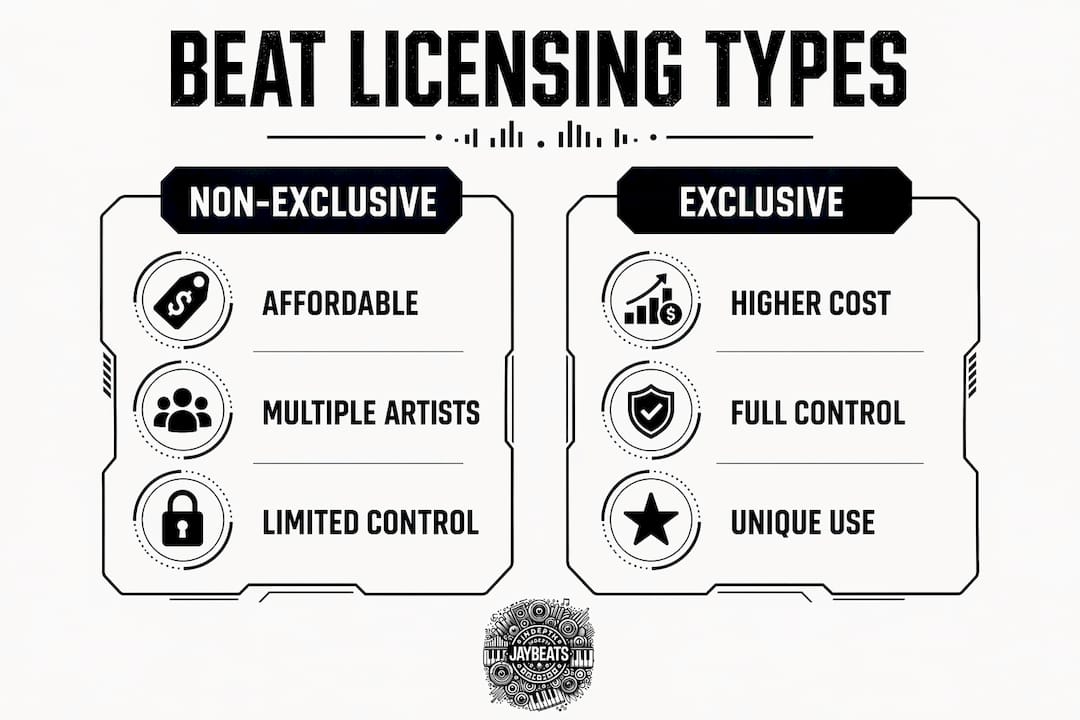
Non-exclusive licenses let multiple artists use the same beat, offering lower costs, while exclusive licenses ensure uniqueness at a higher price. Artists often choose exclusivity for long-term career-building tracks, which makes sense. If a song is going to represent you for years, you do not want another rapper releasing the same instrumental six months later.
Exclusive licenses cost $300 to $5,000+ and allow full control, while non-exclusive leases suit early-stage releases with lower risk. Most platforms allow upgrading from a non-exclusive to an exclusive license as a song gains traction. That upgrade path is one of the smartest tools available to independent artists. Start with a lease, build momentum, then lock it down when the song proves it has legs.
Pro Tip: Always read the lease terms before you buy. Some MP3 leases cap you at 5,000 streams or 1,000 downloads. If your song blows up and you are still on a capped lease, you could face a licensing violation without even knowing it.
Understanding your licensing options and terms before you purchase protects your music and your income from day one.
How have online beat stores changed the game?
Online beat stores disrupted traditional studio networking, enabling artists to browse genre-specific beats anytime and scale production without custom fees. Before platforms like BeatStars, Airbit, and Traktrain existed, getting a quality beat meant knowing the right people or paying for studio time you could not always afford. The internet changed that completely.
Here is what the digital beat marketplace now gives you that the old model never could:
Genre-specific catalogs. You can search trap, boom bap, R&B, drill, or lo-fi and find hundreds of options within minutes. No more settling for whatever your local producer had available.
Type beat discovery. Searching “J. Cole type beat” or “Travis Scott type beat” on YouTube or BeatStars connects you with producers whose sound already matches your reference point. This shortcut alone saves hours of back-and-forth communication.
Instant previews and downloads. You hear the beat, buy the license, and download the file in one session. The entire process that used to take days now takes twenty minutes.
Global producer access. You are no longer limited to your city. Producers from Atlanta, London, Lagos, and Tokyo are all competing for your attention, which drives quality up and prices down.
Social proof built in. Platforms show play counts, purchase history, and producer ratings. You can see which beats are connecting before you commit.
The digital marketplace has also transformed producers into independent entrepreneurs, offering mixing, sample packs, and mentorship alongside beats. That shift means buying a beat today can open a door to a long-term creative partnership, not just a one-time transaction. The best producers are building brands, and aligning yourself with the right one can add credibility to your own.
Pro Tip: Follow producers on social media before you buy. Producers who post consistently, engage with artists, and share their process are usually the ones who take licensing seriously and deliver clean files on time.
What are the strategic advantages of mixing subscriptions and individual purchases?
Efficient independent artists blend subscriptions for 80% of routine needs and buy exclusive singles for the 20% of targeted tracks that require full control. This hybrid approach is one of the most practical frameworks in modern independent music production. It keeps your costs predictable while protecting your most important work.
Here is what the numbers look like in practice:
Approach
Monthly cost
Beats accessed
Best for
Subscription only
$15–$20
Unlimited library access
High-volume content creators
Per-beat purchases only
Varies
Selected tracks
Artists releasing infrequently
Hybrid model
$15–$20 + selective buys
Library + exclusives
Most independent artists
Subscription-based models lower costs to pennies per beat, with monthly fees typically running $15 to $20 for library access. That math works in your favor when you are recording frequently. Instead of paying $50 per lease every time you want to test a new concept, you pull from a subscription library and save your budget for the tracks that matter most.
Subscription models also remove repetitive checkout friction, standardize licensing, and provide clear proof of use. Platforms like BeatPass issue verifiable BeatPassID certificates with each licensed beat. That documentation is not just paperwork. It is your protection if a distributor or sync licensing company ever questions your rights to the instrumental.
The hybrid model also keeps your creative momentum alive. When you have a subscription, you never have to pause a recording session because you cannot afford a beat that day. You stay in the zone, keep producing, and make the exclusive investment when the song is ready for it.
Pro Tip: Treat your subscription library as a testing ground. Record rough versions of multiple concepts, then identify which one has the most energy before spending on an exclusive license. You save money and make better decisions.How does buying beats build your brand and career?
Buying beats supports your branding, professionalism, and creative momentum in ways that go beyond the music itself. High-quality instrumentals signal to listeners, playlist curators, and industry contacts that you take your craft seriously. A poorly produced beat can undermine even the best lyrics. The production is the first thing people hear.
Here is how purchasing beats directly impacts your career trajectory:
Consistent output. When you are not waiting on a producer to finish a custom track, you release more music. More releases mean more data, more streams, and more opportunities for your audience to grow.
Monetization rights. A properly licensed beat gives you the legal foundation to collect streaming revenue, pitch to sync placements, and license your own music to TV and film. Without that documentation, you are building on sand.
Producer relationships. Buying from the same producer repeatedly builds trust. That trust can turn into exclusive deals, discounts, and collaborative opportunities that you cannot get as a one-time buyer.
Avoiding production debt. Commissioning custom beats on credit or payment plans creates financial pressure that affects your creativity. Buying affordable leases keeps you debt-free and focused.
Learning the market. Every beat you purchase teaches you something about what sounds work for your voice, your audience, and your genre. That education compounds over time.
Buying beats online gives you ready access to thousands of professional-quality instrumentals that aid creativity and timely releases. Speed matters in music right now. The artists who release consistently are the ones building real audiences, and buying beats is the most direct way to keep that pace without burning out.
Understanding why artists need original beats to build real careers comes down to ownership and identity. The beats you choose define your sound. Choose them with intention.
Key takeaways
Independent artists who buy beats with a clear licensing strategy produce more music, protect their income, and build stronger careers than those who treat beat purchases as an afterthought.
Point | Details |
|---|---|
Licensing tiers matter | MP3, WAV, and exclusive licenses each serve a different career stage and commercial goal. |
Hybrid model wins | Combining a $15–$20 subscription with selective exclusive buys optimizes cost and creative control. |
Digital stores changed access | Platforms like BeatStars and Airbit removed geographic and financial barriers to professional beats. |
Documentation protects you | Proof-of-license certificates from platforms like BeatPass are required for distribution and sync deals. |
Beat quality shapes your brand | The instrumental is the first impression. Investing in quality production signals professionalism to every listener. |
What I have learned after 20 years of watching artists buy beats
I have been producing since 2004. I have watched artists make every mistake in the book with beat purchases, and I have watched others use the same tools to land placements on WWE 2K25 and Love And Hip Hop Atlanta. The difference is almost never talent. It is strategy.
The biggest mistake I see is artists treating every beat purchase like a throwaway. They buy the cheapest MP3 lease, record a song, push it out, and wonder why nothing sticks. The beat is your foundation. If you build on a cracked foundation, the whole structure is unstable. You do not need to spend $1,000 on every track, but you do need to be intentional about what you are buying and why.
The second mistake is ignoring the upgrade path. I have seen artists blow up on a non-exclusive lease and then scramble to buy the exclusive rights after the fact, sometimes at a much higher price because the producer knows the song is already performing. Buy smart from the start. If you believe in a record, secure the rights before it takes off.
The third thing I want you to understand is that the rap technology shift toward digital-first production is permanent. The artists who adapt and build a real beat-buying strategy will outpace those who are still waiting for the perfect custom deal that never comes. Use the tools available to you. Test fast, commit when it counts, and always keep your paperwork clean.
— IndepthJayBeats
Find your sound at IndepthJayBeats
If you are ready to stop searching and start recording, IndepthJayBeats has the catalog to match your vision. With over 20 years of production experience and placements in major TV and film projects, every beat in the catalog is built to perform at a professional level.
Browse the full boom bap and trap beat catalog to find instrumentals that fit your style, your voice, and your goals. Whether you need hard 808 trap beats for rappers or classic boom bap for a more lyrical approach, the options are ready to license today. Flexible licensing tiers mean you can start with a lease and upgrade as your music grows. Grab the free beat pack and hear the quality for yourself before you commit.
FAQ
Why do independent artists buy beats instead of making their own?
Buying beats saves time and removes the production learning curve, letting artists focus entirely on writing and recording. Most independent artists are not trained producers, and purchasing professional instrumentals delivers a higher-quality result faster than self-production.
What is the difference between a lease and an exclusive license?
A lease is a non-exclusive agreement that lets multiple artists use the same beat at a lower cost, while an exclusive license gives one artist full ownership and removes the beat from public sale. Exclusive licenses typically cost $300 to $5,000 or more depending on the producer.
Are beat subscriptions worth it for independent artists?
Yes, for artists releasing music regularly. Subscription models lower the per-beat cost to pennies and remove checkout friction, making them ideal for high-volume creators who need consistent access to licensed instrumentals.
What are the best places to buy beats online?
BeatStars, Airbit, and Traktrain are among the most widely used platforms for purchasing beats online, offering large genre-specific catalogs with built-in licensing. IndepthJayBeats also offers a curated selection of trap and boom bap beats with flexible licensing options suited for independent artists.
Can you upgrade from a lease to an exclusive license later?
Most platforms allow you to upgrade from non-exclusive to exclusive as a song gains traction, though the price typically increases once the beat has proven commercial value. Upgrading early is almost always the smarter financial move.