Can You Use a Beat With a Sample in It Legally?
Short answer: you can use a beat that contains a sample, but only if every sample in that beat is properly cleared or the material is pre-cleared and royalty-free. If neither of those conditions is met, releasing that track puts you at legal risk, regardless of whether you made the beat yourself or bought it from a producer online.
Here’s what that means practically:
The clearance burden follows the song, not just the beat. When you release a track built on a sampled beat, you inherit any uncleared copyright issues, even if the producer is the one who flipped the sample.
Buying a beat license does not automatically clear the samples inside it. The U.S. Copyright Office is explicit: a beat store transaction transfers a use right to the instrumental, not ownership of third-party copyrights embedded in it.
Platforms like YouTube and streaming services use Content ID-style detection that can flag your track, seize your revenue, or pull it down before you even notice.
Indepthjaybeats operates with a clear policy: beats sold here do not contain uncleared third-party samples, and documentation is provided when cleared material is used.
This guide breaks down the law, the risks, and the exact steps to protect yourself.
Table of Contents
What does “sampling” actually mean under U.S. copyright law?
What happens if you release a track with an uncleared sample?
Does buying a beat license automatically clear the samples inside it?
What are the safer alternatives to clearing a protected sample?
What should you confirm with a producer before buying a sampled beat?
What if you already released a track with an uncleared sample?
How Indepthjaybeats handles samples and what that means for you
What does “sampling” actually mean under U.S. copyright law?
A sample, in practical terms, is any snippet of a pre-existing sound recording used in a new track. That includes a drum loop, a vocal chop, a bass riff, or even a two-second melodic phrase. Under U.S. copyright law, that act of reuse touches two separate copyrights, and that distinction is what trips most producers up.
The two copyrights you need to understand:
Master use license — covers the actual sound recording, the specific audio file that was recorded. The owner is usually the record label or whoever funded the original session. You need this when you use the original audio.
Composition license (mechanical or sync) — covers the underlying song: the melody, lyrics, and chord structure. The owner is typically the songwriter or their music publisher. You need this regardless of whether you use the original recording or re-record it yourself.
So when you sample a recognizable drum break from a 1970s soul record, you normally need both. When you replay that same break yourself in the studio, you skip the master use license but still owe the composition clearance.
A few situations where clearance requirements shift:
Public domain works: compositions published before 1928 in the U.S. are generally in the public domain for the composition, though the specific recording may still be protected. Always verify the recording date separately.
Interpolation: you re-record the musical element yourself. No master use license needed, but composition clearance still applies.
Original sound design: you build a sound from scratch that resembles nothing specific. No clearance required at all.
The two-license requirement is where most independent artists get caught. They clear one and assume they’re good. They’re not.
What happens if you release a track with an uncleared sample?
The consequences are real and they move fast. Platforms don’t wait for a lawsuit to act.
Short-term platform outcomes:
Content ID or a distributor’s automated system flags your track within days of release.
The rights holder can claim your streaming revenue immediately, redirecting it to their account.
Your track can be muted, blocked in certain territories, or removed entirely.
What rights holders can demand:
100% of past and future streaming royalties from that track.
Removal from all platforms and sync placements.
A retroactive license fee, often at a rate you didn’t negotiate.
Statutory damages in a lawsuit, which under U.S. copyright law can reach significant amounts for willful infringement.
The circuit split problem: courts don’t all agree on the same standard. The Bridgeport v. Dimension Films ruling established a strict “get a license” rule for sound recordings in the Sixth Circuit, while other circuits have applied a de minimis analysis. That regional legal uncertainty means you can’t predict how a court would rule based on geography alone.
For independent artists: the most common outcome isn’t a lawsuit. It’s a Content ID claim that quietly drains your royalties while your track stays up. You might not even notice until you check your distributor dashboard.
The cost comparison is stark. Clearing a sample from an obscure record might cost a few hundred dollars. Clearing a well-known hook can run into the tens of thousands. A copyright infringement settlement or judgment can cost far more than either.
Does buying a beat license automatically clear the samples inside it?
No. This is one of the most common and costly misunderstandings in the independent music world.
When you buy a beat license from a producer, you’re purchasing the right to use that instrumental in your song. You are not purchasing clearance for any third-party samples the producer embedded in the beat. The U.S. Copyright Office guidance is clear: the buyer often inherits liability if the producer used uncleared material and didn’t disclose it.
Most standard beat store licenses say nothing about third-party sample clearance. That silence is not protection.
What to look for in a beat license before you buy:
Warranty of rights: the producer explicitly states in writing that all samples in the beat are cleared or that no third-party samples were used.
Indemnification clause: if the producer’s warranty turns out to be false, they agree to cover your legal costs and damages. An indemnity clause shifts financial risk back to the seller.
Scope of rights: the license specifies streaming, commercial sales, sync/TV/film, and any other use you plan.
Exclusivity: exclusive vs. non-exclusive, and what that means for your release.
Delivery items: stems and a split sheet so you can register the song properly with your PRO.
Territory and term: does the license cover worldwide use, and for how long?
Red-flag language to avoid:
“Producer is not responsible for third-party samples” with no warranty offered.
Vague phrases like “used in accordance with applicable law” that shift all responsibility to you.
No mention of samples at all in a beat that clearly contains recognizable loops.
Before you buy or release, ask in writing: “Does this beat contain any third-party samples? If so, are they cleared? Can you provide documentation?” If the producer can’t answer that clearly, walk away. The risk transfers to you the moment you release.
How do you clear a sample step by step?
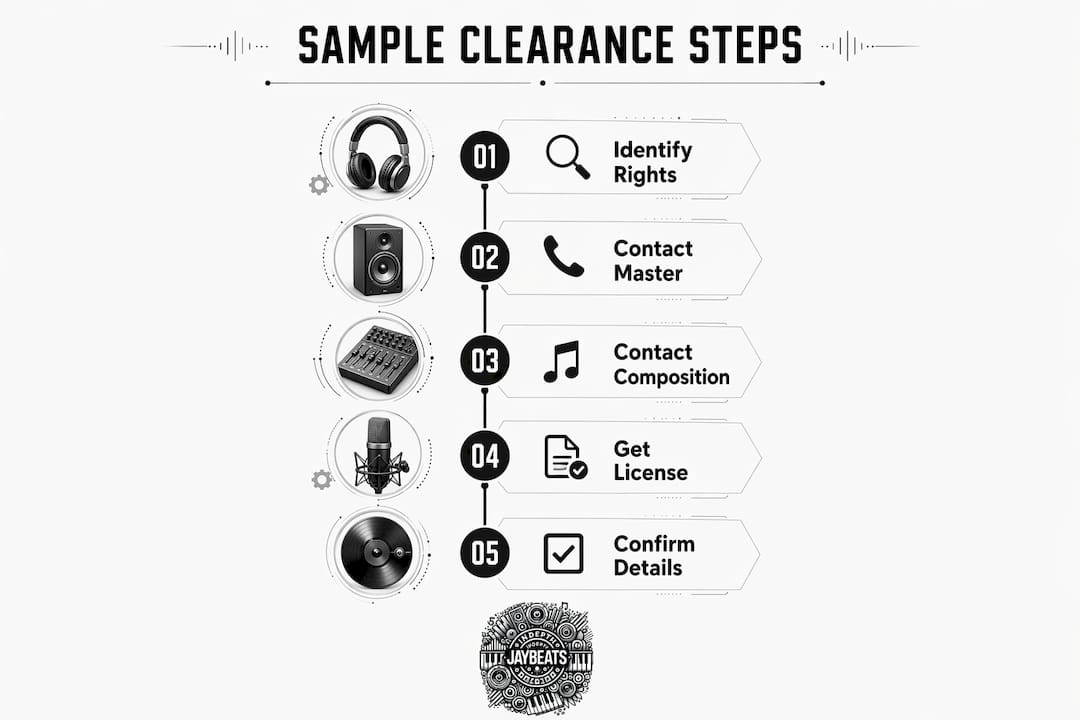
Clearance isn’t quick, but it’s a process you can follow. Here’s how it works in the U.S.
Step 1: Identify both rights holders
Find the label that owns the master recording and the publisher that controls the composition. Start with performing rights organizations like BMI and ASCAP, which maintain searchable databases. The FindLaw guidance on sampling recommends calling the song indexing department directly if the online search doesn’t surface the right contact.
Step 2: Contact the master rights holder
Reach out to the label’s licensing department. Include a preview of your track, the exact sample duration, the context in which it appears, and your release plan (streaming, physical, sync). Be specific. Vague requests get ignored or denied.
Step 3: Contact the composition rights holder
Reach out to the publisher or songwriter’s representative. If the composition is registered with a PRO, that’s your starting point. Negotiate a mechanical license for streaming/downloads or a sync license if you’re pitching for TV or film. Compulsory mechanical licenses exist for cover songs but do not apply to samples, so negotiation is required.
Step 4: Get everything in writing
No verbal agreement counts. Get a signed license document that specifies the rights granted, the fee structure, and the term.
Timeline and cost reality:
These timelines and costs vary widely depending on the sample’s popularity and rights holder demands, generally increasing with the recognition and leverage of the original work.
These ranges reflect the clearance realities producers and artists face: timeline and cost scale directly with how recognizable the sample is and how much leverage the rights holder has.
Pro Tip: If the sample you want is from a well-known record and the label has a no-sampling policy, interpolation is your fastest exit. Re-record the element yourself, clear only the composition, and you’ve cut both the cost and the wait time significantly.
What are the safer alternatives to clearing a protected sample?
Sometimes the clearance path is too expensive, too slow, or just denied. Here’s where to go instead.
Pre-cleared and royalty-free libraries: services that license music for reuse with the rights already sorted. Industry practice treats these as the professional standard for independent releases distributing through streaming and social platforms. The trade-off is that the material is non-exclusive, so other producers can use the same sounds.
Interpolation / replay services: hire a session musician or replay the element yourself. You eliminate the master use license requirement entirely, leaving only the composition clearance. This is often faster and cheaper than clearing the original recording.
Original sound design: build your own sounds from scratch using synthesis, foley, or live recording. Nothing to clear, nothing to worry about. This is the cleanest path for producers who want full ownership of their catalog.
Hire a clearance service or music attorney: worth it when the sample is central to the track’s identity and the release has real commercial stakes (a major label pitch, a sync deal, a high-profile campaign). For a bedroom project with modest distribution, a clearance agent’s fee may outweigh the benefit. For a sync placement that could generate thousands, it’s the smart move.
If you want beats that are built for sync and TV/film without the clearance headache, starting with original production is the most direct route.
What should you confirm with a producer before buying a sampled beat?
Before you spend money or release anything, get these answers in writing.
Confirm in writing:
The producer warrants that all samples in the beat are cleared, or that no third-party samples were used at all.
An indemnity clause is included: if the warranty is false, the producer covers your legal exposure.
You receive stems and a split sheet so you can properly register the song and split royalties.
The license explicitly grants the right to distribute, monetize, and seek sync licenses.
The territory is worldwide and the term covers your release window.
Walk away if you see these red flags:
The producer can’t tell you whether the beat contains samples.
No written documentation is available, just a verbal “it’s all good.”
The license says you’re responsible for clearing any samples yourself, with no warranty from the seller.
Evasive answers like “we’ll figure it out after release.”
Email template to copy and send:
That message takes 30 seconds to send. It can save you months of legal headaches. Understanding what you actually own when you lease a beat is just as important as the clearance question.
What if you already released a track with an uncleared sample?
Don’t panic, but move fast. Here’s the playbook.
Check your distributor dashboard immediately. Look for any holds, claims, or takedown notices. Preserve screenshots of your earnings reports and any communications you’ve received.
Identify the claim source. Is it a Content ID claim (revenue redirect) or a formal DMCA takedown (removal)? The response differs. A Content ID claim is often negotiable; a DMCA takedown requires a counter-notice or direct resolution with the rights holder.
Contact the rights holder directly. Reach out to the publisher and label with your track, your release data, and a proposal. You’re looking for either a retroactive license, a publishing split agreement, or a settlement. Come prepared with numbers: streams, downloads, revenue earned.
Loop in your distributor. They need to know you’re actively resolving the issue. Some distributors will hold your earnings during a dispute; knowing this early lets you plan.
Decide: retro-clearance or removal. If the rights holder is open to a deal and the track has real commercial value, pursue retro-clearance. If they’re not negotiating or the fees are prohibitive, taking the track down voluntarily is cleaner than waiting for a forced removal or a lawsuit.
A music attorney or clearance agent is worth the consultation fee at this stage. The FindLaw overview on sampling permissions recommends contacting an intellectual property attorney when facing potential infringement claims.
Common myths producers use to justify sampling
These justifications are everywhere in producer forums. They’re also wrong.
Myth: “It’s only a two-second sample, so it’s fine.” Fact: there is no safe minimum duration under U.S. copyright law. Bridgeport v. Dimension Films established that even a very short snippet requires clearance for sound recordings. Assume any recognizable snippet needs permission.
Myth: “I pitched it down and chopped it, so it’s unrecognizable.” Fact: courts and Content ID systems look at the source material, not just how it sounds after processing. If the original recording was used, the copyright applies.
Myth: “I credited the original artist, so I’m covered.” Fact: credit is not a license. Crediting someone does not grant you the right to use their copyrighted work.
Myth: “I’m releasing it for free, so there’s no infringement.” Fact: copyright infringement does not require commercial intent. Free releases are still subject to takedowns and claims.
Myth: “Fair use protects me.” Fact: fair use is a legal defense you argue in court after you’ve been sued, not a permission you hold before release. Courts rarely apply it to music sampling used for its musical quality rather than commentary or parody. Relying on fair use before you release is a gamble, not a strategy.
The circuit split between Bridgeport and later cases like VMG Salsoul v. Ciccone means your regional court could rule differently, but that uncertainty doesn’t protect you. It just makes the outcome unpredictable.
How Indepthjaybeats handles samples and what that means for you
The policy here is straightforward: beats sold through Indepthjaybeats do not contain uncleared third-party samples. When a beat uses cleared material, documentation comes with it. That’s not a marketing line; it’s how the catalog is built.
What artists get when they buy from Indepthjaybeats:
A written warranty that the beat is free of uncleared third-party samples.
Indemnity language in applicable licenses, so if a claim ever arises from the producer’s side, you’re not left holding the bag alone.
Stems and split sheets delivered with exclusive licenses, so you can register properly with your PRO and document your chain of title.
Support navigating sync opportunities, including guidance on what documentation sync supervisors and music supervisors actually ask for.
Exclusive and non-exclusive options, so you can choose the level of protection that fits your release.
Real talk: I’ve been producing since 2004. I’ve watched artists lose revenue, lose placements, and lose momentum because a producer sold them a beat with a flip they didn’t disclose. That’s not how this works here. When you buy a beat from this catalog, you know exactly what you’re getting and what you can do with it.
For artists building toward TV and film placements, clean chain of title isn’t optional. Sync supervisors will ask for it, and if you can’t produce it, the placement disappears.
Key Takeaways
Using a beat with a sample in it is legal only when every sample is properly cleared or pre-cleared, and buying a beat license alone does not transfer that clearance to you.
Point | Details |
|---|---|
Clearance is always required | Any recognizable sample needs both a master use license and a composition license before release. |
Beat licenses don’t clear samples | A standard beat store purchase does not cover third-party samples; demand a written warranty before you buy. |
Content ID acts fast | Platforms can claim your revenue or remove your track within days of release if a sample is flagged. |
Alternatives exist | Interpolation, royalty-free libraries, and original sound design all reduce or eliminate clearance obligations. |
Indepthjaybeats delivers clean beats | Beats from Indepthjaybeats come with written warranties, stems, and split sheets so your release is protected from day one. |
Why I won’t sell beats with uncleared samples
Here’s the honest producer take: selling a beat with an uncleared sample in it is passing your problem to someone else. The artist pays for the beat, records their verse, puts real time and money into the release, and then gets hit with a Content ID claim or a takedown they didn’t see coming. That’s not a business model. That’s a trap.
I’ve seen it happen. An artist came to me after a distributor froze their earnings on a track that had been doing well. The producer who sold them the beat had flipped a well-known soul record without clearing it. The label found it within weeks. The artist lost the revenue, lost the placement opportunity they’d been building toward, and had to start over. The producer was nowhere to be found.
The fix isn’t complicated: build original, clear what you use, document everything. Producers who want to build long-term relationships with artists don’t cut corners on this. If you’re buying beats, use the checklist in this article, send that email template, and don’t release until you have answers in writing.
Beats you can legally release, pitch for TV, and build on
If you’ve read this far, you already know the move: start with beats that are clean from the jump. Indepthjaybeats offers exclusive and non-exclusive hip-hop, trap, boom bap, and Detroit-style instrumentals built for artists who are serious about their releases and their careers.

Every beat comes with licensing documentation. Exclusive licenses include stems and split sheets. Custom production is available for artists who need something built specifically for a sync pitch or a major project. And if you’re not sure where to start, grab the free beat pack to hear the sound before you commit.
Browse the full catalog and buy hip-hop beats that are release-ready, sync-eligible, and backed by documentation that protects you. For trap-specific sounds, the trap beats catalog has hard 808 instrumentals ready to license today.
Useful sources and further reading
These are the primary U.S.-focused resources to bookmark for sample clearance and copyright guidance:
U.S. Copyright Office: Sampling, Interpolations, Beat Stores and More — the official federal guidance on how sampling works under U.S. law, what beat store licenses do and don’t cover, and why clearance is the artist’s responsibility. Start here.
FindLaw: Obtaining Permission Before Sampling Music — practical breakdown of the clearance process, how to locate publishers and labels, and when to bring in an IP attorney.
Art & Media Law: How to Clear a Music Sample — detailed guide on the two-license requirement, negotiation strategies, and what to include in clearance requests.
Ditto Music: How to Clear a Sample — covers timeline expectations, cost structures (flat fee, royalty share, publishing split), and practical steps for independent artists.
WIPO: The Song Remains the Same — international legal perspective on sampling, fair use limits, and why relying on fair use before release is high-risk.
TuneCore: Music Sampling and Beat Licensing 101 — explains indemnity and warranty clauses in beat contracts and why independent artists need them in writing.
This article is general information, not legal advice. For your specific situation, consult a qualified music attorney or IP professional and verify current rules with the U.S. Copyright Office.
Recommended

Get 20+ Free Beats delivered to your inbox
Drop your name and email and I'll send a pack to your inbox right away.
We respect your inbox, no spam. Promise!