You can put a boom bap type beat on Spotify without getting sued if you hold a valid commercial license, clear any recognizable samples, and credit all rights holders correctly. That sentence covers the whole game. Most independent rappers skip one of those three steps and end up with a takedown notice or worse. The good news is that none of this is complicated once you understand what you actually own and what you do not.
Can I put a boom bap type beat on Spotify without getting sued?
The short answer is yes. The longer answer is that your legal safety depends entirely on the type of license you hold and whether the beat contains any uncleared samples. A boom bap type beat is a production style built around heavy kick and snare patterns, often layered with sampled or original melodies. The style itself carries no automatic legal risk. The risk lives in the source material used to build it.
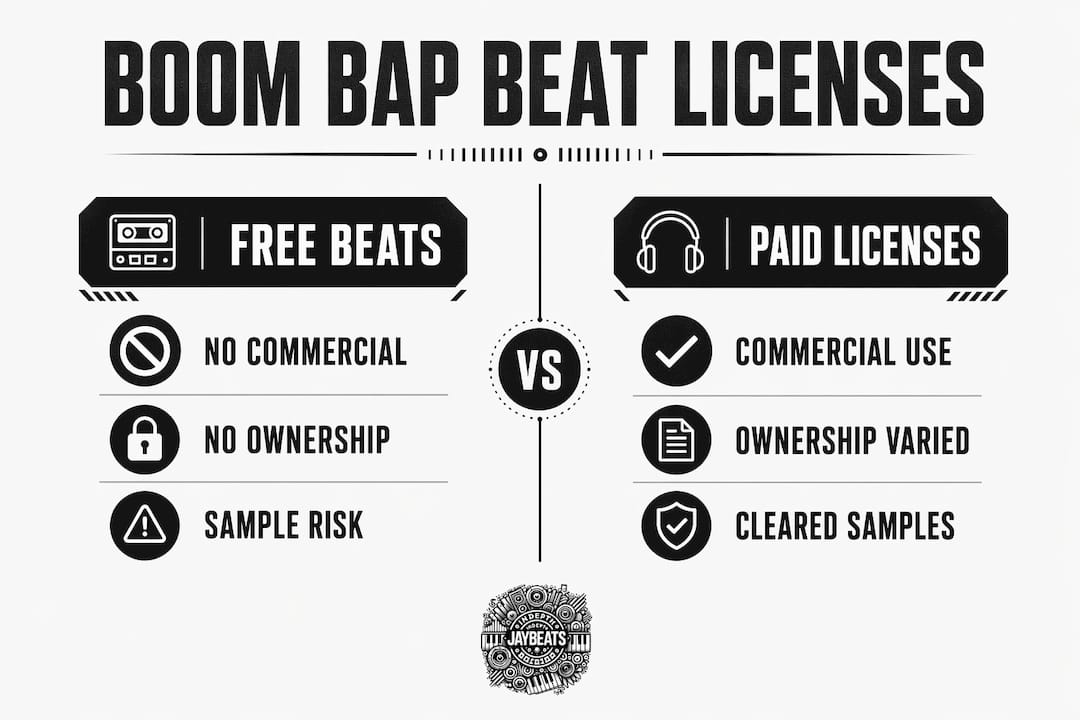
Free beats are restricted to non-commercial use. Using them on Spotify, where streams generate revenue, counts as commercial distribution. That distinction alone causes most copyright problems for independent artists. Paid commercial licenses, whether basic leases, premium leases, or exclusive licenses, grant you the right to distribute on streaming platforms.
What are the types of boom bap beat licenses?
Not all beat licenses work the same way. Understanding the difference between them protects your music and your money.
Free beats carry no commercial rights. They are promotional tools for producers. Uploading a free beat to Spotify is a copyright violation, full stop.
Non-exclusive leases are the most common purchase for independent rappers. You pay a fee, typically ranging from basic to WAV-quality tiers, and receive the right to distribute commercially up to a set stream or download limit. The producer retains ownership of the beat and can sell the same lease to other artists. You can release on Spotify with a non-exclusive lease as long as your license explicitly permits commercial distribution.
Exclusive licenses give you sole rights to the beat. The producer stops selling it to anyone else. These cost more but remove the risk of another artist releasing the same instrumental.
Royalty-free loops and drum samples are a different category entirely. These are pre-cleared audio elements that producers use to build beats. When a producer builds a beat using 100% royalty-free loops and original compositions, the resulting track carries no hidden sample clearance obligations. That is the cleanest path for commercial release.
Here is a quick breakdown of how these license types compare for Spotify release:
License type | Commercial streaming allowed | Beat ownership | Sample risk |
|---|---|---|---|
Free beat | No | Producer | High |
Non-exclusive lease | Yes, with commercial license | Producer | Depends on beat |
Exclusive license | Yes | Shared or transferred | Depends on beat |
Royalty-free beat | Yes | Producer | None if fully cleared |
The beat licensing guide at Indepthjaybeats breaks down each tier in detail if you want to go deeper on what each license actually covers.
How do you make sure your boom bap beat is legally safe?
Sample clearance is the part most artists ignore until it is too late. You must clear recognizable samples of copyrighted works regardless of how short the clip is. A two-second horn stab from a 1970s soul record still requires clearance. Spotify does not check for this at upload, but rights holders and their automated detection systems will.
Here is what you need to verify before you upload:
The beat contains no uncleared samples. Ask the producer directly. If they cannot confirm it, do not use the beat commercially.
Drum sounds alone do not require clearance. Percussive elements like kick and snare patterns generally do not trigger sample clearance requirements. Melodies and distinct audio clips do.
Your license explicitly says “commercial distribution.” Vague language in a license agreement is a red flag. The words “commercial” and “streaming” need to be in there.
You have a written copy of the license. Spotify does not require license documentation at upload, but proof of license may be requested if a dispute arises. Keep every receipt and contract.
Pro Tip: Screenshot or PDF every beat purchase confirmation and store it in a dedicated folder labeled by song title. If a claim hits your track six months later, that documentation is your first line of defense.
Metadata is the other piece that artists overlook. Accurate producer credits listed as songwriter or composer in your distribution platform allow correct publishing royalty allocation. If the producer is not credited, royalties can get misrouted or held up entirely.
Step-by-step guide to uploading your boom bap song legally on Spotify
Follow these steps every time you release a track built on a licensed beat. No shortcuts.
Purchase the right license tier. Basic leases often cap streams at 100,000 or 200,000. If you expect more, buy a premium or WAV lease upfront. Read the terms before you pay.
Confirm sample clearance with the producer. Get it in writing. A quick email reply confirming “all samples are cleared for commercial use” counts as documentation.
Choose a distributor. Platforms like DistroKid and TuneCore handle Spotify distribution for independent artists. Both accept tracks from artists using licensed beats.
Enter accurate metadata. List the producer as a songwriter or composer. List yourself as the performing artist. Match the song title exactly to what appears in your license agreement.
Do not register the beat alone with Content ID. Registering a leased beat alone triggers false claims against other artists using the same instrumental. Only register your finished song recording, not the instrumental by itself.
Store all documentation. License agreements, purchase receipts, and any producer communications go into one folder. Date everything.
Pro Tip: If you are buying a non-exclusive lease, check whether the producer has already registered the beat with Content ID. If they have, your distribution platform may flag your upload. Ask before you buy.
The licensing page at Indepthjaybeats lays out exactly what each license tier covers so you know what you are buying before you commit.
Common copyright pitfalls with boom bap beats and how to avoid them
Most copyright problems with boom bap tracks come from the same handful of mistakes. Knowing them ahead of time keeps your music on the platform.
Using free beats on monetized platforms. Free beats are not licensed for commercial use. Uploading one to Spotify is an infringement, even if the producer gave it away willingly.
Registering a leased beat with Content ID. Only exclusive licenses generally permit Content ID registration. Prior registrations by others create conflicts that can pull your track down.
Ignoring melody samples inside the beat. A producer might build a boom bap beat using a looped piano sample from a classic record. If that sample is not cleared, your release carries the risk, not just the producer’s.
Multiple artists releasing the same non-exclusive beat without proper credits. This creates royalty conflicts when two tracks share the same instrumental but list different composers. Accurate metadata on your end protects your royalties regardless of what other artists do.
No written license agreement. A verbal deal or a DM screenshot is not a license. Without a formal agreement, you have no legal proof of your rights.
“The beat is the foundation. But the license is the deed. You would not build a house on land you do not own.”
Disputes happen even when artists do everything right. The difference between a resolved dispute and a lawsuit is documentation. Keep yours tight.
Key takeaways
Uploading a boom bap beat to Spotify legally requires a valid commercial license, cleared samples, and accurate metadata crediting the producer as a rights holder.
Point | Details |
|---|---|
Commercial license is required | Free beats cannot be used on Spotify; paid commercial leases are the minimum requirement. |
Sample clearance protects you | Melodies and distinct audio clips inside beats must be cleared before commercial release. |
Metadata prevents royalty disputes | Credit the producer as songwriter or composer in your distributor’s metadata fields. |
Content ID registration has rules | Never register a leased beat alone with Content ID; only register your finished song recording. |
Documentation is your defense | Keep all license agreements and purchase receipts in case Spotify or a rights holder disputes your release. |
What I have learned after 20 years of producing beats
I have been making beats since 2007. I have watched artists lose tracks, lose royalties, and lose momentum because they did not understand what they were buying when they licensed a beat. The music was good. The paperwork was not.
Here is the uncomfortable truth: most producers, myself included, retain ownership of the beat composition. When you buy a lease, you are buying permission to use it, not ownership of it. That is not a bad deal. It is just the deal. The problem starts when artists act like they own something they only licensed.
The artists who move smart treat the license agreement like a contract, because it is one. They read it. They ask questions. They keep copies. The artists who get burned treat it like a receipt they can throw away.
Royalty-free drum samples changed the game for independent artists. When a beat is built entirely from original compositions and pre-cleared loops, there is no hidden sample liability waiting to blow up your release six months later. That is why every beat I build at Indepthjaybeats uses 100% royalty-free drum samples and original melodies. I have had clients place music in WWE 2K25 and Love And Hip Hop Atlanta. That level of placement requires clean paperwork from the ground up.
Build your catalog on a clean foundation. The streams will follow.
— Indepthjaybeats
Indepthjaybeats has boom bap beats ready for commercial release
If you want to skip the sample clearance headache entirely, the answer is simple. Every beat in the buy hip hop beats at Indepthjaybeats is built with 100% royalty-free drum samples and original melodies, cleared for commercial DSP streaming from day one.

You get production quality that has landed in major placements, with licensing terms that are clear and straightforward. Indepthjaybeats also offers professional mixing and mastering for independent rappers who want their tracks sounding release-ready before they hit Spotify. Grab a free beat pack to hear the sound first, then build from there.
FAQ
Can I use a free boom bap beat on Spotify?
No. Free beats are licensed for non-commercial use only, and Spotify qualifies as a monetized commercial platform. You need a paid commercial license to distribute legally.
Does buying a non-exclusive lease mean I own the beat?
No. Producers retain ownership of the master composition even after selling a non-exclusive lease. You own the right to use it commercially under the terms of your agreement.
Do boom bap drum sounds require sample clearance?
Generally no. Percussive elements like kick and snare patterns do not trigger clearance requirements on their own. Melodies, vocal chops, and recognizable audio clips within the beat do require clearance.
Can I register my song with Content ID if I used a leased beat?
You can register your finished song recording, but do not register the beat alone. Registering the instrumental triggers false claims against other artists using the same non-exclusive beat.
What happens if I upload a beat with an uncleared sample?
Spotify can remove your track and the rights holder can pursue legal action. Failure to clear samples can lead to takedowns and lawsuits even if you hold a valid beat license, because the sample issue is separate from your licensing agreement with the producer.
Recommended

Get 20+ Free Beats delivered to your inbox
Drop your name and email and I'll send a pack to your inbox right away.
We respect your inbox, no spam. Promise!