Promoting your rap song using ads means running targeted paid campaigns with tested creative, clear conversion goals, and disciplined budgets to expand your reach beyond organic limits. Paid advertising on platforms like Meta Ads, TikTok Spark Ads, Google Ads, and YouTube Ads gives independent artists controlled distribution and real audience data. The key word is controlled. Ads do not create a hit from nothing. They amplify what already works. Before you spend a single dollar, you need proven content, a specific goal, and a plan to measure results.
How to promote your rap song using ads: what you need first
The biggest mistake artists make is launching ads before they have the right creative and a clear goal. Ads amplify what already works. Spending money on content that has not connected organically is an expensive experiment with predictable results.
Your creative asset is the foundation. Pull clips from content that already got strong engagement on Instagram, TikTok, or YouTube. If a 15-second clip of your hook stopped people from scrolling, that is your ad. Effective Meta ad creative uses 15–30 second video clips of the most exciting song parts, with on-video text showing your artist name and song title, plus a clear call to action like “Listen Now on Spotify.”

Your goal must be specific before you build the campaign. Vague goals like “get more exposure” give ad platforms nothing to optimize toward. Pick one conversion target and commit to it.
Creative type | Best use case | Conversion goal |
|---|---|---|
15–30 sec hook clip | New release push | Streams, pre-saves |
5–10 sec teaser clip | Pre-release hype | Pre-saves, email signups |
Lyric video snippet | Catalog promotion | Playlist adds, streams |
Behind-the-scenes clip | Fan connection | Email signups, follows |
Pro Tip: Run teaser campaigns 5–7 days before release using 5–10 second clips with anticipation text. Pre-release campaigns significantly increase first-day stream counts.
Conversion signals like email signups, pre-saves, and merch sales support algorithm optimization better than simple clicks. Clicks tell you someone was curious. Pre-saves tell you someone is committed.
Which ad platforms work best for rap music promotion?
Platform choice depends on where your audience lives and what content style you already produce. Each major platform has a distinct advantage for hip-hop artists.
Meta Ads (Facebook and Instagram) give you the most detailed audience targeting of any platform. You can target by music taste, age, location, behavior, and even fans of specific artists. Manual placement selection on Meta, specifically Instagram Reels, is a top-performing placement for music ads. Reels match the short-form video format that rap content thrives in.
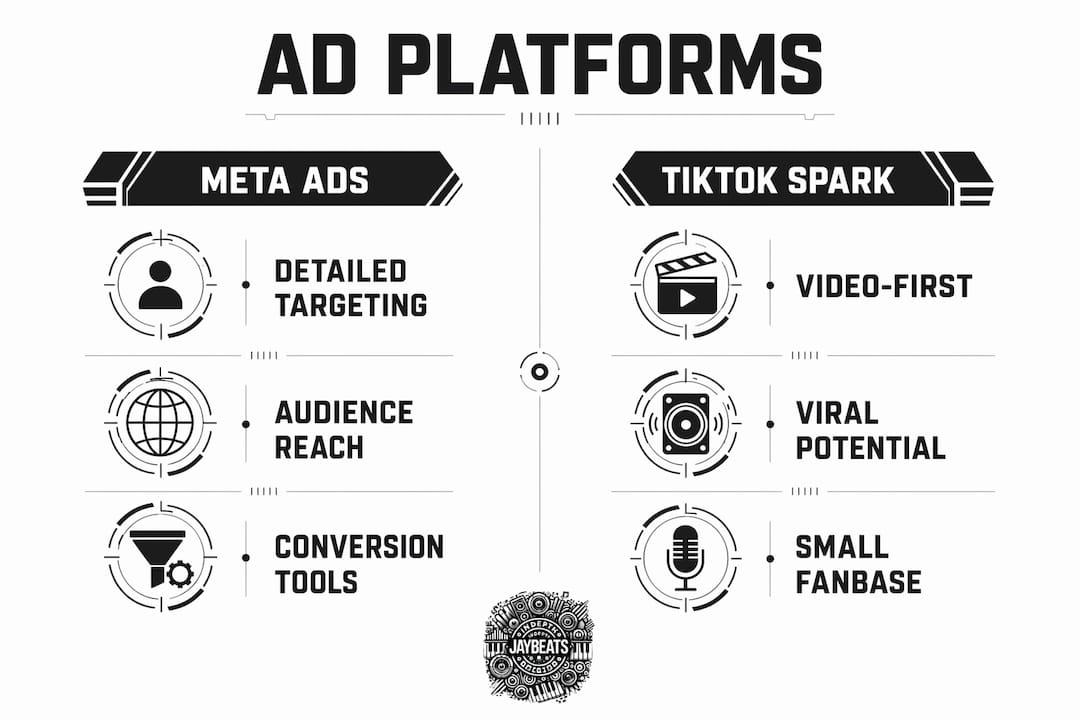
TikTok Spark Ads boost your existing organic posts as ads rather than creating separate ad content. Spark Ads maintain the native look and creator social proof, which matters for music discovery on TikTok. They often deliver better click-through rates and lower cost per acquisition than standard in-feed ads. If your TikTok content already gets views, Spark Ads are the fastest way to scale that reach.
Google Search Ads and YouTube Ads target users who are actively searching for rap music. YouTube Video Discovery Ads appear in search results, related videos, and the homepage, and you only pay when someone watches or clicks. That intent-based targeting is powerful for artists with a specific sound or regional following.
Meta Ads: target by music taste, artist affinity, age, location, and behavior
TikTok Spark Ads: target by interest, hashtag behavior, and lookalike audiences
YouTube Ads: target by search term, channel topic, and viewer history
Google Search Ads: target by keyword phrases like “new rap music 2026” or artist name searches
Pro Tip: If your fanbase is small and your content style is video-first, start with TikTok Spark Ads. If you have an existing email list or website traffic, Meta Ads with custom audiences will outperform cold targeting every time.
For artists building from zero, check out this guide on marketing rap with no fanbase to pair with your paid strategy.
How should you budget and test your rap ad campaigns?
Budget discipline separates artists who learn from ads from those who just burn money. Start small, test multiple creatives, and scale only what proves itself.
Start Meta ad tests at $5–$10 per day for 3–5 days with at least two or three different creatives running simultaneously. This gives the algorithm enough data to optimize without committing serious money to an unproven approach. After 3–5 days, kill the ads that are not converting and put that budget behind the winner.
Scaling comes after proof. Once you identify a creative and audience combination that converts, increase the daily budget gradually. A meaningful test at scale runs $300–$500 total. Spending less than that on a single creative rarely gives you enough data to make confident decisions.
Keep ad spend proportional to your total marketing budget. Ads should amplify organic content, not replace it. Spending 30–50% of your total marketing budget on paid amplification is a reasonable ceiling for most independent artists.
Post content organically and track engagement for 5–7 days
Identify the top-performing clip by saves, shares, or comments
Launch a $5–$10 per day test with 2–3 creative variations
Run for 3–5 days and compare cost per result across creatives
Kill underperformers and scale the winning creative to $20–$30 per day
Reassess every 7 days and refresh creative when performance drops
Pro Tip: Testing different parts of the same song as separate creatives can significantly reduce your cost per conversion. The chorus and the verse often perform very differently with the same audience.
How to build an ad funnel and retarget warm audiences
Sending ad traffic directly to Spotify is one of the most common and costly errors in music advertising. Sending traffic straight to Spotify limits optimization because Spotify cannot track post-click behavior. Meta’s algorithm has no signal to learn from, so it cannot improve your targeting over time.
The right funnel looks like this: ad → tracked landing page → streaming platform. A landing page lets you fire a Meta Pixel event when someone clicks through, giving the algorithm a real conversion signal to optimize toward. Tools like Toneden, Feature.fm, or a simple Linktree with UTM tracking can serve this function.
Attribution is a real challenge. Spotify does not expose conversion events to Meta Pixel, so you need a music-specific attribution solution to connect ad clicks to actual streams. Optimizing on proxy metrics like landing page clicks alone can be misleading. A click does not equal a stream.
Retargeting is where your ad spend becomes efficient. Retarget people who showed intent, such as watching 50% of your clip or engaging with earlier posts. These warm audiences convert at a much higher rate than cold traffic.
Audience type | Definition | Expected outcome |
|---|---|---|
Cold audience | No prior contact with your content | Lower conversion, higher volume |
Warm audience (50% video viewers) | Watched at least half your ad clip | Higher conversion, lower volume |
Hot audience (75%+ video viewers) | High-intent viewers and profile engagers | Highest conversion, smallest pool |
Pro Tip: Build multiple custom audiences at different engagement thresholds: 25%, 50%, and 75% video views. Run separate retargeting ads to each group with increasingly direct calls to action. The 75% group gets “Stream it now.” The 25% group gets another taste of the song.
Common mistakes when advertising your rap songs
Most failed music ad campaigns share the same handful of errors. Recognizing them before you spend saves real money.
Boosting untested content: Putting money behind a post that flopped organically will not fix the creative. Test first, spend second.
Broad audience targeting: Targeting “people who like music” is too wide to be useful. Narrow your audience to fans of specific artists in your lane or users with demonstrated hip-hop listening behavior.
Skipping the landing page: Sending traffic directly to Spotify removes your ability to track conversions and teach the algorithm what a good result looks like.
Optimizing for clicks instead of conversions: Clicks are cheap and often meaningless. Set your campaign objective to conversions or video views, not traffic.
Ignoring ad format fit: An ad that looks like an ad performs worse on TikTok and Instagram Reels. Your creative should look native to the platform. No hard cuts to a logo. No corporate-style text overlays.
Testing only one creative: One creative gives you one data point. Run at least two or three variations to learn what your audience actually responds to.
Letting bad ads run too long: If an ad is not converting after 3–5 days at $5–$10 per day, cut it. Waiting for it to “warm up” is wishful thinking.
For a broader look at promoting rap on TikTok without burning your credibility, that guide pairs well with what you are building here.
Key Takeaways
Running paid ads for your rap song works when you combine tested creative, platform-specific targeting, a proper conversion funnel, and disciplined budget testing before scaling.
Point | Details |
|---|---|
Test before you spend | Only run ads on content that already performed well organically. |
Match platform to content style | Use TikTok Spark Ads for video-first content; use Meta Ads for detailed audience targeting. |
Build a funnel, not a direct link | Route ad traffic through a landing page before Spotify to enable conversion tracking. |
Retarget warm audiences | Focus retargeting on viewers who watched 50–75% of your clip for the best conversion rates. |
Kill underperformers fast | Cut ads that do not convert after 3–5 days and scale only proven creatives. |
What I have learned about ads and rap music promotion
Paid traffic is not a shortcut. I have watched artists spend $500 on ads for a song that was not ready and walk away thinking ads do not work for rap. The ads worked fine. The song was not ready.
The artists who get real results treat paid campaigns the way a label would. They test the creative organically first. They build the funnel before they spend. They retarget the people who already showed interest instead of chasing cold strangers. That discipline is not glamorous, but it is what separates a $50 lesson from a $500 campaign that actually builds an audience.
One thing most guides skip: your production quality directly affects your ad performance. A poorly mixed track with a muddy low end will not hold attention for 15 seconds, no matter how good the targeting is. The creative is the ad. If the beat hits and the mix is clean, people stop scrolling. If it sounds amateur, no amount of targeting fixes that.
The artists I have seen succeed with paid promotion share one habit. They treat every ad as a test, not a bet. They run small, learn fast, and scale what works. That mindset turns a modest budget into real audience growth over time.
— Indepthjaybeats
Quality production makes your ads work harder
Your ad creative is only as strong as the music inside it. A hard-hitting beat with a clean mix stops the scroll. A muddy, poorly produced track loses listeners in the first three seconds, no matter how good your targeting is.

Indepthjaybeats has been producing professional-grade trap and boom bap beats since 2007, with placements in productions like WWE 2K25 and Love And Hip Hop Atlanta. If your current production is not ready for a paid campaign, browse the buy hip hop beats catalog or check out the boom bap beat collection to find the right foundation for your next release. Professional mixing and mastering services are also available to make sure your track sounds polished before you put ad dollars behind it.
FAQ
What is the best platform to promote rap music with ads?
Meta Ads and TikTok Spark Ads are the top choices for most independent rap artists. Meta offers the most detailed audience targeting, while TikTok Spark Ads preserve the native look of your content for better engagement.
How much should I spend on ads to promote a rap song?
Start with $5–$10 per day for 3–5 days across multiple creatives. Scale to $300–$500 total only after identifying a creative and audience combination that converts.
Why should I use a landing page instead of linking directly to Spotify?
Spotify cannot send conversion data back to Meta Pixel, so direct links prevent the algorithm from learning and improving your targeting. A landing page creates a trackable conversion event that makes your ad spend more efficient over time.
What makes a good rap ad creative?
A 15–30 second clip of the most exciting part of your song, with on-video text showing your artist name and song title, and a clear call to action like “Listen Now.” The clip should look native to the platform it runs on.
How do I retarget people who saw my rap ad?
Build custom audiences based on video view thresholds: 25%, 50%, and 75% completion. Run separate retargeting ads to each group, with the most direct call to action going to the highest-intent viewers.
Recommended

Get 20+ Free Beats delivered to your inbox
Drop your name and email and I'll send a pack to your inbox right away.
We respect your inbox, no spam. Promise!