How to Commission a Beat: Your Step-by-Step Guide
To commission a beat, send a clear brief, pay a deposit, review the demo, give time-stamped feedback, and collect your final WAV files plus a signed license. That’s the whole loop. Your brief should include 2–3 reference tracks, a BPM range, mood description, vocal key, intended use (streaming, sync, commercial), and your budget. A producer like Indepthjaybeats will scope the job from that info and come back with a demo built around your sound, not a recycled loop pulled from a catalog. Once you’ve got final files, register the song with ASCAP or BMI and file a copyright with the U.S. Copyright Office if you’re releasing commercially.
Table of Contents
How to commission a beat the right way: build your brief first
How to give feedback that actually moves the session forward
How to commission a beat the right way: build your brief first
Before you message any producer, get your brief together. A vague request wastes everyone’s time and costs you extra revision rounds. Custom-beat briefs commonly ask for 2–3 reference tracks, a BPM range, a mood description, and a list of what not to include. Build yours around this template:
Project goal: single, album cut, sync placement, freestyle, or content use
Reference tracks (2–3): pick songs with similar instrumentation, arrangement, and vocal energy — add time-stamped notes like “0:32–0:48, that hi-hat pattern”
BPM/tempo: give a range, not a fixed number (e.g., 130–140 BPM)
Mood/energy: dark and cinematic, aggressive, melodic, laid-back, etc.
Instrumentation: what you want (808s, live piano, strings) and what you don’t
Vocal key/guide: your comfortable singing or rapping key if you know it
Track length: standard 3:30, extended outro, or short-form content cut
Usage: commercial streaming, free mixtape, TV/film sync, or social content
Send files as a private SoundCloud link, Google Drive folder, or WeTransfer. Label everything clearly: “Ref_Track_1,” “Vocal_Guide_Demo,” “Mood_Board.” If you have a rough voice memo at tempo, include it. Producers who know your voice build better beats.
One more thing on budget: tell the producer your realistic range upfront. It helps them scope the job honestly and match you with the right license tier before any work starts.
What actually happens from first message to final delivery
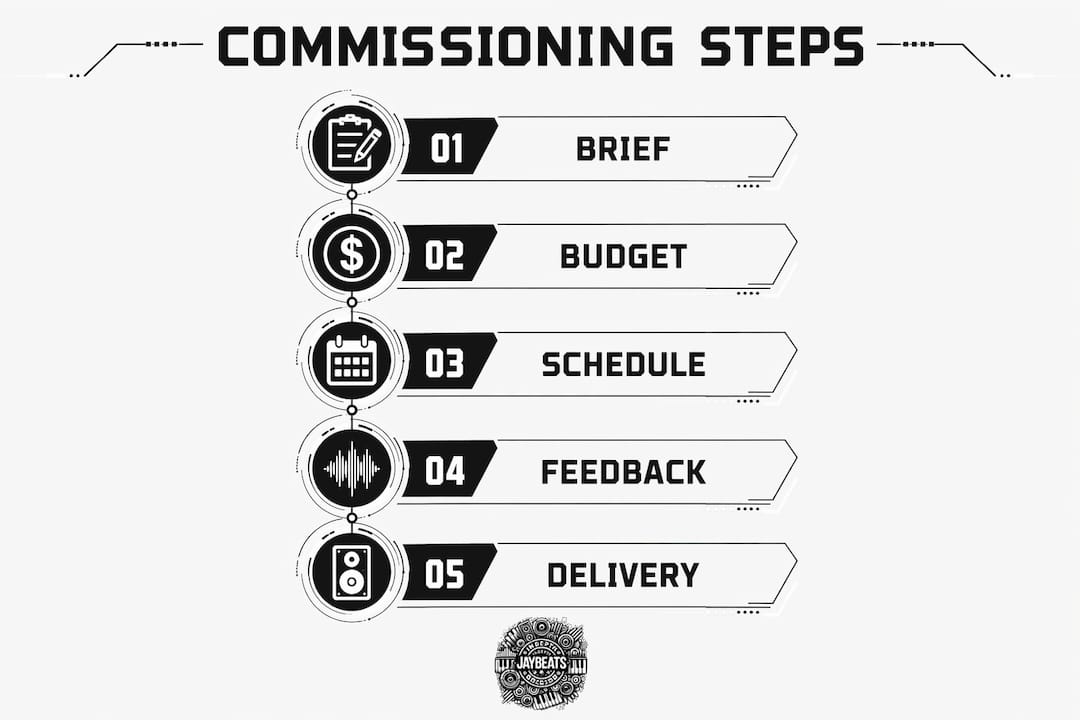
A well-run commission follows a clear sequence. Here’s what each milestone looks like in practice:
Brief submission: You send your brief, references, and budget range. The producer reviews and confirms they can deliver what you need.
Deposit and contract: A deposit (typically a substantial portion of the total fee) is paid before any work begins. Both sides sign or confirm the scope in writing, including revision limits, timeline, and license terms.
Demo draft: The producer builds a first version focused on arrangement and vibe. Treat this as a structural sketch, not a finished record. Expect rough mixes that show you the direction, not the final sonic polish.
Revision rounds: You give time-stamped, specific feedback. The producer incorporates your direction and returns an updated version. Most commissions include 2–3 revision rounds in the base price.
Final mix and stems: Once the arrangement is locked, the producer delivers a polished master, multi-track stems, and an instrumental version.
License and handoff: You receive the license agreement, receipt, and all agreed files. Sign off, pay the remaining balance, and the beat is yours under the agreed terms.
For a single-song commission, a realistic week-based schedule looks like this: Week 1 — brief accepted, deposit paid, demo delivered by end of week. Week 2 — revision feedback exchanged, updated draft returned. Week 3 — final mix, stems, and license delivered. Platforms that handle remote file exchange and escrow payments make this process clean on both sides.
What turnaround time should you actually expect?
Turnaround depends on complexity, the producer’s schedule, and how fast you give feedback. Here’s a realistic breakdown:
Fast-turn (48–72 hours): Rush jobs for simple arrangements. Usually costs more and limits revision rounds. Good for a quick freestyle or content drop, not a single you’re shopping to labels.
Standard (1–2 weeks): The most common timeline for a single-song commission. Covers a demo, one or two revision rounds, and final delivery. This is where most independent artists land.
Extended (3+ weeks): Album projects, complex arrangements with live elements, or commissions that require multiple stems packages and session file exports. Budget the time and communicate your release date upfront.
Revision policies vary by producer. Most offer 2–3 free rounds in the base price. A revision means adjusting elements within the existing arrangement — swapping a synth, tightening the mix, changing the hi-hat pattern. A rework means rebuilding the structure from scratch. That’s a different scope and usually costs extra.
Pro Tip: Lock down the arrangement and structure before you ask for deep mixing work. Changing the song’s structure after the mix is dialed in costs time and money. Approve the skeleton first, then polish.
What files you’ll receive and when to ask for stems
Expect these deliverables on a standard commission:
Final WAV master: lossless audio, 44.1–48 kHz, 24-bit preferred. This is your distribution-ready file.
MP3 reference: a compressed version for sharing and pitching before you go to final.
Multi-track stems: individual groups (kick/snare, bass, melody, pads, FX) labeled and aligned to the same start point. You need these for mixing your vocals or re-editing the arrangement.
Instrumental version: the full beat without any topline or guide vocal.
License/receipt: the signed agreement confirming your rights, territory, and usage terms.
Session files (Logic Pro, Ableton Live) are sometimes available on request and often cost extra. Before you ask for them, know what you’re getting into. Session files include printer FX, routing, and third-party plugins. If you need a session file that’s actually usable in your studio, specify whether you want printed stems only or a full DAW session, and budget for plugin compatibility work. Most independent artists don’t need session files — stems cover 95% of use cases.
The producer should also hand off a tempo map, BPM, key, and any processing notes. That information matters when your mixing engineer picks up the project.
For artists working on mixing and mastering after delivery, having labeled stems at the correct sample rate saves hours of cleanup.
How pricing works and what license types actually mean
Pricing varies by exclusivity and producer stature. Here’s a realistic breakdown:
License Type | Typical Price Range | What You Get |
|---|---|---|
Non-exclusive lease | $30–$50 | Limited streams/sales, no stems, beat stays in catalog |
Non-exclusive custom beat | $100–$500 | Beat built for you, limited commercial use, stems sometimes included |
Exclusive custom beat | $500–$5,000+ | Full commercial rights, stems included, beat pulled from catalog |
A non-exclusive lease means the producer can still sell the same beat to other artists. You get usage rights up to a capped stream or sales count, with typical pricing between $30 and $50. A exclusive license means the beat is yours alone — the producer pulls it from their catalog and transfers full commercial rights to you, generally ranging from $500 to $5,000 or more depending on producer level.
For sync placements (TV, film, ads), you almost always need an exclusive license. The licensing breakdown at Indepthjaybeats covers the tiers in detail, including what each level covers for streaming and sync.
Before you sign anything, confirm these in writing: territory (worldwide or limited), duration (one year, five years, or in perpetuity), commercial and sync rights, stem access, session file access, and publishing splits. Publishing splits between rappers and producers are negotiable and depend on whether the producer contributed to the topline or just the instrumental. A work-for-hire agreement transfers full ownership to you — that’s the cleanest arrangement for artists who want no ongoing royalty obligations to the producer.
Beat licensing for film and TV carries its own requirements, so read up before you pitch a sync.
Deposits, contracts, and payment: what to expect
Most producers require a deposit of 30–50% before starting work. The balance is due on delivery. That structure protects both sides. A structured commissioning process includes a written contract that covers scope, timeline, payment schedule, revision limits, and rights transfer.
Your contract checklist:
Scope of work: genre, BPM, length, stems, session files, and any specific instrumentation
Deliverables: exact file formats and what’s included at each stage
Timeline: demo delivery date, revision window, and final delivery date
Revision limits: number of free rounds and what constitutes a rework
Payment schedule: deposit amount, due date, and final payment trigger
Cancellation policy: what happens if either side walks away mid-project
Rights/license terms: exclusive or non-exclusive, territory, duration, sync rights
Credits: producer credit on the release, if required
Common payment methods include PayPal, Stripe, bank transfer, or escrow through a marketplace. Escrow holds your payment until deliverables are confirmed, which protects you on larger commissions. For custom work over $500, escrow is worth using.
Red flags: no written agreement, vague rights language (“you own it” with nothing in writing), requests for full payment before any demo, or a producer who won’t confirm revision limits. Walk away from any of those.
How to give feedback that actually moves the session forward
Clear, time-stamped feedback and a simple vocal guide cut revision rounds in half. Vague notes like “make it harder” or “I need more energy” don’t give a producer anything to work with. Here’s a format that works:
“At 0:45, the melody feels too busy over the hook. Can you pull back the lead synth and let the 808 breathe more? Reference: the drop at 1:12 in Track 2 I sent.”
That’s a timestamp, the issue, and a suggested fix. That’s all a producer needs.
For the vocal guide: record a simple one-take topline or dry rap verse at the correct tempo and key. It doesn’t have to be perfect. Label the file clearly (“Vocal_Guide_Verse1_130BPM_Aminor”) and include a reference MP3 with a count-in. That one file tells a producer more about your voice and delivery than three paragraphs of description.
Agree on a communication cadence before the project starts. A 48–72 hour response window on both sides keeps the project moving without pressure. Email works for detailed notes; voice memos work for quick directional feedback. Pick one channel and stick to it.
Time-stamped feedback reduces ambiguous notes and speeds up the revision loop. Producers who work with prepared artists consistently deliver better results, faster.
Why Indepthjaybeats is built for 1-on-1 custom work
1-on-1 custom production means the beat is built around your voice, not pulled from a catalog and handed off. Indepthjaybeats has been active since 2007, specializing in trap, boom bap, Detroit-style beats, and R&B instrumentals for independent artists and sync placements.
Placements include productions like WWE 2K25 and Love and Hip Hop Atlanta — that’s the level of production quality you’re working with when you commission here.
For new artists, Indepthjaybeats offers a free beat pack as a first step. Download it, hear the production quality, and then reach out with your brief. The free pack is the demo-to-client funnel — it lets you hear the sound before you commit to a commission.

Get 20+ Free Beats delivered to your inbox
Drop your name and email and I'll send a pack to your inbox right away.
We respect your inbox, no spam. Promise!
Key Takeaways
Commissioning a custom beat comes down to one thing: preparation. The clearer your brief, the faster and better the result.
Point | Details |
|---|---|
Build your brief first | Include 2–3 reference tracks, BPM range, mood, vocal key, and intended use before contacting any producer. |
Expect a deposit upfront | Most producers require 30–50% before starting; get the scope, timeline, and revision limits in writing. |
Treat the demo as a sketch | First demos show arrangement and vibe, not final polish — give time-stamped feedback, not vague direction. |
Confirm license terms before release | Know whether you hold exclusive or non-exclusive rights, and register with ASCAP/BMI and the U.S. Copyright Office. |
Indepthjaybeats for custom work | Active since 2007, with sync placements in major productions — offers 1-on-1 commissions, stems, and a free beat pack to start. |
What most artists get wrong when they commission beats
The biggest mistake artists make isn’t the budget. It’s showing up unprepared. A producer can work with a tight budget. They can’t work with “just make something hard.” When you send a brief with no references, no BPM, and no vocal guide, you’re asking a producer to guess your entire creative vision. That costs everyone time, and it usually costs you extra revision rounds you didn’t budget for.
Here’s the thing most guides won’t tell you: producers talk. The artists who come prepared with clear references, pay their deposits on time, and give specific feedback get extra attention. Not because producers play favorites, but because a well-organized project is genuinely easier to do great work on. When a producer can see your vision clearly, they push harder to nail it.
Custom beats aren’t just about getting a unique instrumental. They’re about building a working relationship with someone who understands your sound, using corporate event entertainment ideas that keep guests engaged to tailor commercial and sync uses effectively. The best commissions turn into ongoing collaborations. The worst ones are one-and-done because the artist never communicated what they actually needed. Bring your references. Know your key. Pay on time. That’s how you earn a producer’s best work.
Ready to start your commission with Indepthjaybeats
If you’ve got your brief ready, Indepthjaybeats is the direct path to a custom beat built around your sound. No recycled loops. No guessing. Just 1-on-1 production from a producer with nearly two decades in the game and sync placements that prove the quality.

Start by grabbing the free beat pack to hear the production style firsthand. When you’re ready to commission, send your brief to Indepthjaybeats with your reference tracks, BPM range, mood, vocal key, and budget. Label your attachments clearly and include a vocal guide if you have one. Once the scope is confirmed, you’ll receive a deposit invoice covering the first phase of production. From there, expect a demo within the standard timeline, revision rounds, and final WAV files plus your license agreement on delivery. Artists working in trap can also browse the trap beats catalog or the boom bap selection to get a feel for the range before commissioning a fully custom track.
Further reading and primary sources
Indepthjaybeats licensing page — license tiers, exclusivity options, and legal notes for commissioned beats
Music Licensing for Film & TV: Complete Guide — how sync licensing works and what rights you need for placements
How Rappers and Producers Split Publishing Royalties — practical breakdown of publishing splits and negotiation points
Why Artists Need Original Beats — the case for commissioning over catalog loops
How to Find the Right Beat for Your Song — brief elements and pricing context for custom commissions
How to Find a Music Producer — producer hiring process, rates, and communication best practices
7 Steps to Commission a Custom Song — workflow and contract clause guidance for commissioned music
Indepthjaybeats homepage — beat catalog, commission inquiries, and free beat pack download