
Every music placement in film or TV legally requires two separate licenses: a synchronization license for the composition and a master use license for the specific recording. Miss either one and you’re infringing copyright, full stop. Here’s what you need to know before you touch a single track:
Sync license: Covers the melody, lyrics, and arrangement. Granted by the songwriter or their publisher.
Master use license: Covers the actual recorded performance. Granted by the record label or, for independent artists, the artist directly.
PROs (ASCAP, BMI, SESAC): These organizations collect and distribute performance royalties when your film airs or streams. Broadcasters and platforms pay them through blanket licenses, not you.
Cue sheets: The formal document listing every piece of music in your film. PROs use it to pay composers and publishers their royalties. No cue sheet, no royalties distributed correctly.
Key license terms to know: territory (where you can distribute), term (how long the license lasts), and exclusivity (whether others can use the same track).
Get both licenses locked before picture lock. That’s the foundation everything else builds on.
How sync and master licenses actually work
Two separate copyrights govern every piece of commercially released music. Understanding the difference between them is the first real step in music clearance for film.
The sync license covers the composition itself: the melody, the lyrics, the arrangement. Think of it as the song on paper. The publisher, who represents the songwriter, controls this right. If a song has five co-writers, you need approval from all five publishers. One “no” kills the whole deal.

The master use license covers the specific recorded performance you want to use. That’s the version on the album, the one with that particular drum sound and vocal take. Usually the record label owns this. For independent artists who self-release, they own it themselves.
Here’s where it gets real for indie producers: when one artist controls both the sync and master rights, that’s called a one-stop clearance. Music supervisors actively seek these situations because they compress weeks of legal back-and-forth into days. No label to chase, no publisher playing phone tag. One conversation, one deal.
Key distinctions at a glance:
Sync license = composition rights = publisher or songwriter
Master license = recording rights = label or independent artist
Both are required for every placement, no exceptions
One-stop clearance (artist owns both) = faster, simpler deals
Cover versions eliminate the master license from the original label, but the sync license for the underlying composition still applies
Pro Tip: If you’re an independent artist, owning 100% of your masters and publishing puts you in the strongest possible position for sync deals. Music supervisors can say yes faster when there’s only one person to call.
What sync fees actually look like and how to negotiate them
Fees vary widely depending on who the artist is, how the music is used, and where the film will be distributed. Sync fees for independent features range from $250 to $15,000 for small to mid-profile artists, while major artist fees can exceed $50,000 per track.
“Per side” is the term you’ll hear constantly. It means you pay the quoted fee twice: once to the publisher for the sync license and once to the label or artist for the master. A song cleared at $500 per side costs $1,000 total. That math adds up fast across a full film.
Typical fee ranges by use type vary; featured use generally costs more than background use, with additional considerations for end credits and festival-only rights.
Exclusive licenses increase cost and are generally unnecessary unless the track is central to the film’s identity. Most films run non-exclusive licenses to keep budgets manageable.
Watch out for Most Favored Nation (MFN) clauses. If the publisher for Song A agrees to $1,000 with an MFN clause and you later pay $2,500 for Song B, you now owe Song A’s publisher $2,500 as well. MFN clauses protect rights holders from being undervalued, but they can blow up your budget if you’re not tracking them carefully across every deal.
Negotiation tips for budget-conscious producers:
Start with festival-only rights to keep initial costs low, then negotiate expansion options
Offer a lower rate upfront. Rates are negotiable, and many artists will flex if they connect with the project
Record a cover version to eliminate the master use fee entirely. You still need the sync license, but you cut costs roughly in half
Limit territory to regions where you actually plan to distribute. A US-only license costs less than worldwide
Clarify trailer rights during initial negotiations if you think you’ll want the song for marketing. Trailers require a separate license
What music supervisors are really looking for
Music supervisors are the gatekeepers between your catalog and a film or TV placement. They’re not just picking songs they like. They’re managing legal risk, creative fit, and production timelines all at once. A track that’s easy to say yes to means clear rights ownership, straightforward licensing, and a strong sonic match for the scene.
Here’s what supervisors actually evaluate when they pull up your music:
Rights clarity: Do you own both sync and master? Is it a one-stop deal? The faster they can confirm ownership, the faster they can move.
Metadata accuracy: Is your music properly registered with ASCAP, BMI, or SESAC? Accurate metadata and PRO registration are crucial for composers to collect performance royalties and get noticed by supervisors.
Sonic fit: Does the track work emotionally and tonally for the scene? Supervisors think in picture, not just in audio.
Licensing simplicity: Fewer rights holders, faster clearance. One-stop artists win here every time.
Availability and speed: Can you respond and execute a deal in days, not weeks? Supervisors work on tight deadlines.
Pro Tip: Register every track with your PRO before you pitch it. A supervisor who can’t verify ownership in the ASCAP or BMI database will move on to the next track. Make it easy for them to find you and confirm your rights.
For indie artists looking to build real relationships with supervisors:
Keep your catalog organized with consistent metadata: title, ISRC code, BPM, key, mood, and genre tags
Pitch tracks that are instrumentally available or have clean vocal versions. Supervisors often need both
Build a simple one-sheet or licensing page that lists your contact, PRO affiliation, and licensing terms
Follow music supervisors on LinkedIn and attend industry events like the Guild of Music Supervisors conference
Check out resources like sync placement strategies to understand how supervisors discover and vet new catalogs
Common pitfalls that kill deals and create legal exposure
Most licensing problems are avoidable. They happen because producers move fast, assume too much, or treat music clearance as a post-production task instead of a production priority.
The public domain trap catches people constantly. Yes, Beethoven’s compositions are public domain. But the 2019 Berlin Philharmonic recording of that Beethoven symphony? That master recording has its own copyright. You need a master use license for any specific recorded performance, regardless of how old the underlying composition is. Classical music is not free just because the composer is long gone.
No response is not approval. Relying on silence or informal approvals risks cease-and-desist orders and distribution blockades. If a rights holder doesn’t respond, you keep pushing. Document every outreach attempt. If you use music without confirmed written permission, you’re exposed.
Cue sheet errors are one of the top reasons films fail to deliver on schedule. Distributors may withhold payment or delay releases for errors or omissions in music credits. A misspelled composer name or wrong PRO affiliation can block royalty payments and stall your distribution deal.
Red flags and preventive practices:
Never use music based on a verbal agreement or a handshake. Get everything in writing
Don’t assume a song is public domain without verifying both the composition AND the specific recording
Start a draft cue sheet the moment you lock a track into your edit. Don’t wait until post-production
Errors and Omissions (E&O) insurance requires clean clearance paperwork. Without it, distribution stalls
If a rights holder says they can grant permission but “aren’t sure about the label,” that’s a red flag. Verify independently
Never use a track in a trailer without a separate trailer license, even if you’ve cleared it for the film itself
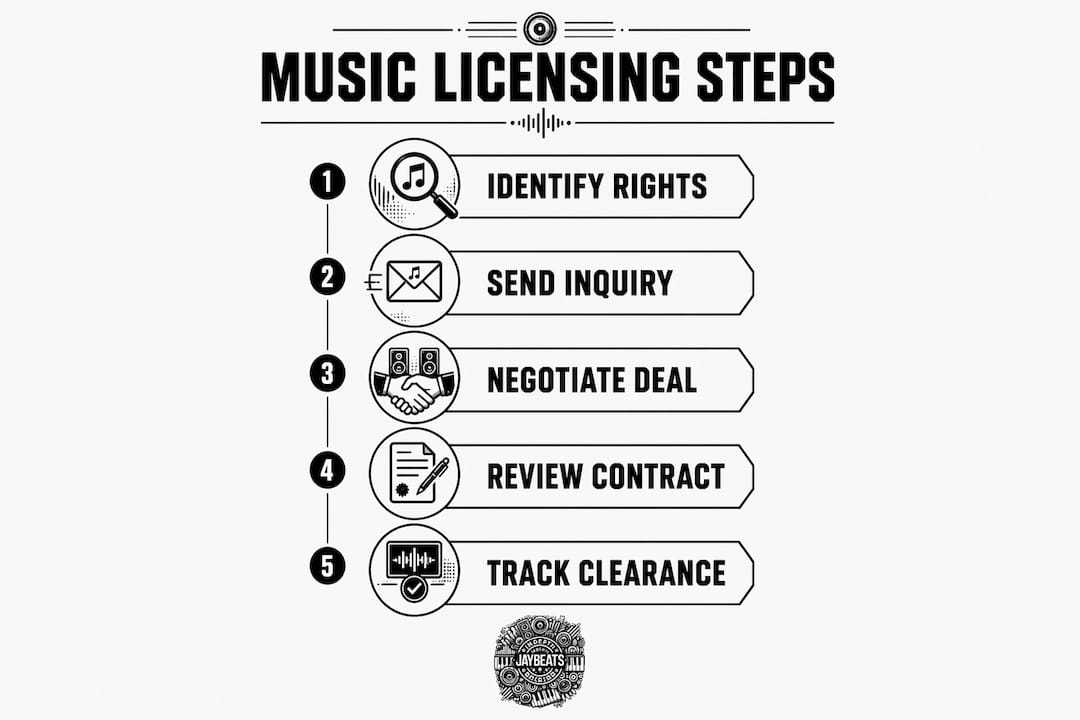
How to clear music rights step by step
Treating music clearance as a last-minute task is one of the most common and costly mistakes in film production. Start this process during pre-production, not after picture lock.
Here’s the clearance workflow that actually works:
Step 1: Identify rights holders. Search the ASCAP, BMI, and SESAC databases to find the publisher for the sync license. For the master, check album credits on streaming platforms, AllMusic, or Discogs. Independent artists who self-release handle master requests directly.

Step 2: Send a formal licensing inquiry. Your outreach email needs to include: film title, genre, and budget range; how the music will be used (background, featured, end credits); duration of the cue; distribution plans (festival, streaming, theatrical, all media); territory; and license term.
Step 3: Negotiate the key deal points. Fee, term, territory, media type, and exclusivity are the five levers. Budget for the distribution reality you’re actually targeting. A US-only license that blocks a global streaming deal costs you more in the long run.
Step 4: Review the license agreement carefully. Have an entertainment attorney review any deal over $5,000. Key clauses to check: exact scope of rights granted, payment terms, warranties from the licensor that they actually own what they’re licensing, indemnification provisions, and waiver of injunctive relief so a dispute can’t block your release.
Step 5: Prepare and submit your cue sheet. Every entry needs: song title, composer and co-writers, publisher, duration as it appears in the film, usage type (background, featured, theme), and PRO affiliation. Submit to ASCAP, BMI, and SESAC after the film is complete. Most distributors require a finalized cue sheet before delivery sign-off.
Clearance milestones to track:
Music selections locked during pre-production
Rights holder research completed before principal photography ends
Initial licensing inquiries sent no later than mid-production
License agreements signed before picture lock
Cue sheet drafted during editing, finalized at delivery
E&O insurance secured with all clearance documentation on file
Pro Tip: Build a music clearance tracker in a spreadsheet from day one. Log every track, every rights holder, every outreach date, and every response. When your distributor asks for documentation, you’ll have it ready.
Inside the industry: how Indepthjaybeats built real sync placements
Most producers talk about getting placements. Indepthjaybeats actually has them. WWE 2K25, Real Housewives of Atlanta, Love and Hip Hop Atlanta. Those aren’t small credits. Those are nationally recognized properties with real music supervisors making real licensing decisions.
What makes that possible at the independent level comes down to one structural advantage: controlling 100% of both sync and master rights. When a supervisor reaches out about a track from Indepthjaybeats, there’s no label to call, no publisher to chase, no co-writer who’s unreachable. One conversation, one deal, done. That’s the one-stop clearance model in practice, and it’s exactly what music supervisors actively seek when they’re working against a deadline.
The catalog is also built with placement in mind from the start. Beats are tagged with accurate metadata, registered with the appropriate PROs, and available in both instrumental and mixed versions. That kind of organization signals professionalism to a supervisor before a single word is exchanged.
Lessons from the Indepthjaybeats approach that any indie artist can apply:
Own your masters. If you don’t control the recording, you can’t offer one-stop clearance
Register every track with your PRO before you pitch it anywhere
Keep instrumental versions of every record. Supervisors need them constantly
Build a licensing page or one-sheet that makes your terms clear upfront
Respond fast. Supervisors move to the next option when they don’t hear back
Position your catalog for the type of placements you want. Trap and boom bap built for TV energy lands differently than bedroom pop
The path from independent producer to nationally placed artist is real. It requires the right music, the right rights structure, and the discipline to stay organized. Indepthjaybeats proves the blueprint works.
Indepthjaybeats has the beats music supervisors want

If you’re an artist or filmmaker who just read this guide and realized your music needs to be placement-ready, the next move is getting beats that are already built for that world. Indepthjaybeats has been producing at an industry level since 2007, with placements on WWE 2K25, Real Housewives of Atlanta, and Love and Hip Hop Atlanta to back it up.
Every beat in the catalog comes with clear licensing terms, full rights documentation, and the kind of production quality that holds up next to major label records on national television. No chasing down co-writers. No label clearance headaches. You get the music and the rights, clean and ready to move.
Whether you need hard trap 808s or classic boom bap energy, the catalog is stacked. Grab a free beat pack to hear the quality firsthand, then lock in the license that fits your project. Music supervisors respond to professionalism and speed. Start with beats that are already built for both.
Key Takeaways
Music licensing for film and TV always requires two separate licenses: a sync license for the composition and a master use license for the recording. Skipping either one is copyright infringement.
Point | Details |
|---|---|
Two licenses required | Every placement needs both a sync license and a master use license, no exceptions. |
Sync fee ranges | Independent artist fees run $250–$15,000 per track; major artists can exceed $50,000. |
Festival-only entry point | Festival-only music licenses typically cost around $500 per side and can include options to expand to all media within two years. |
One-stop clearance wins | Artists who own both sync and master rights get faster placements and are preferred by music supervisors. |
Indepthjaybeats | Proven independent producer with placements on WWE 2K25, Real Housewives of Atlanta, and Love and Hip Hop Atlanta, offering clear one-stop licensing on all beats. |
Recommended

Get 20+ Free Beats delivered to your inbox
Drop your name and email and I'll send a pack to your inbox right away.
We respect your inbox, no spam. Promise!