What is a split sheet, and why do rappers absolutely need one?
A split sheet is a one-page document that records exactly who owns what percentage of a song’s composition. Every contributor gets a defined slice, and all percentages must total exactly 100%. No more, no less. That number matters because PRO registration at ASCAP, BMI, or SESAC requires it to be exact before they will process the work.

Here is what the law does without one. Under U.S. copyright default rules, every co-author on a joint work owns an equal share regardless of how much they actually contributed. Two writers? Equal ownership split. Three writers? Ownership divided equally, even if one person wrote every lyric and another just suggested a title. A split sheet overrides that default with whatever you all actually agreed on.
The document also prevents royalties from getting frozen. When conflicting ownership claims hit a PRO, all payments stop until the dispute resolves. That can take months. Verbal agreements carry zero weight in that process.
Every split sheet needs these elements:
Legal names of all contributors (not stage names)
Song title and any working titles
Each person’s PRO affiliation (ASCAP, BMI, SESAC, etc.)
IPI/CAE number for each contributor
Contribution description (lyrics, melody, production, arrangement)
Ownership percentage for each contributor, totaling exactly 100%
Dated signatures from all parties
Digital signatures through platforms like DocuSign are legally valid and fully accepted in the industry. Get them before the song drops, not after.
How to create and use a split sheet the right way
Building a solid split sheet is not complicated. The conversation is the hard part. The paperwork takes five minutes.
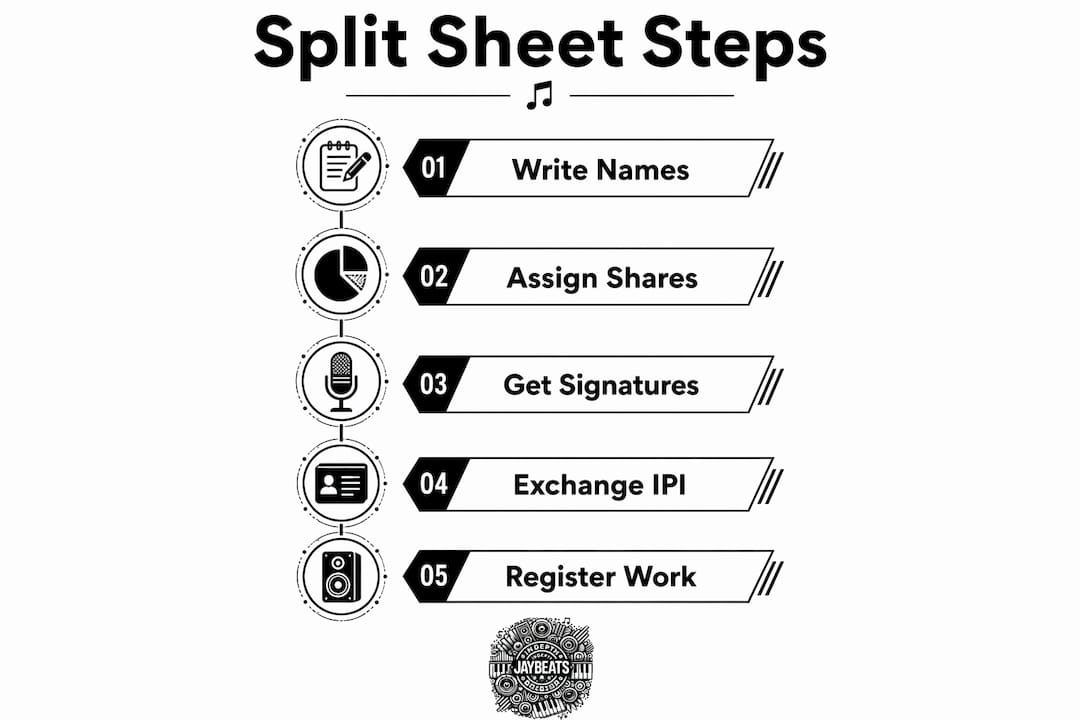
Step-by-step process:
Discuss splits during the session. Before anyone packs up and leaves, agree on who contributed what and what percentage each person deserves. Memory fades fast once people walk out the door.
List every contributor. Anyone who touched the composition, lyrics, melody, beat, arrangement, gets included. Engineers who only mixed are compensated separately through flat fees, not publishing splits.
Fill in all fields completely. Legal names, PRO info, IPI numbers, contribution type, and percentages. Songtrust notes that incomplete metadata is one of the primary reasons royalty payments get lost or rejected.
Note any samples. Uncleared samples can invalidate the whole arrangement downstream.
Sign and date. Every contributor signs. Every contributor gets a copy. A clean PDF stored in the cloud beats a photo in a group chat, though both beat nothing.
Pro Tip: Exchange IPI numbers right there in the session. You cannot register the work with your PRO without them, and chasing that info down later slows everything.
One thing to get clear: a split sheet is not a collaboration agreement. The distinction matters. A split sheet records ownership percentages. A collaboration agreement governs decisions, who can approve a sync license, who can authorize a remix, what happens if someone exits the project. For a one-off collab, a split sheet is usually enough. For an ongoing creative partnership, you want both documents.
Metadata consistency is where a lot of independent artists lose money quietly. If your split sheet says 60/40 but your PRO registration says 50/50, royalties freeze until the conflict is resolved. Your distributor, your PRO, and The MLC all need to show the same writer names, same percentages, same spelling. Every time.
Why independent rappers and producers need a split sheet for every collab
Skip the split sheet and you are handing the law a blank check to fill in however it wants. That is not a metaphor. U.S. copyright law gives every co-author equal ownership and equal exploitation rights when no written agreement exists. That means a producer who contributed 10% of a song can license it to a third party without asking anyone. Any co-author can. That is the default system you are operating under without documentation.
The risks stack up fast for independent artists:
Frozen royalties. PROs place songs in dispute status when conflicting claims are submitted. All performance royalties sit in suspense until resolved.
DMCA takedowns. A producer who feels uncredited or underpaid has legal standing to pull your song off every streaming platform. Algorithmic momentum gone overnight.
Equal-split defaults. Without a written agreement, the law splits ownership evenly regardless of actual contribution, which can seriously underpay the person who did most of the work.
Damaged relationships. Money disputes end creative partnerships. A five-minute conversation upfront prevents a years-long falling out.
Beat licenses and publishing ownership are two completely different things. Buying a beat grants you permission to use the instrumental under specific conditions. It does not transfer the producer’s publishing rights or composition ownership. A split sheet is still required to define who owns the underlying composition. Producers who sell beats and skip split sheets often discover later that they have no documented claim to their own publishing.
Songtrust and NotNoise both emphasize the same point: verbal agreements do not resolve PRO disputes. Only a signed split sheet does. If you have existing catalog with no split sheets, audit it now. Every undocumented collab is a liability sitting in your back catalog.
For a deeper look at how beat licensing and publishing rights interact, that distinction is worth understanding before your next session.
What does a split sheet actually look like?
A basic split sheet does not need to be fancy. Here is a practical example of how one breaks down for a three-person collaboration:
Field | Writer A | Writer B | Writer C |
|---|---|---|---|
Legal name | Marcus James | Deon Williams | Tara Simmons |
Role | Producer | Lyricist | Topline/Hook |
PRO | BMI | ASCAP | BMI |
IPI number | — | — | — |
Ownership shares | Assigned per agreement | Assigned per agreement | Assigned per agreement |
Contribution | Beat, arrangement | Verses, bridge | Hook melody |
Signature | Signed | Signed | Signed |
Date | Documented date | Documented date | Documented date |
Total ownership shares must add to the full composition. This is the essential figure.
Free templates are available through Songtrust’s split sheet download, and the SPLITS app from Create Music Group lets collaborators generate and sign agreements digitally in minutes. You can also build your own in Google Docs using the fields above. The format is less important than the completeness. Every field filled in, every contributor signed, every copy distributed.
For more on how contracts and beat lease agreements work alongside split sheets, that context helps you understand which document does which job.
How to handle split sheet disputes when they come up
Disputes happen even with documentation. Knowing how to move through them protects your career and your relationships.
The first move is always to pull the signed split sheet. If everyone signed before release, that document is your evidence. PROs and legal professionals treat a signed split sheet as the authoritative record. Verbal claims, text messages, and studio session photos are supporting context at best.
If the split sheet exists but the PRO registration does not match it, correct the registration immediately. Contact your PRO directly, submit the signed split sheet as documentation, and request a correction. Metadata mismatches are the most common reason royalties end up frozen in suspense accounts, sometimes for months. The fix is straightforward once you have the paperwork.
When no split sheet exists and contributors disagree, the situation gets expensive fast. At that point, a music attorney is not optional. PROs will not adjudicate based on who remembers the session differently. They need documentation. If you end up in that position, understanding your music copyright and royalty rights is the foundation for any legal argument you make.
The cleanest dispute prevention is also the simplest: sign before you leave the session. Every time.
The real talk on split sheets from a producer’s perspective
Twenty-plus years in this industry, producing trap and boom bap from 2004 through placements in WWE 2K25 and Love And Hip Hop Atlanta, and the pattern never changes. The artists who protect their bag long-term are the ones who treat paperwork like part of the creative process, not an afterthought.
The studio has a certain energy. Everyone is locked in, the beat is knocking, the vibe is right. Nobody wants to slow that down to talk percentages. That hesitation is exactly where careers get derailed. The conversation is awkward for five minutes. The lawsuit is awkward for two years.
Independent rappers especially need to hear this: your beat license is not your publishing agreement. Those are two separate documents doing two separate jobs. Producers who have been in the game know this. If you do not, you are walking into sessions at a disadvantage. Get that clarity before you record a single bar.
The artists who have come through Indepthjaybeats and built real careers all share one habit. They document everything. Splits, licenses, agreements. They build their catalog like a business because that is what it is.
Split sheets are the cheapest insurance in music. The premium is five minutes and a conversation. Skip it, and you might spend the next year watching your song earn money for everyone except you.
Key Takeaways
A split sheet is the single most important document in any music collaboration, and completing one before release is the difference between getting paid and getting stuck.
Point | Details |
|---|---|
Percentages must total 100% | PROs cannot register a work unless all ownership percentages add up to exactly 100%. |
Default law hurts creators | Without a written agreement, U.S. copyright law assigns equal ownership regardless of actual contribution. |
Sign before the session ends | Disputes are far harder to resolve once contributors leave and memory fades. |
Metadata must match everywhere | Your split sheet, PRO registration, and distributor must show identical names and percentages or royalties freeze. |
Beat licenses are not split sheets | A beat license grants usage rights; a split sheet documents composition ownership. Both are required. |
Recommended

Get 20+ Free Beats delivered to your inbox
Drop your name and email and I'll send a pack to your inbox right away.
We respect your inbox, no spam. Promise!