You can get your first real listeners and build genuine momentum with zero budget. The system is short-form video content, targeted outreach, and one owned-audience capture point working together. That combination compounds. One piece of content leads to a follow, a follow leads to an email, an email leads to a stream, and streams create fans who create more streams.
Start here, right now:
Pick one platform: TikTok, Instagram Reels, or YouTube Shorts
Record 3 raw clips from your current track today (hook, behind-the-scenes, lyric moment)
Build one smart link using Linktree or Koji that points to your stream and email sign-up
Message 10 curators, micro-influencers, or collab peers this week with a short, personal note
Schedule your release-week posts before the drop so you are not scrambling
Roughly a significant share of listeners now discover new music through short-form video platforms, and with a very large number of new tracks hitting streaming services every day, the artists who win are the ones who show up consistently, not the ones who wait for the perfect moment. The algorithm rewards volume and native content. Your email list captures the audience the algorithm can take away. Together, they build momentum you actually own.
Key Takeaways
Promoting your music with no fans and no money works when you combine short-form video volume, one owned-audience capture point, and consistent personalized outreach into a daily system you repeat across every release cycle.
Point | Details |
|---|---|
Short-form video first | Post 1 clip per day during release week; many listeners discover new music through short-form platforms. |
One destination, always | Every post points to a single smart link with a streaming link and email sign-up attached. |
Repurpose every track | Turn one song into at least 20 clips using the recipe in this guide; batch-produce in 1–2 hours. |
Outreach beats the algorithm | Send 10 personalized pitches per week to curators, peers, and micro-influencers; generic mass sends get ignored. |
Indepthjaybeats free pack | Download 20 free beats to record your first clips, test hooks, and launch your next release with no upfront cost. |
Table of Contents
What is the right strategy for TikTok, Reels, and YouTube Shorts?
How do you pitch playlists, blogs, and micro-radio for free?
Which free platforms actually move the needle for independent artists?
A producer’s straight talk on why this system actually works
Ready to start? Grab 20 free beats and build your next release
What should you do the week before your release?
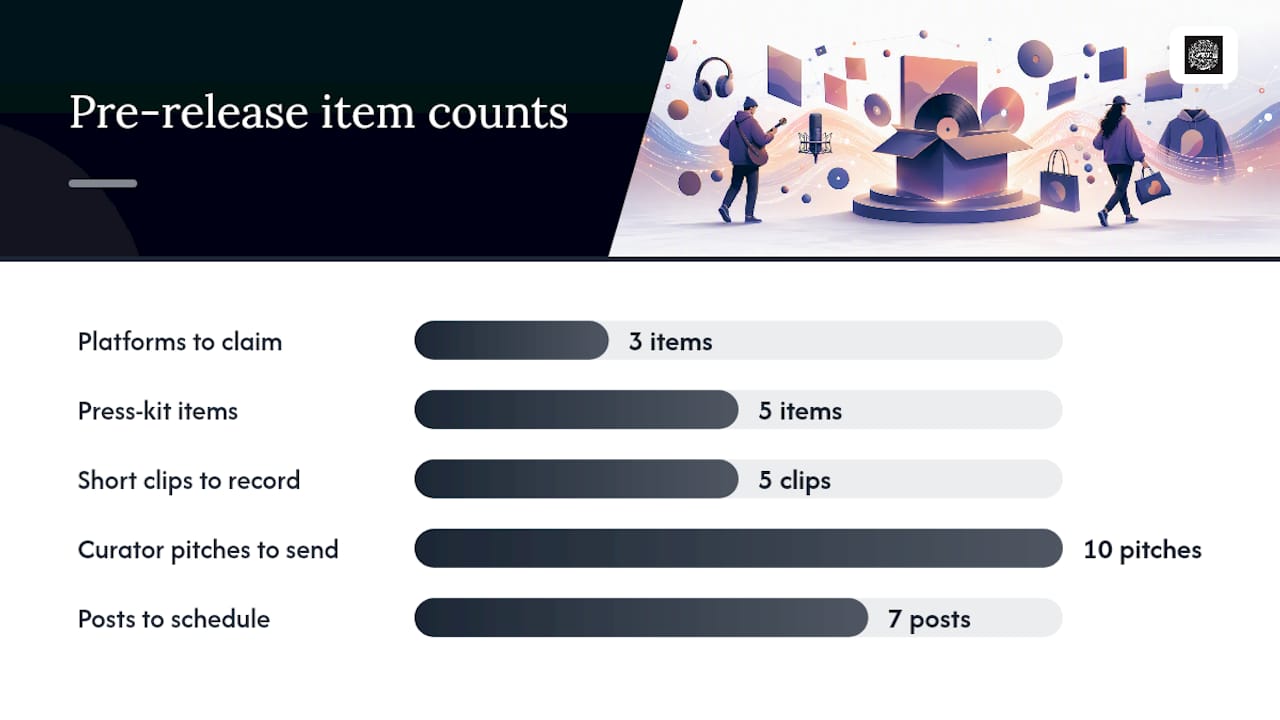
Seven days before your drop, most artists are doing nothing. That is the gap you can exploit. A tight pre-launch week builds anticipation, gets your assets ready, and puts you in front of curators before the song even lands.
Day-by-day pre-release checklist (days -7 to 0)
Day -7: Claim and fully complete your Spotify for Artists profile, Apple Music for Artists, and YouTube channel. Upload a high-quality artist photo, write a bio, and fill every metadata field. Incomplete profiles get skipped by curators.
Day -6: Build your press kit. Keep it lean and copy-paste ready:
One-sentence bio: “I’m [Name], a [city]-based rapper making [genre] for people who [feeling/situation].”
Press photo: One clean, high-contrast image (at least 1500 x 1500 px)
15-second hook clip: A vertical video of the song’s strongest 15 seconds
Streaming link: Your smart link, not a direct Spotify URL
Contact info: One email address, one Instagram handle
Day -5: Record 5 short-form clips. Raw is fine. Phone camera is fine. You need the hook performed live, the beat playing while you vibe, a lyric written on screen, a behind-the-scenes studio moment, and a “this song is about…” story clip.
Day -4: Send your first 10 curator pitches using the template in Section 6. Target micro-playlist curators on SubmitHub, independent hip-hop blogs, and local music journalists.
Day -3: Set up your smart link with a free tool like Linktree, Koji, or Beacons. Point it to your streaming link and an email sign-up with a free offer (an unreleased track, stems, or a free beat pack works well).
Day -2: Schedule your release-week posts. Use Meta Business Suite for Instagram, TikTok’s built-in scheduler, or a free tool like Buffer. Line up at least one post per day for the first 7 days post-release.
Day -1 (release eve): Post a 15-second teaser clip with the caption: “Dropping tomorrow. Save this.” Stories, Reels, TikTok, Shorts — all of them. One post, repurposed across every platform.
Day 0 (release day): Drop the song. Post the full hook clip. Reply to every comment within the first 3 hours. Those early engagement signals tell the algorithm this content is worth pushing.
Pro Tip: Set your DistroKid or TuneCore delivery date at least 7 days before release so Spotify has time to consider your track for editorial playlists through Spotify for Artists’ pitch tool. Miss that window and you lose that shot entirely.
How do you turn one song into 20 pieces of content?
Short-form video performance favors documentation over production, and the data backs creating 20–30 unique assets per release for maximum reach. One song has more content inside it than most artists realize. Here is the full breakdown.
The 20-content repurposing recipe
Hook performance clip — perform the catchiest 15 seconds straight to camera, no cuts
Beat-only vibe clip — let the instrumental play while you nod, drive, or work; text overlay says “produced this at 2AM”
Lyric reveal — type out one bar on screen as the song plays; let viewers finish the sentence
Origin story — 30-second talking-head: “This song came from…”
Studio session clip — raw footage of you recording or mixing, even on a phone
Stem showcase — isolate the 808 or melody and post it; producers and artists share these
Reaction bait — play the hook for a friend or family member on camera and capture their face
Challenge prompt — post the hook with text: “Rap over this. Tag me.”
Lyric graphic — static image with a standout bar, your name, and the release date
Countdown post — “3 days until this drops” with a 5-second audio preview
Behind-the-name — explain what the song title means in 20 seconds
Mood board clip — show 5 images or clips that inspired the song’s vibe, set to the track
Live snippet — record yourself performing the hook in your car, bedroom, or outside
Remix tease — play a loop of the beat and say “I’m giving this away. Comment ‘beat’ to get it.”
Milestone post — “First 100 streams. Thank you.” with the hook playing underneath
Process clip — show the DAW session, the plugin chain, or the vocal booth setup
Collab pitch clip — post the instrumental and say “Who wants to hop on this?”
Fan shoutout — screenshot a comment or DM from someone who connected with the song
Lyrics-vs-meaning — split screen: the bar on one side, what it actually means on the other
Repurposed long-form — take your best 3 clips, stitch them into a 60-second “making of” for YouTube
Batch production checklist (fits a 1–2 hour session)
Record all talking-head clips in one sitting, same background, same lighting
Pull 3–5 audio snippets from the final mix (hook, verse drop, outro)
Edit clips in CapCut or VN Editor (both free) with captions auto-generated
Export in 9:16 for TikTok/Reels/Shorts and 1:1 for feed posts
Schedule across platforms using Buffer’s free tier or each app’s native scheduler
Caption formula that drives saves: “Save this if you feel [emotion]. New music [date]. Link in bio.”
What is the right strategy for TikTok, Reels, and YouTube Shorts?
Each platform has its own algorithm logic. Posting the same clip the same way across all three without adjustment is leaving reach on the table. Here is what actually works on each one in 2026.
TikTok
TikTok’s algorithm is the most aggressive discovery engine for new artists. It pushes content to non-followers first, which means a zero-follower account can hit thousands of views on day one if the hook lands.
Do:
Hook within the first 1–2 seconds. Text on screen before the audio even kicks in.
Use trending sounds under your original audio when possible (duet or stitch format)
Post 1–2 times per day during your release week
Reply to every comment with another video response — TikTok rewards this heavily
Don’t:
Post a polished music video clip with no context. Nobody cares yet.
Use a watermark from another platform. TikTok suppresses watermarked content.
Delete videos that underperform in the first hour. Give them 48 hours.
Three hooks that work for rap/trap/boom bap:
“I wrote this bar after [real situation]. Tell me if you felt this.” (story hook)
“This 808 hits different at [time of day/situation].” (vibe hook)
“POV: You just heard the hardest beat drop of 2026.” (trend adaptation)
Instagram Reels
Instagram’s user base exceeds one billion monthly active accounts, and Reels get pushed to the Explore page, giving you discovery reach beyond your followers. High-contrast visuals and an immediate hook are what the algorithm rewards here.
Do:
Use bold text overlays in the first frame — Reels autoplay without sound
Post Reels to your feed AND share to Stories for double exposure
Use 3–5 niche hashtags (not generic ones like #music — try #traprap2026 or #independentartist)
Engage in the comments of similar artists’ Reels before you post your own
Don’t:
Post a Reel longer than 30 seconds for discovery content. Save longer cuts for subscribers.
Ignore your caption. A question in the caption (“Which bar hit harder?”) drives comments.
Three hooks for Reels:
“I made this beat in 20 minutes. The song took 3 months.” (contrast hook)
“This is what [emotion] sounds like.” (emotional hook)
“Rate this hook 1–10.” (engagement hook)
YouTube Shorts
Shorts feed into your YouTube channel’s long-term SEO value. A viewer who finds your Short can click through to a full video, a playlist, or your channel page, which is a conversion path TikTok and Instagram do not offer as cleanly.
Do:
Add a verbal CTA at the end: “Subscribe for the full track.”
Title your Short with a keyword phrase: “Hard trap beat 2026 | [Song Name]”
Link your full song in the description with a timestamp
Don’t:
Skip the description. YouTube indexes it for search.
Post only Shorts. Mix in at least one long-form video per month to build channel authority.
Three hooks for Shorts:
“This beat was built for one thing.” (mystery hook)
“I recorded this verse in one take. Here’s what happened.” (process hook)
“The hardest 15 seconds I’ve ever made.” (bold claim hook)
Cross-posting checklist
Export the original clip without a TikTok watermark (use SnapTik or record natively)
Re-upload natively to each platform — never share a TikTok link to Instagram
Adjust the caption for each platform’s culture (TikTok: casual; Reels: slightly more polished; Shorts: keyword-rich)
Post within 30 minutes of each other to maximize the same-day momentum window
Pro Tip: On TikTok, your first comment on your own video matters. Post a question or a lyric as the first comment immediately after uploading. It seeds engagement before the algorithm decides whether to push the clip.
How do you get your first 100 listeners with zero budget?
Your first 100 listeners will not come from the algorithm alone. They come from direct, personal outreach. Think of it like this: the algorithm amplifies what already has traction. You have to create that initial traction yourself.
Personalized outreach to micro-curators and micro-influencers converts better than mass submissions. A short, specific message beats a long, generic one every time.
Priority outreach targets (no money required)
Micro-playlist curators on SubmitHub (free tier allows limited submissions) and Soundplate
Hip-hop subreddits — r/hiphopheads, r/makinghiphop, r/undergroundhiphop
Facebook groups for independent artists and music discovery in your genre
Local DJs who post mixes on SoundCloud or Mixcloud
Collab peers — artists at your level who have a small but engaged following
Niche music blogs that cover independent rap (search “[your city] hip-hop blog”)
YouTube channel owners who post “underground rap” or “new hip-hop” compilations
TikTok creators in adjacent niches (fitness, fashion, gaming) who use rap in their content
Discord music communities — many have dedicated “share your music” channels
Instagram comment sections of similar artists — genuine comments, not spam
Outreach templates
DM script for creators/curators:
Reddit post template (r/undergroundhiphop):
Email pitch for micro-blogs:
Subject: New independent rap track — [Song Name] by [Artist Name]
Hey [Name], I’m [Artist Name], a [city]-based rapper. I just released “[Song Name],” a [genre] track about [one sentence]. I think your readers would connect with it. Here’s the smart link: [link]. Press photo and bio attached. Thanks for your time.
Live-stream listening room
Set up a free live stream on Instagram Live or YouTube Live the night of your release. Keep it to 30 minutes. Play the song, talk about it for 5 minutes, then take requests or do a Q&A. End with: “Drop your email in the chat if you want the next one before it hits streaming.” That is your email capture moment. Even 5 emails from a live stream are 5 people who chose you.
How do you pitch playlists, blogs, and micro-radio for free?
Playlist placement is one of the fastest ways to increase your music audience without spending anything. The pitch itself is the product. A bad pitch from a great artist gets ignored. A sharp pitch from an unknown artist gets listened to.
The one-paragraph pitch template
That is it. No long backstory. No “I’ve been making music since I was 5.” One sentence on the song, one sentence on the fit, one link.
What to attach vs. what to host on your smart link
Attach directly to the email:
One press photo (under 2MB)
One-sentence bio in the email body
Host on your smart link (do not attach):
Full streaming link
Extended bio
Additional photos
Social media handles
Curators do not want to download a ZIP file. Keep the email light and the smart link loaded.
Follow-up cadence
Action | Timing | Subject line example |
|---|---|---|
Initial pitch | Day 1 | “New [genre] track for [Playlist Name] — [Artist Name]” |
First follow-up | Day 4 | “Quick follow-up — [Song Name] by [Artist Name]” |
Final nudge | Day 8 | “Last note — [Song Name] still available for [Playlist Name]” |
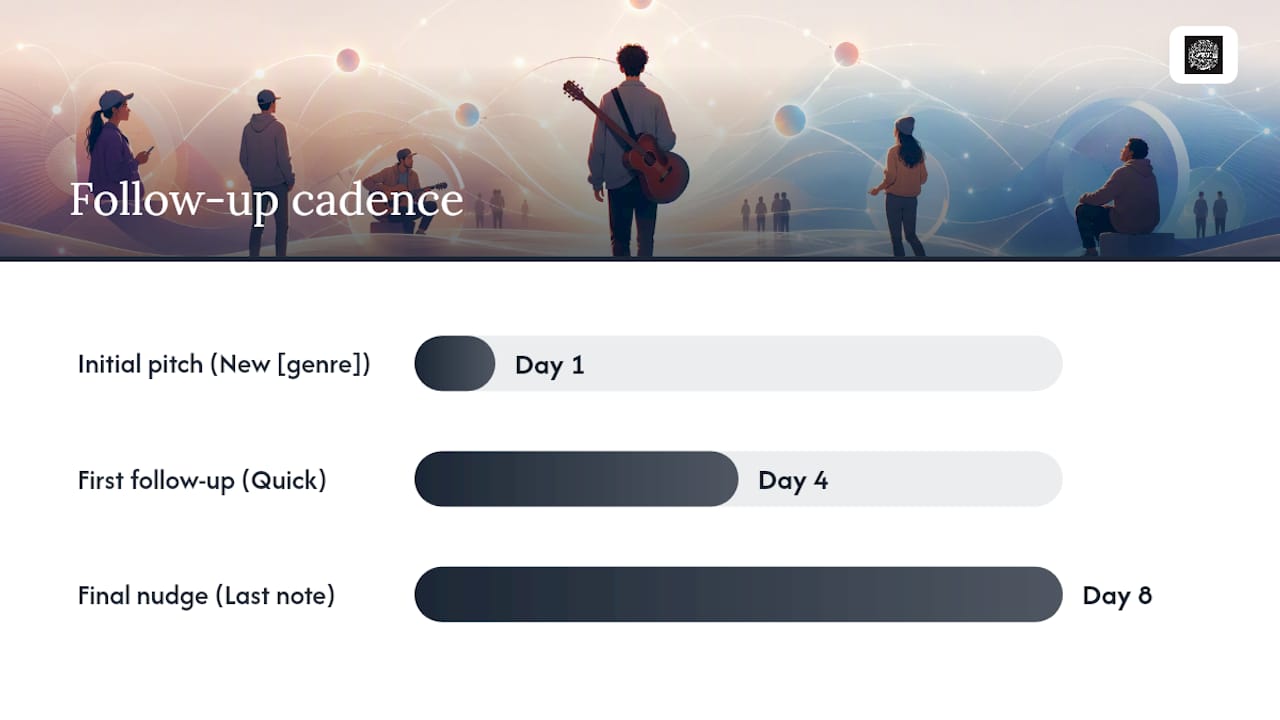
After the third message, move on. Chasing beyond that damages your reputation with that curator. Keep a simple spreadsheet: curator name, platform, date sent, response status. Fifty pitches tracked beats 200 sent blind.
Which free platforms actually move the needle for independent artists?
Building the foundation first — claiming profiles, setting up metadata, and establishing an email list — is what separates artists who get traction from those who post and wonder why nothing happens. Here is what to set up and how each platform converts.
Spotify for Artists
Claim your profile at artists.spotify.com. Upload a bio, a header image, and pin your newest release as the “Artist Pick.” The pitch tool inside the dashboard lets you submit unreleased tracks for editorial playlist consideration — use it every single release. Saves and playlist adds are the metrics that matter here; they signal to Spotify’s algorithm that listeners want to hear more.
Bandcamp
Bandcamp is the best platform for direct fan monetization with zero upfront cost. Set your tracks to “pay what you want” so fans can download for free but also tip you. Bandcamp’s own discovery features (tags, genre pages, and the Bandcamp Weekly) give independent artists real organic reach. Fill in every tag field — genre, mood, city, influences.
SoundCloud
SoundCloud still has an active community of producers, beatmakers, and underground rap listeners. Upload your track, write a full description with keywords, and engage in the comments of similar tracks. The free tier limits uploads, so prioritize your strongest tracks.
YouTube
YouTube is the world’s second-largest search engine. A track with a simple lyric video or even a static image will rank for your artist name and song title searches. Title it correctly: “[Song Name] — [Artist Name] | [Genre] [Year].” That metadata works for you indefinitely.
DistroKid (low-cost distribution)
DistroKid is not free, but at roughly $23 per year for unlimited uploads, it is effectively zero-cost per release. It gets your music onto Spotify, Apple Music, Amazon Music, and Tidal. That distribution is non-negotiable for discoverability on Spotify’s platform of roughly 600 million monthly active users.
Mailchimp (email list)
Mailchimp’s free tier supports up to 500 contacts and 1,000 sends per month. Connect it to your smart link. Every person who gives you their email is a fan the algorithm cannot take from you. Send one email per release: the story behind the song, the link, and a free bonus.
Pro Tip: On Bandcamp, add a “name your price” download with a minimum of $0. In the download gate, require an email address. That single setup turns every Bandcamp visitor into a potential email subscriber.
Your 30-day daily promotion calendar
Organic promotion requires consistency — most independent artists see meaningful traction after several weeks to a few months of steady work, not after one big push. This calendar is built for a release in week two. Budget 30–60 minutes per day. For a deeper walkthrough of the full marketing system behind this calendar, check the 30-day music marketing plan built specifically for independent rappers.
Week 1: Foundation (Days 1–7)
Day 1: Claim all artist profiles. Complete every bio and metadata field. Time: 45 min.
Day 2: Record 5 short-form clips from your upcoming track. Time: 60 min.
Day 3: Build your smart link. Set up Mailchimp free tier. Time: 30 min.
Day 4: Send 10 curator pitches. Use the template from Section 6. Time: 45 min.
Day 5: Post clip #1 on TikTok. Post clip #2 on Reels. Engage in 3 relevant comment sections. Time: 30 min.
Day 6: Post clip #3 on YouTube Shorts. Reply to every comment from Day 5. Time: 20 min.
Day 7 (release day): Drop the song. Post the hook clip everywhere. Reply to all comments within 3 hours. Host a 30-minute Instagram Live listening session. Time: 90 min.
Week 1 milestone: Song live on all platforms, 10 pitches sent, 3 clips posted, email list started.
Week 2: Amplify (Days 8–14)
Day 8: Post the origin story clip. Caption: “This song came from a real place. Here’s the story.”
Day 9: Follow up on Day 4 pitches (first follow-up). Send 10 new pitches to a fresh list.
Day 10: Post the lyric reveal clip. Ask: “Which bar hit harder — drop it in the comments.”
Day 11: Engage in 2 Reddit communities. Share your track with context, not just a link.
Day 12: Post the stem showcase clip. Caption: “Producers — this 808 is available. DM me.”
Day 13: Send your first email to your list. Subject: “The story behind [Song Name].” Include the link and a free bonus.
Day 14: Post a milestone update. “100 streams. Thank you.” with the hook playing underneath.
Week 2 milestone: 50+ streams, first email sent, 20 pitches total, 6 clips posted.
Week 3: Community (Days 15–21)
Day 15: Post the reaction clip. Caption: “First time hearing this. Real reaction.”
Day 16: Final follow-up on original pitches (Day 8 follow-up group). Archive non-responders.
Day 17: Post the challenge prompt clip. “Rap over this. Tag me. I’ll repost the best one.”
Day 18: Join 2 Facebook groups for independent artists. Introduce yourself and share the track.
Day 19: Post the mood board clip. 5 images that inspired the song, set to the track.
Day 20: Host a second Instagram Live or Twitter/X Space. Play the song, take questions.
Day 21: Post the “making of” long-form clip on YouTube (60 seconds, stitched from your best 3 clips).
Week 3 milestone: First UGC clip or collab response, 5 Facebook group connections, YouTube channel growing.
Week 4: Sustain and Plan (Days 22–30)
Day 22: Post the lyrics-vs-meaning split screen. Caption: “What I said vs. what I meant.”
Day 23: Reach out to 5 collab peers at your level. Propose a feature swap or a joint live session.
Day 24: Post the collab pitch clip. “Who wants to hop on this beat? DM me.”
Day 25: Send a second email to your list. Subject: “Something I’m working on.” Tease the next release.
Day 26: Post the fan shoutout clip. Screenshot a real comment and build a clip around it.
Day 27: Audit your metrics. Check Spotify for Artists (saves, streams, listener location), TikTok analytics (watch time, shares), and email open rate.
Day 28: Post the process clip. Show the DAW session or the vocal booth setup.
Day 29: Plan your next release. Set the DistroKid delivery date. Record 3 new clips for the next track.
Day 30: Post a “30 days in” recap clip. What you learned, what’s next. This builds trust and keeps momentum.
Week 4 milestone: 100+ listeners, 50+ saves, at least 1 UGC clip, next release planned.
Weekly milestone tracker
Week | Primary goal | Key metric to watch |
|---|---|---|
Week 1 | Foundation and release | Profiles complete, song live, 10 pitches sent |
Week 2 | Amplify and outreach | 50 streams, first email sent, 20 pitches total |
Week 3 | Community and UGC | First collab or UGC response, Facebook/Reddit engagement |
Week 4 | Sustain and plan | 100 listeners, 50 saves, next release scheduled |
Common promotion mistakes that kill your momentum
Most artists do not fail because their music is bad. They fail because of avoidable promotion errors that waste the little traction they do get. Here is what to stop doing and what to do instead.
Sporadic posting. Posting 5 times in one week then going silent for 3 weeks resets your algorithmic momentum. Replace with: 1 post per day minimum during release week, then 3–4 per week ongoing.
Incomplete metadata. A song with no genre tags, no mood descriptors, and a blank artist bio is invisible to playlist curators and streaming algorithms. Replace with: Fill every field on every platform before the release date.
No clear CTA. Posting a clip with no instruction leaves the viewer with nothing to do. “New music out now” is not a CTA. Replace with: “Save this,” “Drop your email in bio for the free pack,” or “Comment your city.”
Chasing virality only. One viral moment with no follow-up system captures nothing. Fans need somewhere to go. Replace with: Every post points to one destination — your smart link with an email capture.
Generic outreach. “Hey, check out my music” sent to 100 people gets 0 responses. Replace with: The personalized DM template from Section 5, sent to 10 targeted people per week.
Ignoring owned audience. Social followers can disappear if a platform changes its algorithm or bans your account. Replace with: Treat every email address as more valuable than 10 followers.
Buying fake streams or followers. Inflated numbers with no engagement destroy your algorithmic credibility and can get your account flagged. Replace with: Real outreach to real people, even if the numbers grow slower.
What signals actually matter: saves on Spotify, repeat listens, playlist adds, email sign-ups, and video shares. Those are the metrics that compound. Views and follower counts are vanity without them.
How do you turn early traction into a sustainable audience?
Getting your first 100 listeners is the hardest part. Keeping them and growing from there requires a system, not just more posts. Consistent, repeatable content that targets a niche will outperform one-off viral attempts, and the artists who build real careers are the ones who treat each release as a chapter in a longer story.
Email capture micro-offer template
Give people a reason to hand over their email. The offer needs to feel exclusive and immediately useful:
Option A: “Get my unreleased track before it hits streaming. Drop your email below.”
Option B: “Free stems from [Song Name]. Email list only.”
Option C: “Download a free beat pack. No strings. Just good music.” (This is exactly what Indepthjaybeats offers — a free pack of beats that gives artists a real taste of the sound before they commit to anything.)
Set up the delivery through Mailchimp’s automation: someone signs up, they get an automated email with the download link within 5 minutes. That is a professional experience with zero cost.
6–12 week release planning checklist
Release one new track every 4–6 weeks to maintain algorithmic presence
Start the pre-release checklist (Section 2) 7 days before each drop
Repurpose each track into at least 10 clips (aim for 20)
Send one email per release to your growing list
Pitch 20 curators per release, rotating to new targets each cycle
Track your metrics at the end of each release cycle and adjust what is not working
When to test small paid experiments
After 60–90 days of consistent organic work, you will have real data: which clips get the most watch time, which captions drive the most saves, which audience responds. That data is what makes a paid experiment worth running. A $5–$10 boosted post on a clip that already performed organically is a validation test, not a gamble. Without organic data first, paid promotion is just burning money. For a full breakdown of how to run low-budget ad tests once you have that foundation, the guide to promoting your rap song using ads walks through the process step by step.
Pro Tip: Build a “release cycle” folder in Google Drive or Notion. Every release gets its own folder: press kit, clips, pitch list, email draft, and metrics log. After 3 releases, you will have a repeatable system that takes half the time.
A producer’s straight talk on why this system actually works
Look, I have been in this industry since 2007. I have seen artists with incredible talent get zero traction because they treated promotion like an afterthought. And I have seen artists with average skills build real audiences because they showed up every single day with a plan.
The placements in WWE 2K25 and Love And Hip Hop Atlanta did not happen because of luck. They happened because the music was positioned correctly, the metadata was clean, the pitches were personal, and the follow-up was consistent. That same discipline applies whether you are pitching a major production or trying to get your first 100 streams. The process is the same. The scale is different.
Here is what most promotion guides will not tell you: the first 30 days feel like you are talking to nobody. The algorithm is not going to hand you an audience. Your first 10 pitches might get 1 response. Your first 5 clips might get 50 views combined. That is normal. That is the cost of entry. The artists who quit at day 15 never find out what day 45 looks like. Consistency is not a motivational poster concept — it is literally how the algorithm decides whether to invest in your content. Keep going.
One more thing: do not confuse activity with strategy. Posting 10 times a day with no direction is noise. Posting once a day with a clear hook, a clear CTA, and a clear destination is a system. Build the system first. Then scale the volume.
Ready to start? Grab 20 free beats and build your next release
You have the plan. Now you need the music to back it up.
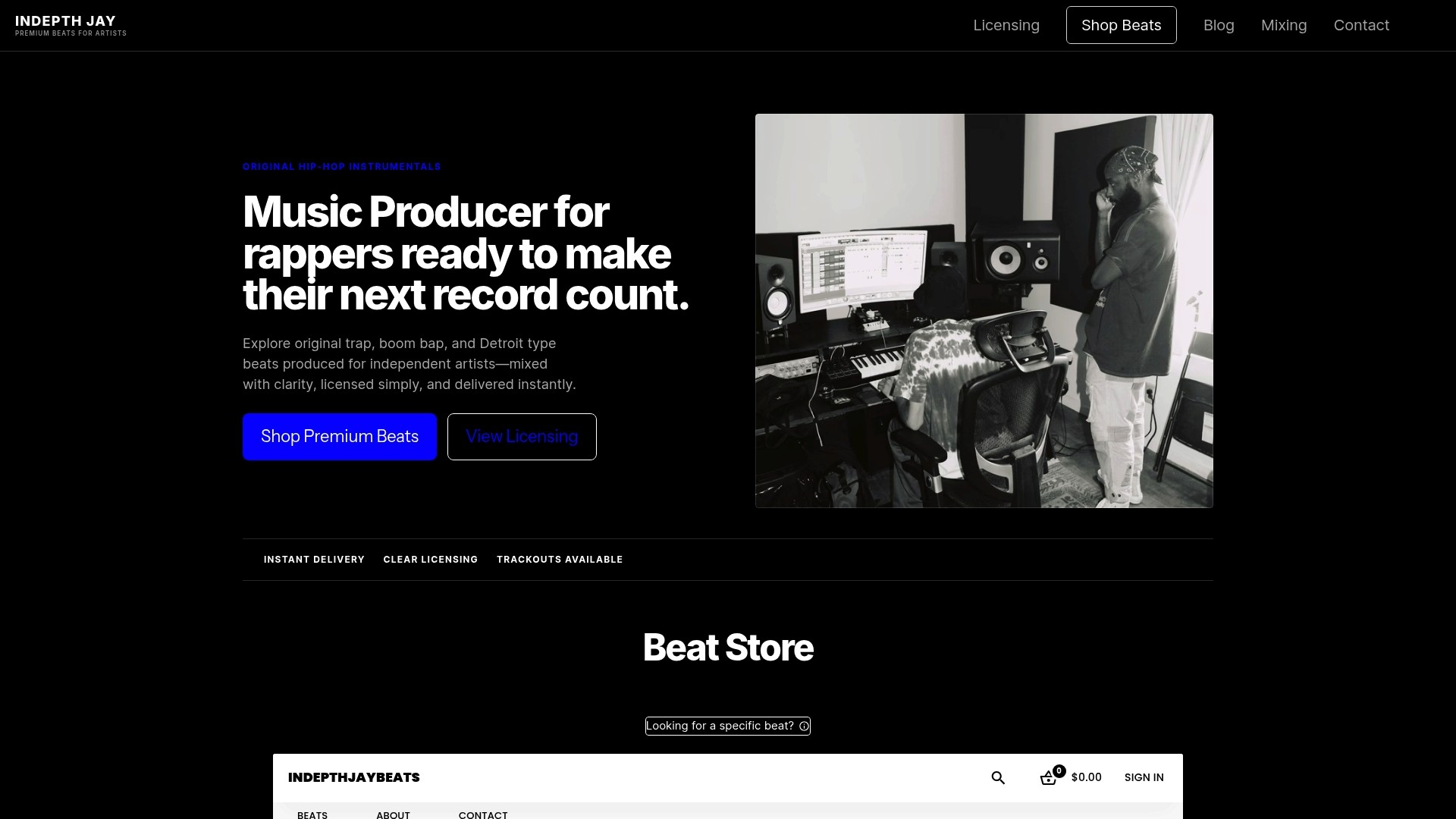
Indepthjaybeats has been producing high-quality trap, boom bap, and hip-hop beats since 2007, with placements in major productions that prove the sound works at the highest level. The free beat pack gives you 20 production-ready instrumentals to work with right now, no commitment required. Use them to record your hook clip for TikTok, build your A/B test for release week, or drop a loop in a UGC challenge to get your first shares. When you find the one that hits, you can browse the full catalog of trap beats or explore boom bap instrumentals built for artists who take their craft seriously. The beats are there. The plan is in your hands. Go get your first 100 listeners.
Download 20 free beats and start building
Sources
How to Promote Your Music in 2026: 10 Proven Strategies That Actually Work - DropTrack
How to Promote a Song Without a Record Label (Independent Artist Guide) - Wolfson Marketing
How Can I Promote My Music With No Money: A Practical Guide | Your Ghost Production
Spotify crosses the 600M monthly active users mark - TechCrunch
Recommended

Get 20+ Free Beats delivered to your inbox
Drop your name and email and I'll send a pack to your inbox right away.
We respect your inbox, no spam. Promise!