
Repurposing music for content is the most efficient promotion strategy available to independent rap artists today. One finished rap song contains enough raw material to fuel 30 distinct content pieces across TikTok, Instagram, YouTube Shorts, and Spotify. The key is systematic extraction, not duplication. This article shows you how to turn one rap song into 30 pieces of content by breaking your track into components, mapping each part to a platform, and batching production so you stay consistent without burning out.
How to turn one rap song into 30 pieces of content: the foundation
Every strong repurposing workflow starts with an anchor piece. The anchor is your full song or its official music video. Everything else branches from it. Think of it as the trunk of a tree. You pull stems, verses, hooks, and visuals off that trunk and build content from each branch.
Before you touch an editing app, you need the right tools in place. Here is what the core toolkit looks like:
Stem splitter: Voice.ai or similar tools isolate vocals, drums, and instrumentals from your finished track. Isolated stems open up remix content, karaoke clips, and producer-focused posts.
Video editing software: CapCut, Adobe Premiere Pro, or DaVinci Resolve for cutting short-form clips from your recording session footage.
Transcription service: Tools like Descript or Otter.ai convert your lyrics and spoken content into text. Scanning transcripts cuts clip-finding time from roughly 30 minutes per clip down to 10–12 minutes.
Scheduling app: Buffer or Later lets you plan posts across platforms in one session instead of logging in daily.
Spotify Canvas: A 3–8 second looping video tied to your track on Spotify. Canvas loops correlate with higher save and share rates and cost nothing beyond creation time.
Pro Tip: Check safe-area margins on every vertical video before you export. Text and faces cut off at the edges on TikTok and Instagram Reels kill the visual impact fast.
The platform specs matter too. TikTok and Instagram Reels run at 9:16 vertical, 1080x1920 pixels. YouTube Shorts uses the same ratio. Horizontal cuts from a studio session need to be reframed before they work on these platforms.

How do you break down your rap song into content-ready components?
A single rap track has more distinct sections than most artists realize. Each section carries a different emotional weight and serves a different content job. Map them out before you record anything extra.
Intro (0–15 seconds). This is your hook for discovery content. Use it as the opening of a TikTok that teases the drop. Pair it with a text overlay asking a question your lyrics answer.
Verse 1. This is your storytelling section. Pull the most vivid two-line sequence and build a lyric graphic carousel for Instagram. The story angle works well for caption-heavy posts.
Hook/Chorus. The hook is your most repeatable moment. It works as the centerpiece of a Reel, a Spotify Canvas loop, and a standalone lyric video clip. One hook can generate at least four separate pieces.
Verse 2. Use this for a behind-the-scenes clip. Record yourself explaining the inspiration behind a specific line. That raw, personal content builds connection faster than polished promos.
Bridge. The bridge often carries the emotional peak of the song. Strip it back to just vocals and piano or guitar for an acoustic version clip. Acoustic content hits differently and reaches listeners who skip harder production.
Outro. Use the outro as a call-to-action moment. A short clip that ends with “link in bio” or “out now” works here without feeling forced.
Building a content inventory that logs each section and assigns it a specific content purpose prevents you from posting the same moment twice. It also keeps your feed varied so followers do not feel like they are watching the same clip on a loop.
Pro Tip: Write your content inventory in a simple spreadsheet. Columns: song section, content type, platform, status. Update it every time you post. This one habit keeps 30 pieces organized without confusion.
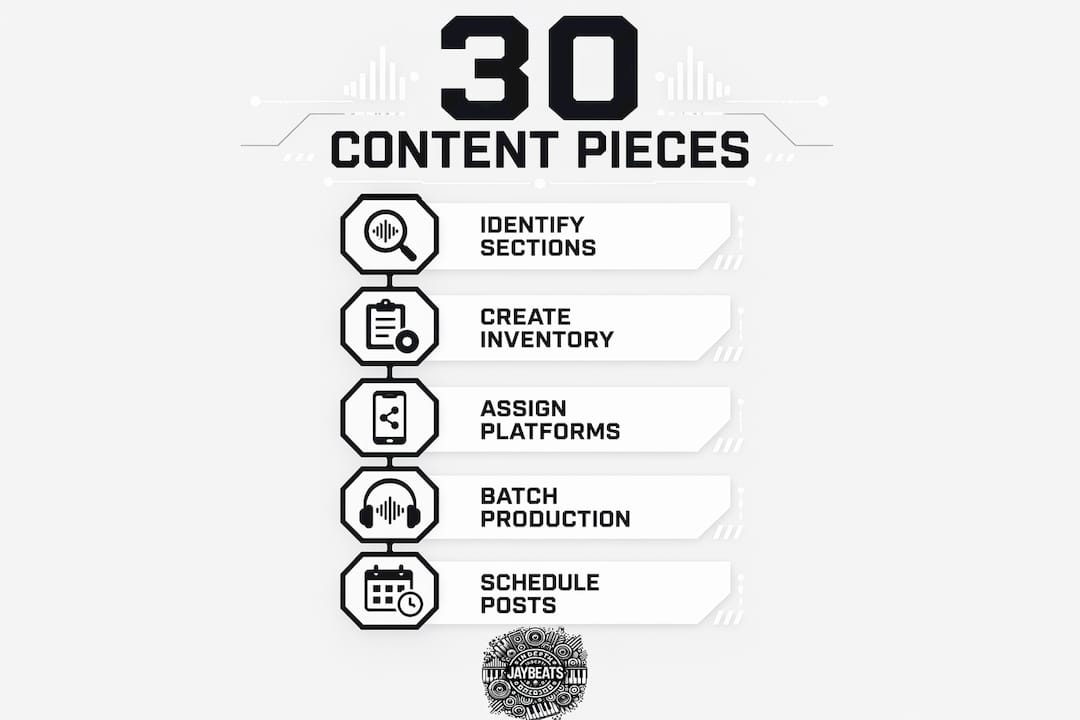
Identifying emotional peaks inside the song is the move most artists skip. A line that made you feel something in the booth will make a listener stop scrolling. Mark those moments first. They become your highest-priority clips.
What types of content pieces can emerge from these song components?
One rap track, broken down correctly, produces content across at least seven distinct categories. Each category serves a different audience behavior and platform algorithm.
Short-form video clips (TikTok, Reels, Shorts):
Hook clip using the chorus over a reaction or performance moment
Verse 1 clip with lyric text overlay
Verse 2 clip with behind-the-scenes studio footage
Bridge clip as an emotional standalone moment
Intro clip as a teaser before release
Full song preview cut to 60 seconds for YouTube Shorts
Lyric and visual content:
Static lyric graphic for Instagram feed (one per standout line)
Lyric carousel breaking down the full song line by line
Lyric video posted to YouTube
Spotify Canvas loop using the hook section
Behind-the-scenes and storytelling content:
Recording session mini-doc (2–3 minutes, YouTube)
“How I wrote this song” talking-head video
Producer breakdown of the beat (great for original beat credit and collaboration visibility)
Studio photo series for Instagram stories
Acoustic and alternate versions:
Stripped acoustic version of the hook
A cappella vocal clip showing raw delivery
Slowed and reverb version clip for late-night content
Fan engagement content:
Isolated vocal stem posted for fans to remix
Q&A post asking fans what the song means to them
Poll asking which verse hits harder
Each derivative satisfies a different listener need without diluting the song’s original essence. That is the core logic behind this entire approach.
Content category | Pieces generated | Primary platform |
|---|---|---|
Short-form video clips | 6 | TikTok, Reels, Shorts |
Lyric and visual content | 4 | Instagram, YouTube, Spotify |
Behind-the-scenes and storytelling | 4 | YouTube, Instagram Stories |
Acoustic and alternate versions | 3 | TikTok, YouTube |
Fan engagement content | 3 | Instagram, TikTok |
Remixes and collaborations | 2 | SoundCloud, TikTok |
Promotional graphics and ads | 4 | Instagram, Facebook |
That table maps to 26 pieces. Add your full music video, a press release post, a playlist pitch graphic, and a release-day countdown story. You are at 30.
How to batch and schedule your 30 content pieces for maximum impact
Batching production prevents burnout and fragmented workflow. The goal is to generate, review, export, and schedule all content in dedicated sessions rather than spreading tasks across weeks.
Here is a four-phase schedule built around a single release:
Week 1: Tease phase. Post three to four teaser clips using the intro and hook sections. Drop one lyric graphic. Run a countdown story. The goal is curiosity, not full exposure.
Week 2: Release phase. Drop the full song, the lyric video, and the music video on release day. Post the Spotify Canvas loop. Share the studio mini-doc two days after release to keep momentum going.
Week 3: Storytelling phase. Post the “how I wrote this” video, the verse-by-verse lyric carousel, and the acoustic version clip. This phase deepens the connection for listeners who already streamed the track.
Week 4: Engagement phase. Release the isolated vocal stem, run the fan Q&A, and post the remix or collaboration preview. This phase turns passive listeners into active participants.
A structured content calendar maps each of your 30 deliverables to a specific format, channel, and date. That structure is what separates artists who stay consistent from those who post in bursts and disappear.
Pro Tip: Block two full production days before your release date. Day one: record all extra footage and alternate versions. Day two: edit, caption, and schedule everything in Buffer or Later. You walk away with 30 pieces queued and nothing left to scramble for.
Repurposing is not cross-posting the same file to every platform. A TikTok clip needs a different caption, pacing, and intro than the same clip on Instagram Reels. Adapt each piece to fit where it lives. That adaptation is what drives reach. Tracking performance after each phase tells you which formats to push harder in your next campaign. Check saves, shares, and profile visits, not just views.
Key takeaways
Turning one rap song into 30 content pieces requires a content inventory, platform-specific adaptation, and batched production sessions to stay consistent without burning out.
Point | Details |
|---|---|
Start with an anchor piece | Build all 30 pieces from your finished song or music video as the single source. |
Map every song section | Assign each section (intro, verse, hook, bridge, outro) a specific content job before editing. |
Diversify content categories | Spread pieces across short clips, lyric visuals, behind-the-scenes, acoustic versions, and fan content. |
Batch production in two sessions | Record all extra footage on day one, then edit and schedule everything on day two. |
Adapt per platform | Reframe, recaption, and repace each clip to match TikTok, Reels, Shorts, or Stories individually. |
Why most rappers leave 25 pieces of content sitting on the table
I have watched artists drop a song, post once on release day, and then go quiet for two months waiting on streams to move. That is not a promotion problem. That is a planning problem. The song had everything needed for a full month of content. They just never extracted it.
The biggest mistake I see is treating repurposing as an afterthought. Artists finish the track, rush to release it, and then try to figure out content on the fly. That is where burnout comes from. You end up staring at a blank caption box at 11 p.m. with nothing ready. The fix is not more creativity. It is more structure.
A 30-day music marketing plan built around one song changes the entire experience. You stop reacting and start executing. Every post has a purpose. Every clip serves a phase. The song does not get old to your audience because they are seeing it from a different angle every few days.
One more thing: do not strip the art out of repurposing. The acoustic version, the lyric breakdown, the “why I wrote this” video. Those pieces show who you are beyond the track. That is what builds a real fan base, not just a stream count.
— Indepthjaybeats
What Indepthjaybeats offers independent rap artists
The content strategy only works when the song itself is worth building around. A weak mix or a generic beat limits how far any clip travels.

Indepthjaybeats has been producing boom bap and trap beats since 2007, with placements in WWE 2K25 and Love and Hip Hop Atlanta. If you need a hard 808 foundation for your next release, the trap beat catalog is built for rappers who take their sound seriously. Professional mixing and mastering services are also available to make sure your track sounds ready before you build 30 pieces of content around it. A free beat pack is available for artists who want to hear the quality before committing.
FAQ
How many content pieces can one rap song realistically produce?
One rap song can produce 30 or more distinct content pieces when you break it into sections and map each part to a specific format and platform. Short clips, lyric visuals, behind-the-scenes footage, acoustic versions, and fan engagement posts each count as separate pieces.
What is the difference between repurposing and cross-posting?
Repurposing means adapting each piece with platform-specific captions, pacing, and framing. Cross-posting means uploading the same file everywhere with no changes, which limits reach and engagement on every platform.
What tools do I need to start repurposing a rap song?
The core tools are a stem splitter like Voice.ai, a video editor like CapCut or DaVinci Resolve, a transcription tool like Descript, and a scheduling app like Buffer. Spotify Canvas rounds out the toolkit for streaming platform visuals.
How long does it take to produce 30 content pieces from one song?
Two dedicated production days cover most of the work. Day one handles recording extra footage and alternate versions. Day two covers editing, captioning, and scheduling all pieces in one session.
When should I start planning content before a song release?
Start building your content inventory and recording extra footage at least two weeks before your release date. That lead time lets you enter the tease phase with clips already edited and scheduled.
Recommended

Get 20+ Free Beats delivered to your inbox
Drop your name and email and I'll send a pack to your inbox right away.
We respect your inbox, no spam. Promise!