If you want a professional rap career, treat your music like a product delivered by a real company — with systems, revenue channels, and measurable goals running in the background every single day. Most rappers fail not because their music is weak, but because they have no operating structure behind it. The Artist Operating System framework makes this plain: independent artists who build repeatable systems around product, distribution, audience, and revenue consistently outperform those who rely on talent alone.
Start here. This week. Before you read another word.
Your one-week starter checklist:
Audit every username and handle across platforms — lock down one consistent artist name everywhere
Open a separate bank account dedicated to music income and expenses only
Claim your profiles on Spotify, Apple Music, Amazon Music, and TIDAL
Draft a simple 30–90 day content and release calendar (even a notes-app list counts)
Set a price for at least one product: a beat license, a feature verse, or a merch item
Register your email list tool (Mailchimp or ConvertKit) and collect your first 10 subscribers
Pick three KPIs to track weekly: monthly listeners, email signups, and revenue per fan
Those KPIs are not vanity metrics. Monthly listeners tell you if your reach is growing. Email signups tell you if you own your audience. Revenue per fan tells you if your monetization is working. Track all three from day one.
Key Takeaways
Running your rap career like a business means building systems for product, distribution, revenue, and measurement before you need them — not after your first break arrives.
Point | Details |
|---|---|
Systems over talent | Independent artists with repeatable operating systems consistently outperform those relying on talent alone. |
Own your rights | Register every composition and master with the U.S. Copyright Office and your PRO before releasing publicly. |
Diversify revenue | Stack fast channels (beat sales, merch) with medium channels (streaming, Patreon) and long-runway channels (sync). |
Track three KPIs | Monitor monthly listeners, email subscribers, and revenue per fan every week from day one. |
Indepthjaybeats | Offers licensing-ready trap and boom-bap beats with stems, clean metadata, and a free starter pack for independent artists. |
Table of Contents
How do you set up money systems that actually protect your income?
How do you package beats and pitch for TV and film placements?
How do you actually think like a business as a rapper?
The honest answer: you run two jobs at the same time. One is creative — writing, recording, producing. The other is commercial — marketing, distribution, licensing, and money management. Most rappers pour everything into the creative job and ignore the commercial one entirely. That gap is where careers stall.
Academic research on professionalizing the rap career confirms this pattern: artists who adopt structured, business-like practices around promotion and registration build more durable careers than those who treat every release as a one-off event. The music industry has always rewarded the organized.
So what does the commercial job actually look like on a Tuesday afternoon? It looks like checking your Spotify for Artists dashboard, responding to a sync inquiry, updating your split sheet, and scheduling next week’s Instagram post. None of that is glamorous. All of it compounds.
KPIs every rapper should track:
Save rate on Spotify (saves per stream indicate catalog loyalty)
30-day listener retention (how many new listeners come back the following month)
Repeat-listen rate on YouTube (rewatches signal a real fan, not a casual click)
Revenue per supporter (total monthly revenue divided by paying fans or Patreon members)
Conversion rate from listener to buyer (how many listeners click your merch or beat store link)
Set SMART goals around these numbers. Not “blow up this year” — that is not a goal. Try: “Grow monthly Spotify listeners from 500 to 2,000 by the end of month three by releasing one single per month and running two targeted playlist pitches per release.” That is specific, measurable, and tied to a real action.
Pro Tip: Treat your catalog like a product line, not a highlight reel. Every song is a SKU. Some will be your best-sellers, some will be slow movers, and some will find their audience six months after release. Catalog depth is what keeps revenue flowing between drops.
Labels now expect artists to arrive with audience data and business infrastructure before they invest. That means building your systems now is not just smart for independence — it is the prerequisite for any deal worth signing.
What does a strong artist brand actually look like?
A consistent brand shortens the path to monetization because it removes friction. When a sync supervisor, a playlist curator, or a potential fan lands on your page, they should know within five seconds who you are, what you sound like, and what you stand for. Confusion kills conversions.

Hip-hop culture has always been identity-first — from the graffiti tags to the DJ names to the borough affiliations. Your brand is not a logo slapped on a hoodie. It is the full picture: your name, your sound, your visual world, and the one sentence that captures all of it.
Core brand elements to lock in:
Artist name: Is it searchable? Is it taken on every platform? Does it travel well across genres?
Logo and color palette: Pick two or three colors and one mark. Use them everywhere, every time.
One-line artist positioning: Something like “dark melodic trap from Detroit built for late-night drives” or “raw boom-bap storytelling for people who came up the hard way.” Specific beats generic every time.
Visual assets: Cover art templates, social headers, and press photos that share the same visual DNA
Voice and messaging: How do you caption posts? What words do you use? What do you never say?
Your 30-day brand audit checklist:
Google your artist name — what comes up, and is it consistent?
Screenshot every profile header and compare them side by side
Write your one-liner and test it on three people outside the music world
Commission or create one logo file in SVG or high-res PNG
Build a simple Canva template for cover art using your color palette
Update every bio to match the same messaging and tone
Pro Tip: Your brand choices directly affect your sync and licensing appeal. A dark, cinematic visual identity with a clear genre tag makes it easier for a music supervisor to picture your track in a scene. Vague branding gets skipped. Specific branding gets placed.
Brand consistency also affects merch. A strong visual identity means your hoodie, your cover art, and your Instagram grid all feel like they belong to the same world. That coherence is what makes fans want to wear your name.
How do you build a digital HQ that actually works for you?
You need a central digital presence that funnels Spotify listeners and social followers into channels you own — your website and your email list. DSPs are rented land. Your mailing list is property.
Platform strengths at a glance:
Platform | Primary strength | Best use for rappers |
|---|---|---|
Spotify / Apple Music | Discovery and catalog streaming | Release singles, pitch playlists, collect royalties |
TikTok | Viral short-form reach | 15–30 second hooks, challenge audio, behind-the-scenes |
YouTube | Long-form and search traffic | Music videos, freestyles, vlogs, lyric videos |
Visual brand and community | Cover art reveals, reels, story polls, DMs | |
Email / SMS list | Owned audience, highest conversion | Drops, merch launches, exclusive content |
Website | Central hub and credibility | EPK, beat store, mailing list opt-in, press |
Your website does not need to be complicated. A one-page site with your bio, a music player, a press kit download, and an email opt-in form covers 90% of what you need at the start. Tools like Bandzoogle or Squarespace get you there without a developer.
For your content calendar, run a weekly cadence like this:
Monday: Post a snippet or lyric graphic to Instagram and TikTok
Wednesday: Send a short email to your list (new music, behind-the-scenes, or a direct offer)
Friday: Drop or tease the week’s main content (single, freestyle, video)
Sunday: Engage — reply to comments, share a fan post, post a poll
Check out this 30-day music marketing plan for independent rappers for a more detailed week-by-week breakdown. And if TikTok feels awkward, this guide on promoting rap music on TikTok without looking corny is worth your time before your next drop.
The biggest mistake rappers make with distribution is treating a release like a finish line. A release is the starting gun. The promotion window — playlist pitching, press outreach, social content — runs for at least four weeks after the drop date.
What are the real ways to make money from your rap career?
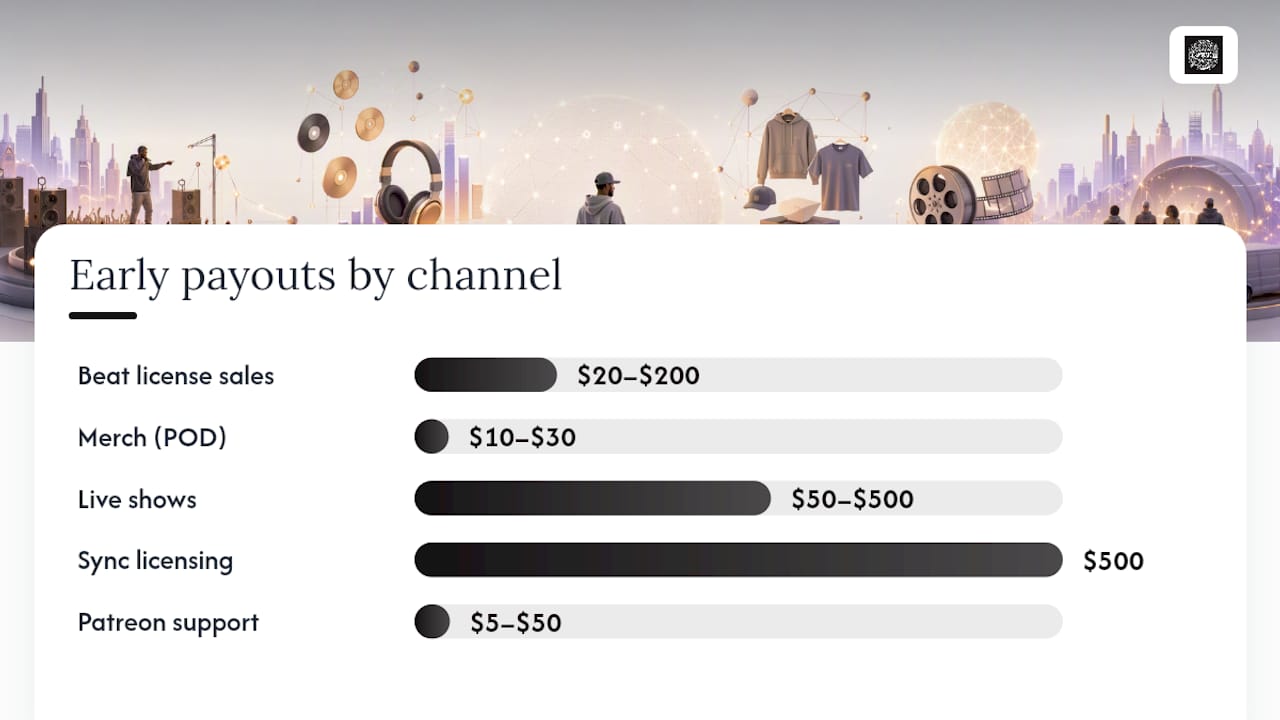
Diversify across fast, medium, and long-runway channels. Fast channels pay within days or weeks (beat sales, merch drops, paid shows). Medium channels build over months (streaming royalties, YouTube AdSense, Patreon). Long-runway channels take a year or more to mature (sync licensing, brand deals, publishing advances). You need all three running at once.
Revenue channel map:
Channel | Effort level | Speed to first dollar | Realistic early payout |
|---|---|---|---|
Beat / license sales | Low–medium | Days | $20–$200 per non-exclusive license |
Merch (print-on-demand) | Low | 1–2 weeks | $10–$30 margin per item |
Live shows / gigs | Medium | 2–4 weeks | $50–$500 for local shows |
Streaming royalties | Low (after release) | 2–3 months | Fractions of a cent per stream |
YouTube AdSense | Low (after threshold) | 3–6 months | Varies by views |
Sync / TV licensing | High (pitch effort) | 3–12 months | $500 per placement |
Patreon / fan support | Medium | 1 month | $5–$50 per supporter per month |
Brand deals | High | 6 months | Highly variable |
Chance the Rapper built a fully independent revenue model by combining free music for reach with direct monetization through merch, ticketing, and selective partnerships — no label required. That model still works for independent artists at every level.
At the top end, Drake’s approach to building a music empire shows what happens when you stack catalog ownership, brand equity, and institutional financing over years. The principle scales down: own what you create, and build revenue on top of that ownership.
Quick revenue experiments to run in the next 30 days:
Drop a limited merch item (one design, print-on-demand, 72-hour window)
Offer a paid livestream Q&A or listening session via Zoom or StreamYard
Package two or three beats as a themed bundle and price it at a slight discount
Pitch one track to a sync library or music supervisor this week
Launch a $5/month Patreon tier with one exclusive benefit (early access, stems, or a monthly freestyle)
Pro Tip: Jay-Z’s ownership-first strategy is the template — equity over fees, always. Every time you take a flat fee instead of a royalty split, you are trading long-term income for short-term cash. Sometimes that trade makes sense. Know when you are making it.
How do you set up money systems that actually protect your income?
Money systems protect your income and scale it. Without them, you are running a business out of your personal checking account, mixing music money with grocery money, and handing the IRS a reason to audit you. Set up the infrastructure before the money gets real.
Step one: separate your accounts. Open a dedicated business checking account for all music income and expenses. Many independent artists use business accounts through banks like Chase, Bank of America, or credit unions. This single step makes bookkeeping, taxes, and cash flow tracking dramatically cleaner.
Step two: bookkeeping basics. You do not need an accountant on day one, but you do need a system. Tools like Wave (free) or QuickBooks Self-Employed handle income tracking, expense categorization, and quarterly tax estimates for solo artists. Your chart of accounts for music should include: recording costs, beat purchases, marketing spend, travel for shows, equipment, and distribution fees.
Business structure options:
Sole proprietor: Zero setup cost, simplest taxes, but your personal assets are exposed to any business liability. Fine for early-stage artists with minimal revenue.
LLC (Limited Liability Company): Separates personal and business liability, costs $50–$500 to file depending on your state, and can elect S-corp tax treatment later. The most common structure for independent artists earning consistent income.
S-Corporation: Reduces self-employment tax on profits above a reasonable salary, but adds payroll complexity. Worth exploring once annual net profit exceeds roughly $40,000–$50,000 — consult a CPA before making this move.
Tax basics for U.S. independent artists:
You are self-employed, which means you owe both the employee and employer portions of Social Security and Medicare taxes (15.3% on net self-employment income)
Deductible expenses include home studio costs, beats purchased, recording fees, travel to shows, marketing, and professional subscriptions
Pay estimated quarterly taxes to the IRS (due in April, June, September, and January) to avoid underpayment penalties
Sales tax on merch varies by state — check your state’s department of revenue for current rules
Pro Tip: Set aside 25–30% of every music payment the moment it hits your account. Move it to a separate savings account labeled “taxes.” That habit alone prevents the end-of-year scramble that wipes out artists who had a good run.
Bookkeeping tasks to run monthly:
Reconcile your business account against your income log
Categorize every expense in your bookkeeping tool
Calculate your net profit and compare it to last month
Review your streaming and royalty statements from your distributor
Update your quarterly tax estimate if income changed significantly
This article provides general financial information for independent artists. Consult a licensed CPA or tax professional for advice specific to your situation.
What legal basics do you need to protect your music?
Register your works and understand your splits — those two actions protect more income than any marketing campaign ever will. Most rappers skip this step until they lose money. Do it before the money arrives.
Copyright and registration checklist:
Register every sound recording and composition with the U.S. Copyright Office — group registration for unpublished works costs $55 and covers multiple songs in one filing
Obtain an ISRC (International Standard Recording Code) for every master recording through your distributor or CD Baby Pro
Obtain an ISWC (International Standard Work Code) for every composition through your PRO
Join a Performing Rights Organization: ASCAP, BMI, or SESAC. ASCAP and BMI are free to join for songwriters and publishers
Register every released song with your PRO to collect performance royalties from radio, streaming, and live performances
Set up a publishing entity (even a simple DBA) to collect the publisher’s share of performance royalties — most artists leave this money uncollected
Publishing vs. master rights — the split that matters most:
Your master recording is owned by whoever paid for the recording. Your composition (melody and lyrics) generates publishing royalties. These are two separate income streams. If you sign away your masters without retaining publishing, you lose both. Retain both for as long as you can.
Sample clearance basics:
Sampling without clearance is a lawsuit waiting to happen. If you sample a recognizable element from another recording, you need two clearances: one from the master owner (usually a label) and one from the publisher (the composition owner). Uncleared samples can result in your track being pulled from DSPs and legal liability. When in doubt, use original production or cleared sample packs.
Contract red flags to watch for:
Perpetual rights grabs with no reversion clause
Recoupment structures where you owe back expenses before seeing royalties
Exclusivity clauses that prevent you from releasing music independently
Vague ownership language around “works created during the term”
No audit rights — you should always be able to verify royalty statements
Simple split sheet template (fill in before any session):
Contributor | Role | Composition % | Master % |
|---|---|---|---|
Artist A | Lyrics / topline | 50% | 50% |
Producer B | Beat / instrumental | 50% | 50% |
Adjust percentages before the session, not after. Post-session splits are where friendships and business relationships break down.
Get a music attorney to review any contract before you sign. The American Bar Association’s Lawyer Referral Service connects you to entertainment lawyers, and many offer a free or low-cost initial consultation.
Who do you actually need on your team, and when?
You need a lean, trusted crew — not a full label roster. The mistake most emerging rappers make is hiring too early, too broadly, or based on hype instead of results. Build the team around specific gaps, not status.
Core roles and when to bring them on:
Manager: When you have consistent income, a release schedule, and more opportunities than you can handle alone. A manager takes 15–20% of gross income — they should earn more than they cost within six months.
Entertainment attorney: Before you sign anything. Not after. A one-time contract review costs $200–$500 and can save you years of locked-up rights.
Booking agent: When you are ready to tour or play regular shows and need someone to negotiate fees and route dates. Agents typically take 10–15% of show fees.
Publicist: When you have a release worth pitching to press and a budget of at least $1,000–$2,000 per month for a campaign. A publicist without a story to tell burns money.
Videographer / content creator: Earlier than most rappers think. Visual content drives discovery. A reliable freelancer on retainer is more valuable than one expensive video per year.
Red flags to watch for in managers and promoters:
Asks for a percentage before delivering any results
Cannot name three artists they have worked with and what they accomplished
Pushes you to sign a long-term exclusive deal before you have seen their work
Promoter collects ticket money upfront with no written agreement on your guarantee
Anyone who says “trust me” more than they show you receipts
Outreach email template for collaboration:
Subject: Collab — [Your Artist Name] x [Their Name]
Hey [Name], I’ve been following your work for a minute — [specific song or project] hit different. I’m [your name], a [genre] artist based in [city]. I think our sounds could do something interesting together. I’m working on [project name/type] and have [X] slots for features/production. No pressure — if it makes sense, I’d love to send you something to vibe with. Here’s my latest: [link]. Let me know.
Keep it short. Keep it specific. Never ask for a favor in the first message.
Pro Tip: For every co-write or producer collaboration, complete a split sheet before the session ends. Use a free tool like Splits.io or a simple Google Form. A signed split sheet is your paper trail if the song blows up two years later and someone’s memory gets convenient.
How do you package beats and pitch for TV and film placements?
Craft licensing-ready beat packs and concise sync-friendly pitch materials before you ever send an email to a music supervisor. The pitch is only as strong as the deliverables behind it.
A sync placement starts with the right metadata. Every instrumental you want to pitch needs: the BPM, key, mood tags, genre tags, and a clean title that describes the feel (not just “Beat 47”). Music supervisors search by mood and tempo, not by artist name. If your files are not tagged, they get skipped.
What a licensing kit needs:
High-quality WAV files (minimum 44.1kHz / 24-bit) for every track
Separate stems (drums, bass, melody, top line) for each instrumental
A completed cue sheet with song title, composer, publisher, PRO affiliation, and ISRC
A one-page pitch document: your name, contact, genre, BPM range, and three mood descriptors per track
A short bio (three sentences max) and a link to your catalog
Pitch email template for sync supervisors:
Subject: Sync Submission — [Mood/Genre] Instrumentals for [Show/Film Type]
Hi [Name], I’m [your name], a producer specializing in [genre] instrumentals. I have a catalog of [X] cleared, stems-ready tracks that fit [specific mood or show type]. Attached is a one-page overview with streaming links and download access. All tracks are 100% cleared with no sample issues. Happy to send WAVs and stems on request. Thank you for your time.
Short. Professional. No attachments over 2MB in the first email — link to a Dropbox or Google Drive folder instead.
Getting a placement is not about luck. It is about having the right file in the right format with the right metadata when the supervisor needs it. Most producers lose placements not because their music was wrong, but because their delivery was sloppy. Clean files, clear rights, fast response — that is the real competitive edge.
The complete guide to music licensing for film and TV breaks down the submission process in detail, including which libraries accept unsolicited submissions and how to price sync licenses at different budget levels.
Pro Tip: Prep an “instrumental-only” version and a “no hook” version of every vocal track you release. Sync supervisors often need a version without the lead vocal for background scenes. Having those files ready before the request comes in is the difference between a placement and a missed opportunity.
What does a real 30–90 day plan look like for a rapper?
Here is the exact 30–90 day plan to move from hobby to business. Not a vague roadmap — specific tasks, specific checkpoints, and specific numbers to hit.
Days 1–30: Build the foundation
Complete the one-week starter checklist from the opening of this guide
Register your artist name as a DBA or LLC in your state
Join ASCAP or BMI and register your two most recent releases
Set up your website with a bio, music player, and email opt-in
Distribute your next single through a distributor (DistroKid, TuneCore, or CD Baby) with full metadata
Create your split sheet template and use it for every session this month
Post content on at least three platforms, three times per week, for 30 straight days
Collect your first 25 email subscribers
Days 31–60: Build the audience
Pitch your current single to 10 independent playlist curators via SubmitHub or direct outreach
Run one limited merch drop (one item, 72-hour window, print-on-demand)
Book one local show or open mic and document the performance for content
Launch a Patreon or fan subscription at one tier ($5/month)
Send your first three sync pitches using the licensing kit you built in month one
Reach out to two producers or artists for a collaboration session
Review your KPIs at the 30-day mark and adjust your content calendar based on what performed
Days 61–90: Build the revenue
Release your second single with a full promotional push (content, email, playlist pitching)
Follow up on all sync pitches and submit to two music licensing libraries
Price and list one exclusive beat or licensing package on your website or beat store
Negotiate your first paid show or feature verse
File your first quarterly estimated tax payment if you have earned income
Review your business structure and consult a CPA if monthly revenue exceeds $1,000
Set your 90-day KPI targets for the next quarter
KPI targets by month:
These are starter targets for an artist beginning from near zero. Adjust up if you already have an audience. The point is to have a number to beat, not to hit a universal benchmark.
Checkpoints to confirm before moving to the next phase:
Copyright registrations filed for all released works
PRO membership active and songs registered
Business bank account open and in use
At least one revenue experiment completed (merch, beat sale, or paid show)
Email list active with at least one sent campaign
For a more detailed release-by-release breakdown, the guide on how to release your first single as an independent rapper walks through every distribution and promotion step.
A producer’s note: real talk from someone who places beats
Most artists I work with have the talent. What they are missing is the patience to build the infrastructure before the big moment arrives. I have been producing since 2007, and the artists who get placements — in projects like WWE 2K25 or Love And Hip Hop Atlanta — are not always the most talented people in the room. They are the most prepared. They have clean files. They have cleared rights. They respond to emails within 24 hours. They treat every beat purchase and every sync inquiry like a business transaction, because it is one. Systems do not kill creativity. They protect it. Build yours now, before you need them.
Ready-made beats and licensing tools from Indepthjaybeats
If you need production that is already built for placements, Indepthjaybeats has been delivering that since 2007. The catalog covers hard 808 trap beats, classic boom-bap instrumentals, and a full range of hip-hop and R&B production — all available as non-exclusive or exclusive licenses with stems included.
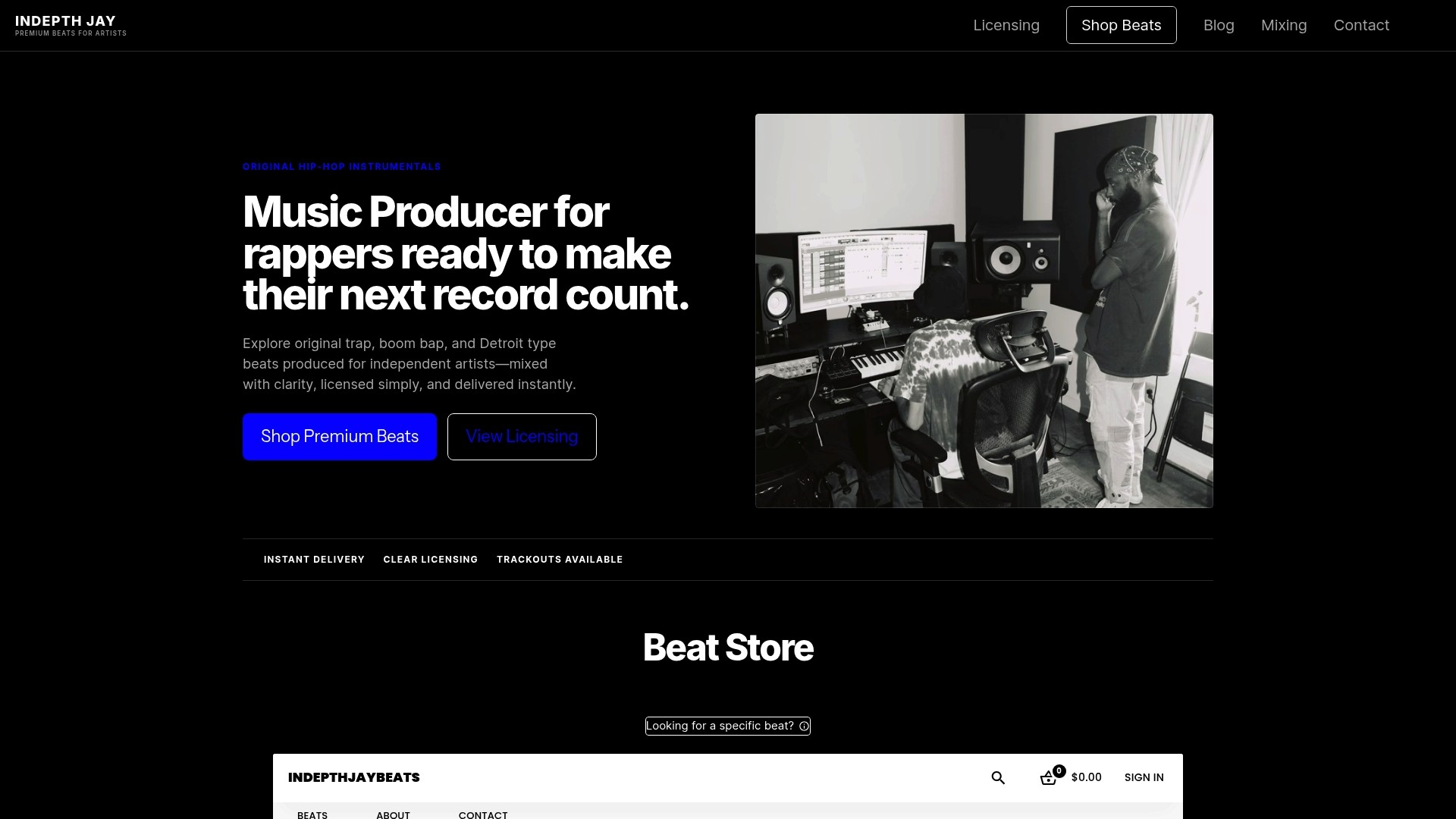
Every beat in the catalog comes with clean metadata, proper licensing documentation, and the option to upgrade to an exclusive license as your career grows. Artists have used these instrumentals to land placements in major productions, and the free beat pack gives you a direct sample of the sound before you commit to a purchase. Browse the full catalog and buy hip-hop beats online to find the right instrumental for your next project, or grab the free starter pack at Indepthjaybeats to hear the quality firsthand.
Sources
Chance the Rapper: Build a career where ‘you’re the upper management’ - CNBC
How Drake brilliantly built a $100M music empire - RollingOut
The Label Catch-22: Why You Must Build a Business Before Getting Signed
This article is general information, not a substitute for advice from a qualified financial advisor. Consult a qualified financial professional about your own circumstances before acting on anything here.
Recommended

Get 20+ Free Beats delivered to your inbox
Drop your name and email and I'll send a pack to your inbox right away.
We respect your inbox, no spam. Promise!