A verse is defined as the setup machine of any song, responsible for building the scene, conflict, and character that make your chorus land with real weight. Knowing how to write verses that keep people listening means mastering three things at once: vivid storytelling, rhythmic flow, and structural intent. The 80/20 rule of specificity tells you that concrete sensory details drive memorability far more than abstract emotions ever will. Prosody, the technique of matching stressed syllables to strong musical beats, determines whether your lines feel natural or forced. Get these right, and your verses stop being filler and start being the reason people replay the whole track.
What story elements should your verse include to hook listeners?
Industry guides define a verse as a structure built on three foundational elements: who is in the scene, what they want, and what stands in their way. Without all three, your verse floats without direction. The chorus becomes a punchline with no setup.
Concrete imagery is what separates a verse people feel from one they skip. Vague lines like “I’ve been through a lot” give listeners nothing to hold onto. Specific lines like “three missed calls from my landlord, lights cut off on a Tuesday” put them right in the room with you. That specificity is what creates emotional connection, because the listener’s brain fills in the rest from their own experience.

The 80/20 rule of specificity works like this: 80% of your verse’s impact comes from 20% of your most vivid, concrete details. This means you do not need to explain everything. You need to show the right things. One sharp image does more work than five generic bars.
Build your verse around these story anchors:
Who: Name the person or perspective clearly, even if it is just “I” with a defined situation.
What they want: Give the character a clear desire or goal the listener can root for.
The obstacle: Introduce friction. Conflict is what keeps ears locked in.
The sensory detail: At least one line should place the listener in a physical moment, not just an emotional one.
Pro Tip: Write your verse’s core conflict in one plain sentence before you write a single lyric. If you cannot summarize it simply, your verse will wander.
How do verse melodies and rhythmic phrasing keep listeners engaged?
Melody and rhythm are not decoration. They are structure. Keeping verse melodies in a lower, conversational register creates the dynamic contrast that makes your chorus feel like it explodes upward. If your verse melody sits too high, your chorus has nowhere to go. The listener feels nothing when it hits.
Prosody is the most misunderstood factor in verse writing. Poor prosody sounds like skating uphill, where the words fight the beat instead of riding it. When your stressed syllables land on strong beats, the verse feels like it was born from the music. When they do not, even great lyrics sound awkward.
Here is a practical approach to building rhythmic phrasing that works:
Map the beat’s strong pulses first. Before writing a word, count where beats 1 and 3 land. Those are your anchor points for stressed syllables.
Speak your lyrics out loud before you record. If a line sounds unnatural spoken, it will sound worse sung or rapped.
Use pockets. A pocket is the rhythmic space between beats where you can fit extra syllables without rushing. Finding pockets gives your verse groove and personality.
Try slant rhymes over perfect rhymes. Slant rhymes feel more authentic and conversational than perfect rhymes, which can make verses sound stiff or forced.
Rewrite forced lines by shifting word order. If “I was running through the city late at night” feels clunky, try “Late at night, running through the city” and feel how the stress shifts.
Pro Tip: Record a rough voice memo of yourself speaking the verse over the beat before you finalize anything. Your ear will catch rhythm problems your eyes miss every time.
What is the step-by-step framework for drafting a verse that leads into your chorus?
Treating verses as structural problems to solve rather than creative freeforms is what separates working songwriters from people who stay stuck. The 15-minute songwriting framework cuts writer’s block by giving you a clear sequence to follow every session.
Work backward from your chorus first. Know the emotional core of your chorus before you write a single verse bar. Your verse exists to make that chorus feel earned, not to stand alone as its own statement.
Answer these three setup questions before you write:
What does the chorus say or feel?
What situation or moment leads someone to feel that way?
What detail or image best captures that moment?
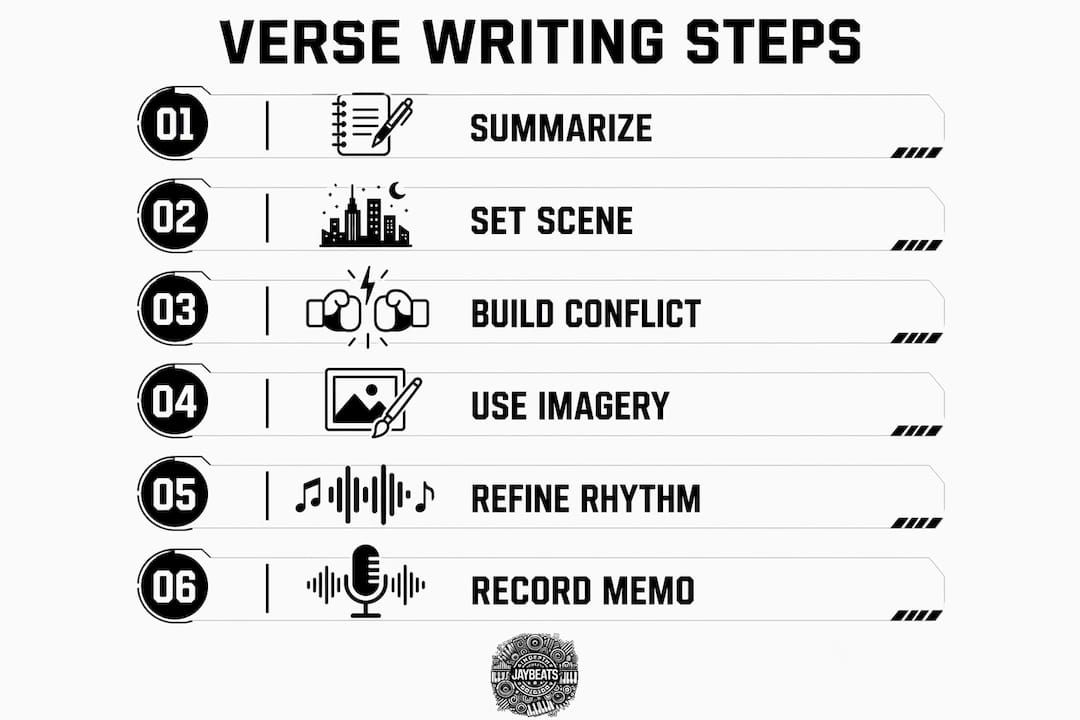
Once you have those answers, follow this draft sequence:
Step | Action | Goal |
|---|---|---|
1. Write a chorus summary | One sentence capturing the chorus’s emotional core | Gives the verse a clear destination |
2. Outline the verse setup | List 3 story beats the verse needs to hit | Prevents wandering and filler bars |
3. Draft the opening line | Write the strongest, most specific first line you can | Hooks the listener in the first two seconds |
4. Complete the verse | Fill in the remaining bars using your story beats | Builds momentum toward the chorus |
5. End on tension | Stop the verse before the story resolves | Pulls the listener into the chorus naturally |
Ending a verse on an incomplete thought or tension point is one of the most effective tools in songwriting. It creates momentum instead of resolution. The listener leans forward because they need the chorus to finish the thought.
After your draft is done, revise for clarity and flow. Cut any bar that does not serve the three setup questions. If a line is clever but off-topic, it belongs in a different song. Tight verses respect the listener’s attention. You can also check out how to make your rap sound professional for tips on polishing your delivery once the lyrics are locked.
How do you write a second verse that keeps listeners from tuning out?
The second verse is where most songs lose people. Repeating the same emotional territory from the first verse is the fastest way to kill momentum. Second verses must advance the story or shift emotional perspective to keep the song moving forward.
Think of your first verse as the situation and your second verse as the consequence or reflection. If verse one shows the problem, verse two shows what it costs. If verse one is the night of the argument, verse two is the morning after. That shift in time or perspective gives the listener something new to process.
Practical ways to keep your second verse fresh:
Advance the timeline. Move the story forward, not sideways. Show what happened next, not a different angle on the same moment.
Raise the emotional stakes. The second verse should feel heavier or more resolved than the first. Give the listener a reason to feel the chorus differently the second time it hits.
Shift the point of view slightly. You can move from external action to internal reflection, or from the present moment to a memory that explains it.
End one step early. Stopping the verse before full resolution creates the same forward pull as the first verse, but with higher emotional stakes behind it.
Avoid recycled rhyme schemes. If your first verse used an AABB pattern, vary the second. Predictable rhyme schemes signal to the brain that nothing new is coming.
The bar-by-bar approach to verse construction, where you plan internal rhymes, pockets, and punchline placement deliberately, keeps both verses tight and purposeful. Wandering bars are a demo problem. Professional verses are built, not just written.
Key Takeaways
Writing verses that keep people listening requires structural intent, specific imagery, and rhythmic precision working together from the first bar to the last.
Point | Details |
|---|---|
Build around three story anchors | Every verse needs a clear who, what they want, and what stands in their way. |
Use the 80/20 specificity rule | One vivid sensory detail does more work than five generic emotional statements. |
Master prosody | Match stressed syllables to strong beats so your lines feel natural, not forced. |
Work backward from the chorus | Define the chorus’s emotional core before writing a single verse bar. |
End verses on tension | Stop before the story resolves to pull the listener forward into the chorus. |
What I have learned writing verses from the production side
Most lyricists I have worked with treat the verse like a blank canvas. They sit down, wait for inspiration, and then wonder why the verse feels scattered. The truth is, a verse is a puzzle. Every bar has a job. Every word either earns its spot or wastes space.
The bar-by-bar mindset changed how I hear verses entirely. When you plan where your internal rhymes land, where your pockets open up, and where your punchline sits, the verse stops sounding like a demo and starts sounding like a record. That level of intentionality is not about killing creativity. It is about giving your creativity a structure to push against.
The other thing I tell every artist I work with: patience in the edit is where the real work happens. The first draft is just raw material. The verse that keeps people listening is the one you rewrote three times until every line felt said, not performed. If a bar sounds like you are trying too hard, you probably are. Cut it. The listener always feels the difference between a line that came from truth and one that came from a rhyme dictionary.
Collaboration with a producer who understands prosody and flow is what takes a good verse to a great one. The beat tells you where the pockets are. Your job is to find them and fill them with something real.
— Indepthjaybeats
Beats built for lyricists who take their verses seriously
Writing tight verses is only half the equation. The beat underneath shapes how your words land, where your pockets open, and how much room your story has to breathe.

Indepthjaybeats has been building beats for artists since 2007, with placements in productions like WWE 2K25 and Love and Hip Hop Atlanta. The catalog covers boom bap beats built for lyricists who need space to tell a story, and hard trap instrumentals for artists who want rhythmic tension under every bar. A free beat pack is available so you can hear the sound before you commit. If your verses are ready, the right beat makes them hit harder. Find your fit in the catalog and put your words to work.
FAQ
What is the main purpose of a verse in a song?
A verse sets up the scene, character, and conflict that make the chorus feel earned. Without a strong verse, the chorus has no emotional weight behind it.
How do I stop my verse from sounding forced or awkward?
Focus on prosody by matching stressed syllables to strong beats in the music. Speaking your lyrics out loud over the beat before recording catches most rhythm problems immediately.
How long should a verse be?
Most verses run 8–16 bars, though the right length depends on the song’s tempo and structure. The verse should be long enough to set up the chorus but short enough to keep the listener’s attention locked in.
What is the difference between a first verse and a second verse?
The first verse introduces the situation, while the second verse advances the story or shifts the emotional perspective. Repeating the same content in both verses causes listener fatigue and kills momentum.
What does “ending a verse early” mean?
Ending a verse early means stopping before the story fully resolves, leaving an incomplete thought or tension point. This technique pulls the listener forward into the chorus instead of letting them settle.
Recommended

Get 20+ Free Beats delivered to your inbox
Drop your name and email and I'll send a pack to your inbox right away.
We respect your inbox, no spam. Promise!