Find a Producer to Help Finish Your Song (Sync-Ready)
Hire a producer who matches your trap or boom bap reference, send stems plus two or three reference tracks with your deadline and budget, and expect a project consult within 1 business day. That’s the fast path. Indepthjaybeats has been in the game since 2007, runs DocuSign agreements before any work starts, and has client placements in WWE 2K25 and Love And Hip Hop Atlanta. The timeline looks like this: consult → free preview → payment → revisions → final files.
When you reach out, include:
Where your project is right now (rough demo, tracked vocals, stems ready)
Two or three reference tracks that match the vibe you’re going for
Your hard deadline and your budget range
Table of Contents
What does a professional production workflow actually look like?
How does Indepthjaybeats finish songs for TV and film placement?
Audition the free pack and book your consult at Indepthjaybeats
What should you prepare before contacting a producer?
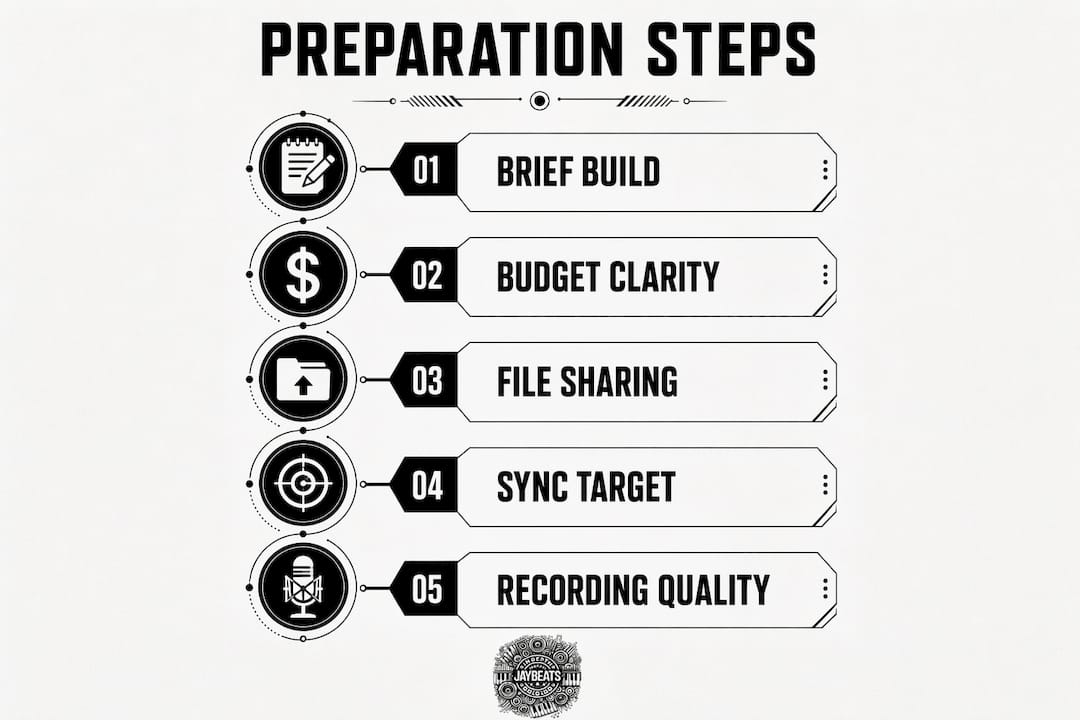
Don’t send a cold “how much?” message. Producers respond to project-specific briefs that show you know what you want. Put together a tight one-paragraph brief covering genre, stage, and creative goal before you hit send.
Your pre-contact checklist:
Rough stems or a demo file (even a voice memo works at this stage)
Dry vocal takes or treated vocals if you have them
BPM and key of the track
Two or three reference tracks that capture the mood
Target runtime (usually 2:30–3:30 for sync placements)
One sentence on the use case: “dark trap for a TV crime drama trailer” beats “I want it to sound hard”
Budget clarity matters too. Know whether you’re open to a flat fee, a royalty split, or producer points before the call. Independent producers commonly charge $300–$1,500 per song for production, with established producers commanding higher fees depending on scope and credits.
Share files via Dropbox, Google Drive, or WeTransfer. Keep folder names clean: artist name, song title, BPM, key. Sloppy file organization signals a sloppy project, and producers notice.

Pro Tip: If you’re pitching for a specific sync target like a WWE 2K25-style trailer, say that in your brief. This tells the producer exactly what energy and mix loudness to aim for.
If your home recordings need polish before you send them, check out tips for professional-sounding home recordings before you package your stems.
What does a professional production workflow actually look like?
A solid producer runs a defined process. Knowing the phases means you won’t be left guessing where your track is or when to expect a preview.
Phase | What Happens | Typical Timeframe |
|---|---|---|
Kickoff / consult | Creative call, scope lock, DocuSign agreement | Within 1 business day |
Free preview | Short clip or rough arrangement to confirm direction | 2–6 weeks |
Arrangement & editing | Structure, transitions, layering | 1–2 weeks |
Sound design & mixing | 808 tuning, FX, balance, stereo imaging | 1–2 weeks |
Mastering | Final loudness, clarity, format prep | 3–5 days |
Delivery | WAV stems, stereo mix, MP3, session exports | Per agreement |
Full scope projects typically run 2–6 weeks from kickoff to final files, depending on revision rounds and how quickly you turn around feedback. Most services include two or three revision rounds; anything beyond that usually triggers an additional fee, so read the agreement before you sign.
Remote asynchronous workflows are standard now. You send stems and notes; the producer works on their schedule and sends back a time-stamped preview. You review it on your own time, drop specific notes (“the 808 at 1:14 needs to sit lower”), and the cycle repeats. It removes time-zone friction and keeps the project moving without back-to-back sessions.
Always check the provider’s FAQ page and your production agreement for exact SLA windows. Those documents are the source of truth, not the homepage copy.
How do you choose the right producer for trap and boom bap?
Prioritize genre fit and verifiable credits over location or the lowest price. A cheap producer who doesn’t know trap will cost you more in re-dos than a specialist who charges more upfront.
Questions to ask before you commit:
Can you point me to finished releases on Spotify or Bandcamp in this genre?
Do you have TV/film sync placements I can verify?
Who handles sample clearance, and are your beats sample-free?
How many revision rounds are included, and what triggers extra fees?
Will I receive stems and session files, or just a stereo mix?
What’s your realistic turnaround for a single track at this scope?
Red flags to walk away from:
No verifiable credits on streaming platforms
Vague deliverables (“I’ll send you the final mix” with no format or stem details)
No written agreement or DocuSign before work starts
Promises of a finished master in 48 hours on a complex project
Slow or evasive communication before you’ve even paid
Producers with documented releases you can actually listen to are the ones who can deliver the aesthetic you need for sync-level work. Check liner notes, Spotify credits, and public placement announcements. If a producer can’t point you to anything external, that’s a problem.
Pro Tip: Always audition a free sample pack or short preview before committing. A producer whose free pack doesn’t move you probably won’t move your audience either. Learn more about why free packs matter for independent artists.
What deliverables and licensing terms should you expect?
Expect stems, a final stereo mix, a final master, and written ownership terms before you hand over a dollar. Anything less is a red flag for sync work.
Standard deliverables for a finished track:
WAV stems (drums, bass, melodics, FX, vocals separated)
Stereo mix WAV and MP3
Instrumental and acapella versions
Session exports on request (agreed upfront)
Metadata: song title, producer credit, ISRC if applicable
Licensing shapes vary. A flat fee gives you full ownership of the master production. An exclusive sale transfers the beat entirely. A sync license grants specific placement rights without full ownership. When a producer co-writes or contributes significantly to the arrangement, publishing splits and producer points come into the conversation. Know which model you’re signing before the DocuSign lands in your inbox.
Before you pitch anything to a music supervisor, confirm in writing who owns the master, who clears any samples, and what rights the producer retains. A sync placement that falls apart over an uncleared sample or a disputed ownership claim can kill a deal and damage your relationship with the supervisor permanently.
Pro Tip: Get deliverables and metadata requirements in writing before work starts. If you’re targeting a specific show or network, tell the producer so they can format files to the supervisor’s specs. Check out beat lease contract basics to understand what a solid agreement covers.
How does Indepthjaybeats finish songs for TV and film placement?
Indepthjaybeats offers tailored trap and boom bap finishing services with a one-business-day consult response and DocuSign agreements before any work begins. The producer has been building in this space since 2004, and the credits back it up: client placements include WWE 2K25 and Love And Hip Hop Atlanta.
What the service covers:
Custom trap and boom bap beat production
Vocal production and arrangement
Online mixing and mastering for artists who already have a beat
Stems and session file delivery on request
Free sample pack to audition the sound before committing
The workflow maps directly to what music supervisors need: clean files, clear licensing, and a producer who communicates. You send your brief, get a consult within one business day, review a free preview to confirm direction, then move into production under a signed agreement.
To start, send your project stage, two or three reference tracks, your BPM and key, your deadline, and your budget range. The consult covers scope, timeline, and licensing options so there are no surprises mid-project.
Key Takeaways
Hiring the right producer to finish your song means matching genre fit, verifying credits, locking deliverables in writing, and auditing your files for sync readiness before you pitch anywhere.
Point | Details |
|---|---|
Build a tight brief first | Include stems, BPM/key, two or three references, deadline, and a one-sentence creative goal. |
Verify credits before committing | Check Spotify, Bandcamp, or public sync placements — no external credits is a red flag. |
Get everything in writing | A DocuSign agreement before work starts protects your ownership and deliverable expectations. |
Know your deliverables | Expect WAV stems, stereo mix, master, and metadata; confirm sample clearance upfront. |
Indepthjaybeats for trap/boom bap | Placement credits in WWE 2K25 and Love And Hip Hop Atlanta, free pack audition, one-business-day consult. |
A straight note from the studio
Most artists come in with the vibe locked but the execution scattered. That’s fine. That’s literally what finishing a track is for. What slows everything down is when an artist can’t tell me what they want beyond “make it hard.” Hard like what? Hard like a 2024 Lil Baby record or hard like a '90s Primo loop? Those are two completely different conversations.
Send me time-stamped notes. “The drop at 1:08 needs more space” is something I can act on in an hour. “It doesn’t feel right” sends us back to square one. The artists who move fastest are the ones who come prepared, stay specific, and trust the process once the agreement is signed. If you’re nervous about collaborating remotely, don’t be. Asynchronous remote workflows are how most professional finishing projects run now, and they work. You don’t need to be in the same room. You need to be on the same page.
Audition the free pack and book your consult at Indepthjaybeats
You’ve got the brief ready. Now put it in front of a producer who actually has the credits to back up the conversation.

Indepthjaybeats has been producing sync-ready trap and boom bap since 2007, with placements in WWE 2K25 and Love And Hip Hop Atlanta to prove it. The free pack lets you hear the sound before you spend a dollar. If it moves you, the next step is a consult, locked within one business day, with a DocuSign agreement before any production starts.
Browse trap beats built for hard placements or dig into the boom bap catalog to find your sound. Need mixing and mastering on a track you already have? That’s covered too. Check the licensing page for sync-specific rights options, then request your consult and get moving.
Recommended

Get 20+ Free Beats delivered to your inbox
Drop your name and email and I'll send a pack to your inbox right away.
We respect your inbox, no spam. Promise!