Demo at home, book the studio for your final vocal takes, and spend what you save on a professional mix. That’s the move for most independent rappers in 2026. A hybrid approach delivers the best value: write and stack flows at home, then use a focused 4-hour studio block when the record demands it. Here’s what to do right now:
Start recording at home. Even a basic setup captures ideas, builds your catalog, and costs you nothing per session after the initial gear spend.
Budget for a pro mix. The gap between a demo and a release-ready record is usually the mix, not the recording location.
Book one 4-hour studio block for your final vocal takes on any single you’re pushing hard, especially if your room isn’t treated.
Table of Contents
How much does studio time actually cost?
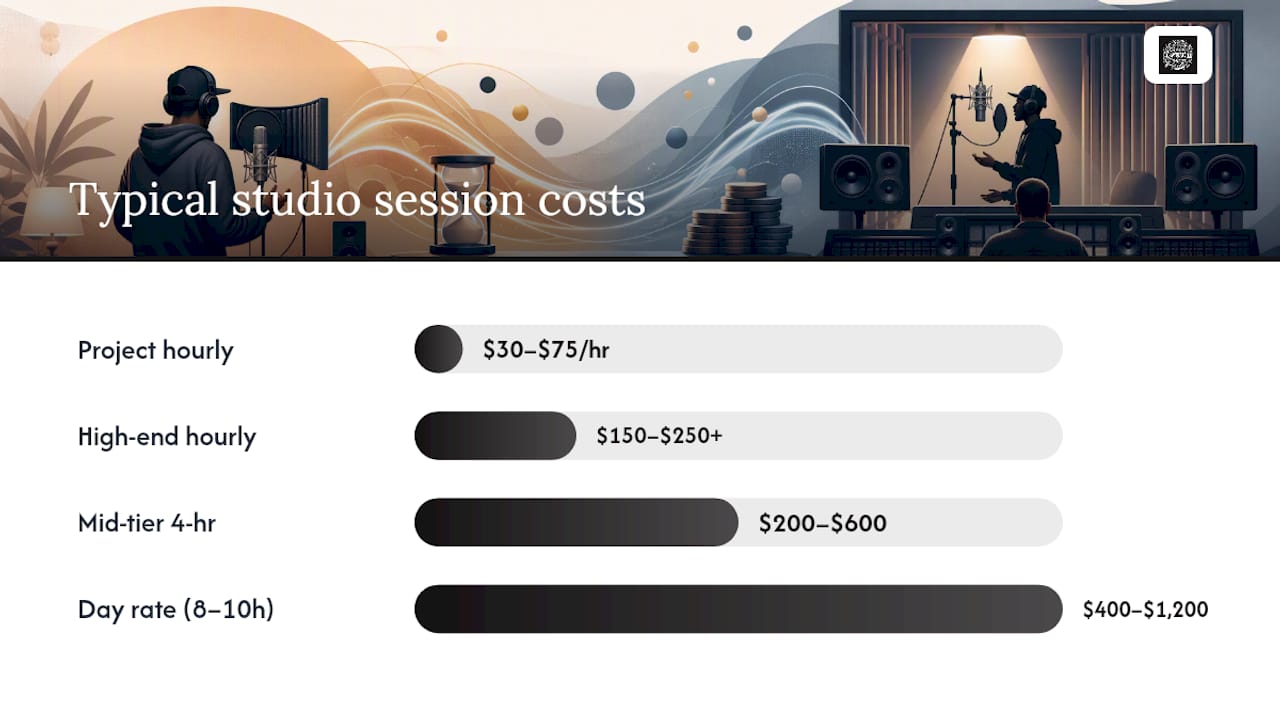
U.S. studio rates vary widely depending on the market and the room. Local project studios typically run $30–$75/hr. Mid-tier studios with a house engineer land in the $75–$150/hr range. High-end rooms with vintage outboard gear and top engineers push $150–$250+/hr.
Session Type | Typical U.S. Rate | What’s Usually Included |
|---|---|---|
Hourly (project studio) | $30–$75/hr | Room, basic gear, engineer |
4-hour block (mid-tier) | $200–$600 | Engineer, mixing console, outboard |
Day rate (8–10 hrs) | $400–$1,200 | Full session, engineer, some editing |
High-end hourly | $150–$250+/hr | Vintage mics, premium preamps, top engineer |
A single 4-hour block at a typical studio hourly rate runs around a few hundred dollars. Repeated sessions can add up significantly over time. A functional home studio, by contrast, can be built for $500–$1,200 in essential gear plus $200–$600 in acoustic treatment. The math on home recording pays off within a few months for anyone recording consistently.
Smart ways to cut studio costs:
Book off-peak hours (late night or early morning slots often come at a discount).
Bundle tracking and rough editing into the same session so you leave with usable files.
Hire a junior engineer instead of the senior room engineer for tracking sessions where you know your parts cold.
Treat professional mixing and mastering as a separate budget line, not an add-on. A remote mix from a skilled engineer typically runs $100–$400 per song, and that spend moves the needle more than extra tracking hours.
When should you record at home vs. book a studio?
Scenario | Budget Range | Recommendation | Budget Split |
|---|---|---|---|
First mixtape / building catalog | Under $500 | Record at home entirely | Mostly gear/treatment, some pro mix |
Single with social push | $500–$1,200 | Home demos + 4-hr studio for final vocal | 40% home setup, 30% studio, 30% mix/master |
Commercial sync / TV placement | $1,200+ | Studio for final vocal, pro mix mandatory | 20% studio, 50% mix/master, 30% marketing |
Ongoing content (freestyles, features) | Any | Home recording only | 100% home setup investment |
A few rules that cut through the noise:
If you’re uploading to SoundCloud or building a following, home recording is more than enough. Focus on consistency, not perfection.
If you’re pitching to labels, sync libraries, or running paid ads behind a release, the final vocal and mix need to be competitive. That’s when studio time earns its cost.
If your room is untreated and you can’t fix it, one focused studio session beats 20 mediocre home takes.
How to build a home studio that actually works
The biggest mistake rappers make is spending everything on a mic and nothing on the room. A modest mic in a treated space will outperform an expensive mic in an untreated bedroom every single time. Start with treatment, then build your signal chain.
Step 1: Treat the room first
Bass traps in the corners and reflection control panels at your first reflection points are the highest-leverage physical additions you can make. Foam squares on the wall alone won’t tame low-frequency room modes — you need mass in the corners. DIY panels with Rockwool or Owens Corning 703 cost $100–$200 and outperform most premade kits.
Step 2: Build your signal chain by budget
Budget Tier | Mic | Interface | Headphones | Monitors |
|---|---|---|---|---|
Starter (under $500) | Shure SM7B | Focusrite Scarlett Solo | — | Skip monitors, use headphones |
Solid ($500–$1,200) | Rode NT1 or Shure SM7B | — | — | Yamaha HS5 |
Near-pro ($1,200 and up) | — | Universal Audio Apollo Twin | — | Yamaha HS8 or KRK Rokit 8 |
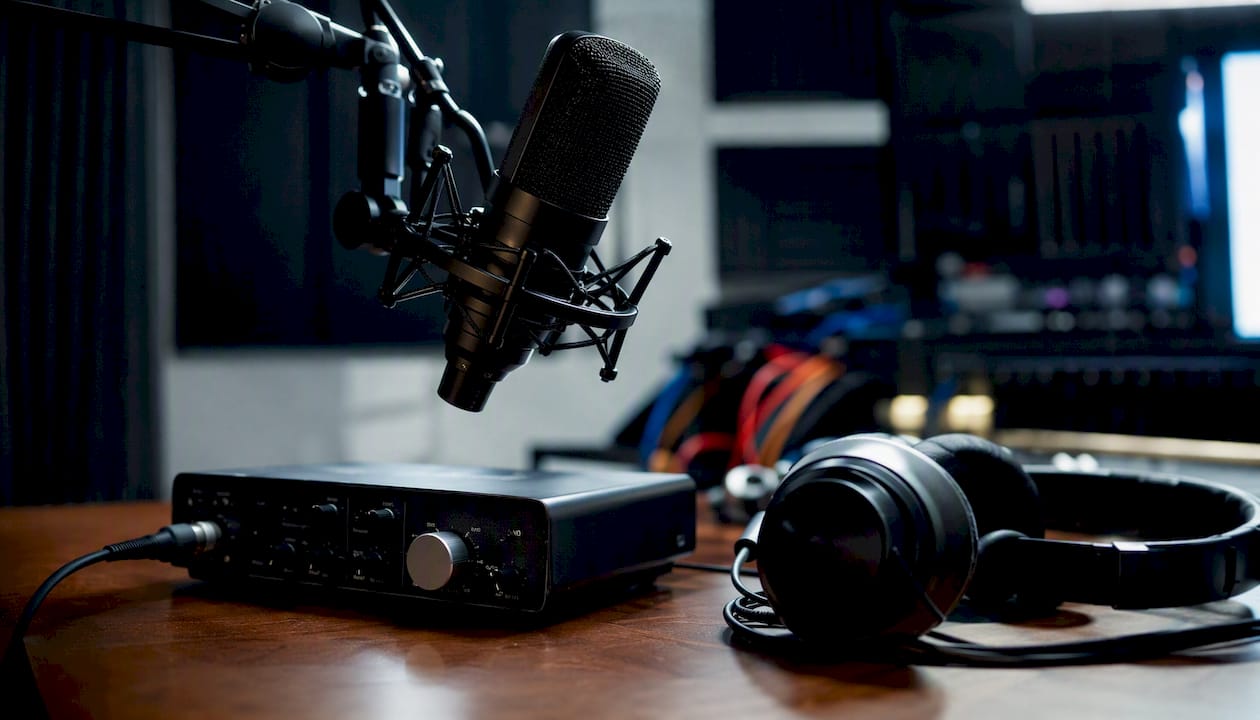
The Shure SM7B deserves a specific mention for untreated rooms. It’s a dynamic mic with tight off-axis rejection, which means it picks up less room noise than a condenser. Many rappers recording in apartments get cleaner results from the SM7B than from a condenser mic that costs twice as much.
Step 3: Nail your signal chain and workflow
Gain staging matters more than most beginners realize. Set your input gain so your loudest vocal peaks hit around -12 to -18 dBFS in your DAW — that gives your mix engineer headroom to work. Mic placement and gain staging are the two variables that most directly affect how easy your vocals are to mix. Get those right before you touch a plugin.
Pro Tip: For rap doubles and ad-libs in an untreated room, move the mic slightly off-axis (about 15–20 degrees) and back it off 8–10 inches from your mouth. You’ll get less plosive buildup and a more natural room sound that sits better in the mix.
Pro Tip: If you’re in a noisy apartment, record inside a closet full of clothes. The fabric absorbs reflections and kills outside noise better than most budget treatment panels.
For a deeper breakdown of building a home studio on a budget, Indepthjaybeats has a full guide tailored specifically to rappers.
How to make every studio hour count
Wasted studio time is just money on the floor. The rappers who get the most out of a 4-hour session show up prepared. Here’s the prep checklist that keeps sessions tight:
Finalize your lyrics before you walk in. Not “mostly done” — fully memorized or printed and marked up.
Record a guide vocal at home. Bring it on your phone or a USB drive so the engineer hears your intended delivery.
Prepare time-coded notes. Know which sections you want to punch in, which lines you’re uncertain about, and where you want doubles.
Build your cue mix at home. Know the beat inside out — tempo, drops, ad-lib moments. Don’t spend studio time learning the track.
Bring reference tracks. Two or three songs with the vocal tone and energy you’re going for. Play them for the engineer before you start.
Questions to ask the engineer before the session:
What file format and sample rate will you deliver?
Do you comp during tracking or after?
What outboard gear is available for the vocal chain?
What’s your revision policy if I need a punch-in after the session?
Time-block a 4-hour session like this: 20 minutes setup and soundcheck, 90 minutes tracking (verse 1, verse 2, hook), 45 minutes doubles and ad-libs, 45 minutes comping and rough edit, 20 minutes file export and backup. That’s a full song, done right, with no wasted clock.
The hybrid strategy: how to combine home and studio for the best results
The hybrid workflow is where most independent rappers land when they’re thinking clearly about their budget and their goals. Write and demo at home. Book the studio for final vocal takes on priority releases. Send the files to a remote mix engineer. That’s the loop.
A realistic example for a single release:
Weeks 1–2: Write and demo at home. Record reference vocals, test flows, build the arrangement.
Week 3: Book a 4-hour studio block for final vocal tracking. Come in prepared (see the checklist above).
Week 4: Send stems to a remote mix engineer. Budget $150–$300 for the mix, $75–$150 for mastering.
Week 5: Deliver the master, schedule the release.
Sample budget split for a single with a real push behind it:
Home setup (one-time, amortized): $800–$1,200
4-hour studio session: $200–$600
Remote mix and master: $200–$450
Marketing and promotion: $300–$600
The remote mixing option is worth calling out specifically. Services that handle online mixing let you send your home-recorded stems and get back a radio-ready mix without booking additional studio time. For most independent rappers, that’s the move — online mixing and mastering converts your home recordings into something competitive without the overhead of a full studio day.
Key Takeaways
The most effective recording strategy for independent rappers is a hybrid approach: demo and write at home, book focused studio time for final takes, and invest in professional mixing to close the gap to a release-ready record.
Point | Details |
|---|---|
Home recording is viable from day one | A $500–$1,200 setup with basic treatment captures publishable rap vocals. |
Treatment beats gear upgrades | Bass traps and reflection panels improve your sound more than a pricier mic in an untreated room. |
Studio time has a clear use case | Book a 4-hour block ($200–$600) for final vocal takes on singles with real promotion behind them. |
Pro mixing is the real separator | Budget $150–$450 for remote mix and master — that spend moves a track from demo to release. |
Indepthjaybeats covers the full chain | Beat licenses, stems, and online mixing and mastering services let you build a hybrid workflow without multiple vendors. |
The producer’s honest take on home vs. studio
Here’s what most articles won’t tell you: the studio debate is really a discipline debate. The rappers who sound great at home are the ones who treat their bedroom like a studio — same prep, same focus, same standards. The ones who sound bad in a pro room are the ones who showed up without their lyrics locked and spent $300 figuring out the hook.
The room matters. Good acoustics and a clean signal chain are real advantages. But the performance is the performance. A technically perfect recording of a weak take is still a weak take. And a raw, energetic home recording of a great verse — properly mixed — can compete with anything coming out of a $200/hr room.
What I’ve seen over years of working with artists is that the biggest mistake isn’t choosing home over studio or studio over home. It’s spending the entire budget on recording and leaving nothing for the mix. The mix is where the record gets made. A $100 mix on a $1,000 recording session is backwards math. Flip it. Record smart, mix right, and put real money behind the release.
The hybrid approach isn’t a compromise. It’s the professional workflow, used by producers and engineers at every level. Build your home setup, use the studio surgically, and never skip the mix.
Ready to build your sound without the studio overhead?
Indepthjaybeats has been producing beats since 2007, with placements in WWE 2K25 and Love and Hip Hop Atlanta. The catalog covers trap, boom bap, Detroit-style, and R&B instrumentals — exclusive and non-exclusive licenses available, with multi-track stems so your mix engineer has everything they need.

If you’re running a hybrid workflow, the two things you need most are a beat that’s built for your voice and a mix that makes it competitive. Indepthjaybeats handles both. Browse exclusive rap instrumentals built for independent artists, or send your home-recorded stems straight to the online mixing and mastering service and get back a radio-ready master without booking a single extra studio hour. That’s the move.
Useful sources and next steps
Where to go depending on your next move:
Home Studio vs Pro Studio: Where to Spend Your Music Budget in 2026 | ArtistTrack
Home Studio Recording Guide: Build a Professional Setup on a Budget | AudioCalcs
Building a home studio — start here | Berklee Now
How Much to Rent a Music Studio? — Recording Connection
15 Essential Recording Tips for Beginners: How to Capture Pro Audio at Home | Home Studio Recordings
Should you use a home studio or pay for studio time? | Smart Rapper
Home recording studio setup | Music Production Wiki
Recommended

Get 20+ Free Beats delivered to your inbox
Drop your name and email and I'll send a pack to your inbox right away.
We respect your inbox, no spam. Promise!